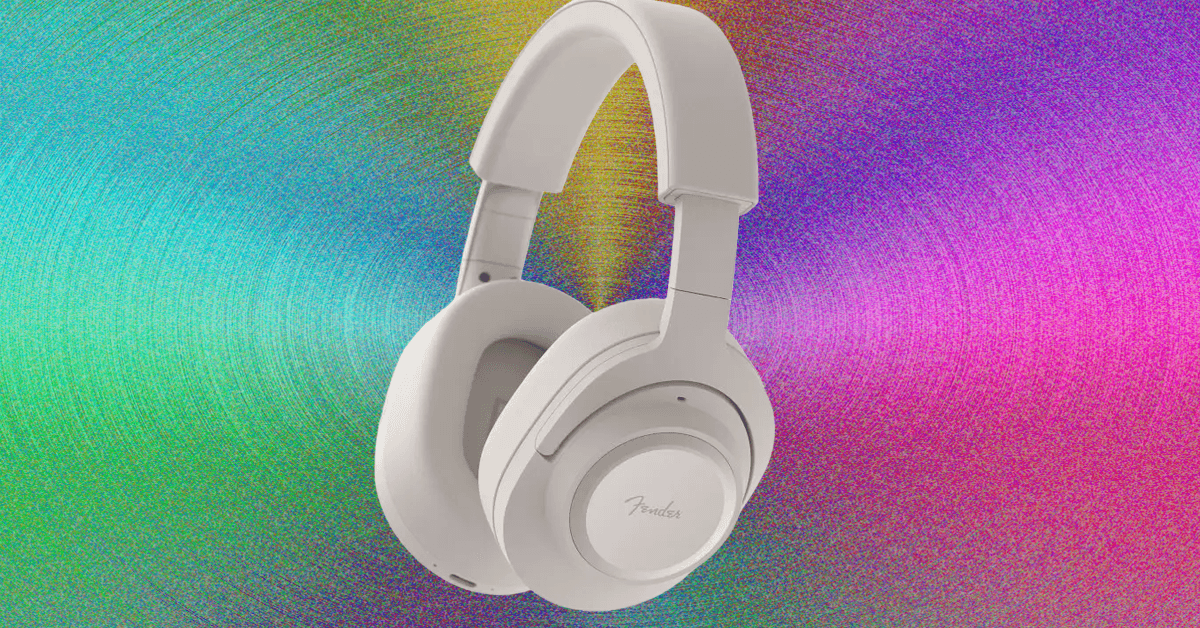
My 10-day stint with the Mix wasn’t enough time to evaluate whether the USB-C-based connections between the ear cups and the headband (an element they share with the Fairbuds XL) would prove strong enough for long-term use, but they showed no obvious signs of weakness. In fact, I was impressed by how tightly the parts were held together, and how well made these boxes seem to be in general. By holding or wearing them, you would never guess that they could be pulled apart.

Photograph: Simon Cohen
I found the Mix comfortable to wear, even with glasses. The ear cushions provide a soft but effective seal, and the headband does a good job of distributing pressure. The clamping force felt a little aggressive when I first wore them, but after a few minutes, I got used to it and happily wore them for hours. My only challenge is the size of the ear cushion openings; They’re a little narrow for my liking. I prefer a roomier fit.
Like Apple’s AirPods Max, the ear cushions magnetically stick to the ear cups, but on the Mix, it serves a dual purpose: Not only does it make swapping cushions a cinch, (they’ll sell for $29 a pair later this year), but it’s also how you access that USB-C Bluetooth transmitter, which resides under the left ear cushion, and how you access the battery compartment (under the right). Fender expects replacement cells to cost $49 but has not said when they will be available.
farewell bad broadcast

Photograph: Simon Cohen
The transmitter is an extremely useful little device. Using its button (and LED indicator), you can switch between lossless (red), low-latency (blue), and Bluetooth Auracast (violet) modes. Lossless (via the LHDC v5 codec if you’re curious) is a bonus, especially for iPhone owners, who are typically limited to lossy SBC and AAC connections. I don’t play games, but if Fender’s claim of less than 20-millisecond performance for the low-latency mode is accurate, it should satisfy all but the most hardcore, fast-action game players. Auracast (via LE Audio/LC3) is a real treat: it lets you share your audio with anyone who has a set of Auracast-compatible headphones or earbuds. The Mix can also tune into any other Auracast broadcast, but there’s a catch.
<a href