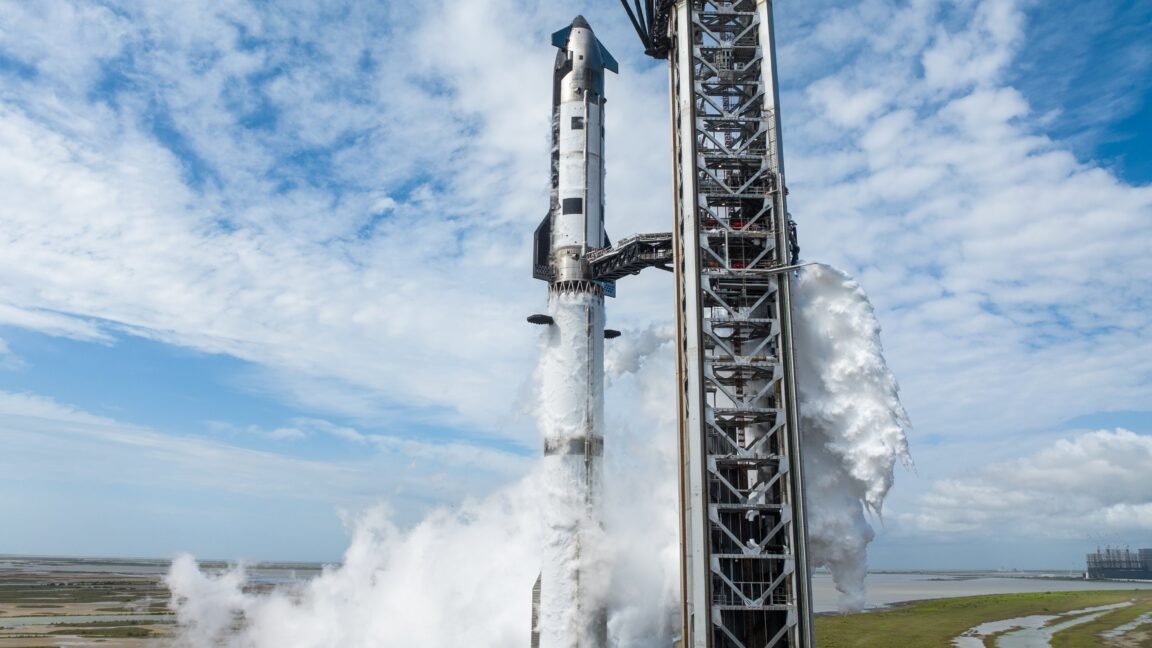
In early February, the next V3 booster successfully passed pressure testing. After it gets to the launch pad, SpaceX plans to fire the 10 engines at full power. But immediately after ignition, due to automatic abort from the ground system, a hard shutdown was ordered. Due to this, half of the Raptors were damaged.
Then, in mid-April, the company transferred this booster to the launch pad for another static fire test with its full complement of 33 engines. This time, ground-side sensors reported a problem with pressure in the manifolds, which distribute propellant to the vehicle. This may have been a spurious reading, but it ended the test early, only 1.88 seconds after ignition.
The company ultimately completed a successful, full-duration static fire test in early May.
“It’s been a pretty wild ride,” Jenna Lowe, senior manager of Starship operations, said in the new video. “The highs are high. The lows are low.”
new rocket
In many ways this is a completely new rocket. It incorporates hundreds of lessons learned from the vehicle’s V1 and V2 and seeks to improve overall performance, reliability and robustness. It is this vehicle that SpaceX hopes will allow SpaceX to begin deploying larger Starlink satellites into orbit and perform in-space refueling that is critical to NASA’s Artemis Moon goals.
For the booster phase, changes start at the bottom and continue to the top.
SpaceX says that for this third version of the Raptor rocket engine, it has reduced the mass from 1,630 kg to 1,525 kg and the total vehicle-level mass savings through simplification of the engine, vehicle-side commodity and supporting hardware is approximately 1 ton per engine. The entire fuel transfer system has been redesigned. This should be more reliable and will allow all Raptors to start simultaneously.
<a href