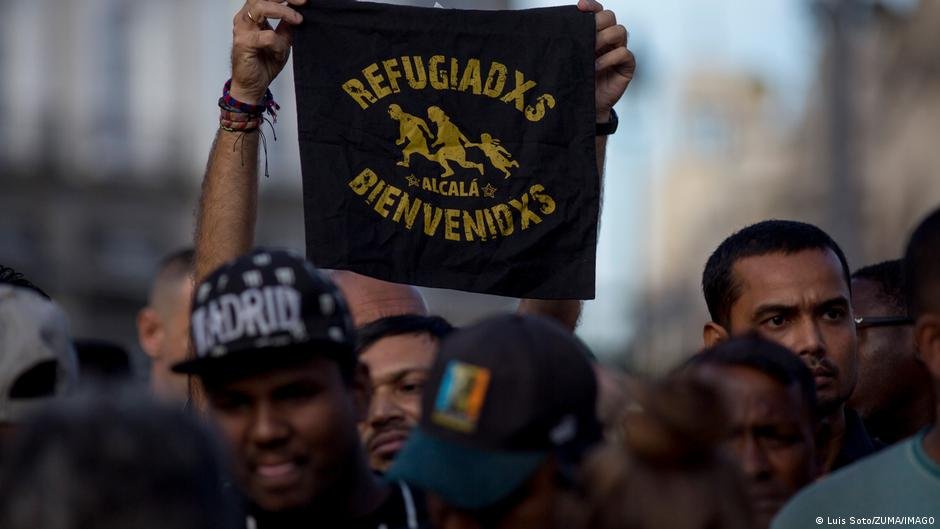
The government of Prime Minister Pedro Sanchez first announced the plan earlier this year.
This policy, enacted not through Parliament but through royal decree, is in contrast to many other European governments trying to reduce or prevent irregular migration or migration.
How will the waiver work and who does it apply to?
The amnesty will only apply to those who can demonstrate that they arrived in Spain before January 1 this year, before the plan was made public, so as not to encourage crowds in Spain after the announcement.
Irregular migrants will be allowed to claim a one-year temporary residence permit, provided they can prove five months’ residence and demonstrate they have no criminal record in Spain or elsewhere.
After this period, they will be eligible to apply for a long-term work or residence permit.
The government of Spain advocates this scheme because of the importance of migration to overall economic growth and to enable irregular migrants to seek officially taxed employment and thus reduce the size of the untaxed shadow economy.
Migration Minister Alma Saez said migrants can apply in person starting April 20 and online starting Thursday. The window will close on June 30.
A Spanish union representing immigration officials has called for more resources to handle applications, saying the government is unprepared to meet the potential influx.
What did Prime Minister Sanchez say about this move?
Prime Minister Sanchez announced the signing of the law on social media on Tuesday during his visit to China.
He described the plan as “an act of normalization, an act of recognizing the reality of nearly half a million people who are already part of our daily lives. And, at the same time, an act of justice and a necessity.”
Launching the apology, he said he was “proud to be Spanish” but also urged those who use it to do their part.
“We recognize rights, but we also demand obligations,” Sanchez wrote. “Those who are already part of our day-to-day do so on equal terms, contributing to the survival of our country and our model of coexistence.”
Migration, at least from Latin America, fueled rapid growth in the Spanish population.
About 50 million people live in Spain. The government estimates that around five lakh people may be irregular migrants eligible for the scheme. Some analysts have put the figure higher, with think tank Funcas estimating around 840,000.
Spain’s population has grown rapidly in recent years and includes an estimated 7.2 million foreign nationals. Many of them have fled from Colombia or Venezuela, or across the Mediterranean Sea or Morocco to Spain’s African enclaves.
Spain’s centre-right opposition Popular Party has criticized the move, calling it unsustainable.
However, this notion is anything but foreign to Spanish politics. Governments of all types in Madrid took similar measures on six occasions between 1986 and 2005.
However, this time, the government was forced to rapidly move legislation through a mechanism to amend immigration laws. Doing so bypassed Parliament, where the legislation did not receive majority support. Previous attempts at an apology stalled.
Edited by: Srinivas Majumdaru
<a href