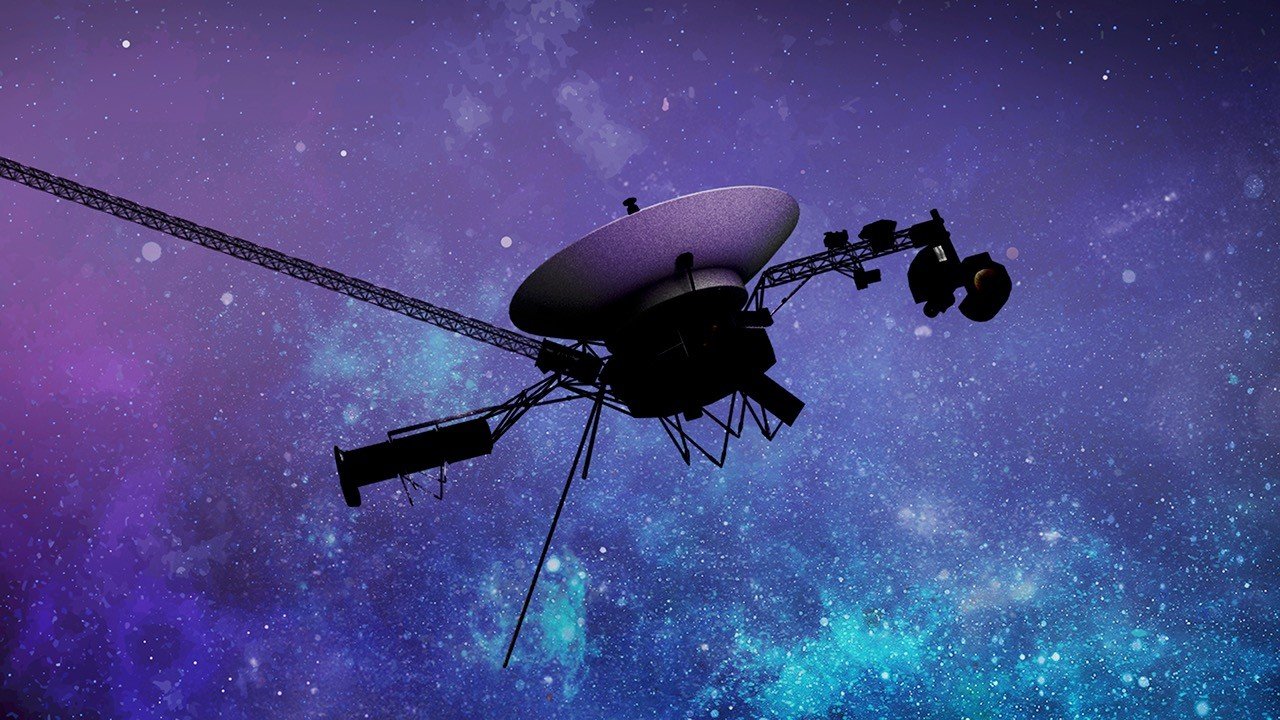
The LECP has been operating almost without interruption for almost 49 years, since the launch of Voyager 1 in 1977. It measures low-energy charged particles, including ions, electrons and cosmic rays, emanating from our solar system and galaxy. The instrument has provided important data about the composition of the interstellar medium, detecting pressure fronts and regions of different particle density in space beyond our heliosphere. The twin Voyagers are the only spacecraft far enough from Earth to provide this information.
Like Voyager 2, Voyager 1 relies on a radioisotope thermoelectric generator, a device that converts heat from decaying plutonium into electricity. Both probes lose about 4 watts of power each year. After spending nearly half a century in space, power margins have become extremely thin, requiring the team to conserve energy by turning off heaters and instruments, as well as ensuring the spacecraft don’t get so cold that their fuel lines freeze.
During a routine, planned roll maneuver on February 27, Voyager 1’s power level unexpectedly dropped. Mission engineers knew that any additional drop in power could trigger the spacecraft’s undervoltage fault protection system, which would automatically shut down components to protect the probe, requiring recovery by the flight team – a lengthy process that carried its own risks.
The Voyager team needed to act first.
“Although shutting down a science instrument is not anyone’s preference, it is the best option available,” said Karim Badruddin, Voyager mission manager at JPL. “Voyager 1 still has two remaining operating science instruments – one that listens for plasma waves and one that measures magnetic fields. They’re still doing great work, sending back data from a region of space that no other manned spacecraft has ever explored. The team is focused on keeping both Voyagers running for as long as possible.”
long term plan
The choice of which device to shut down next was not made in real time. Years ago, the Voyager science and engineering teams sat down together and agreed on the order in which they would shut down parts of the spacecraft and ensure that the mission could continue to conduct its unique science. Of the 10 identical sets of instruments each spacecraft will carry, seven have been jettisoned so far. For Voyager 1, LECP was next on that list. The team shut down the LECP on Voyager 2 in March 2025.
Because Voyager 1 is more than 15 billion miles (25 billion kilometers) from Earth, the sequence of commands to shut down the instruments would take 23 or so hours to reach the spacecraft, and the shutdown process would take about three hours and 15 minutes to complete. One part of the LECP – a small motor that rotates the sensor in a circle to scan in all directions – will remain on. It uses low power (0.5 watts), and leaving it on gives the team the best chance of being able to turn the device back on someday when they get extra power.
what comes next
Engineers are confident that shutting down LECP will give Voyager 1 a respite of about a year. They are using the time to finalize a more ambitious energy-saving solution for both Voyagers that they call “The Big Bang”, designed to further expand Voyager operations. The idea is to replace a bunch of instruments operating at the same time — hence the nickname — turning some things off and replacing them with lower-power alternatives to keep the spacecraft warm enough to continue collecting science data.
The team will first apply the Big Bang on Voyager 2, which has slightly more power and is closer to Earth, making it a safer test subject. Trials are planned for May and June 2026. If they go well, the team will try to make the same improvements on Voyager 1 before July. If this works, there’s also a possibility that Voyager 1’s LECP could be turned back on.
DC Egle/Kaila Cofield
Jet Propulsion Laboratory, Pasadena, California.
818-354-5011/626-808-2469
agle@jpl.nasa.gov / calla.e.cofield@jpl.nasa.gov

<a href