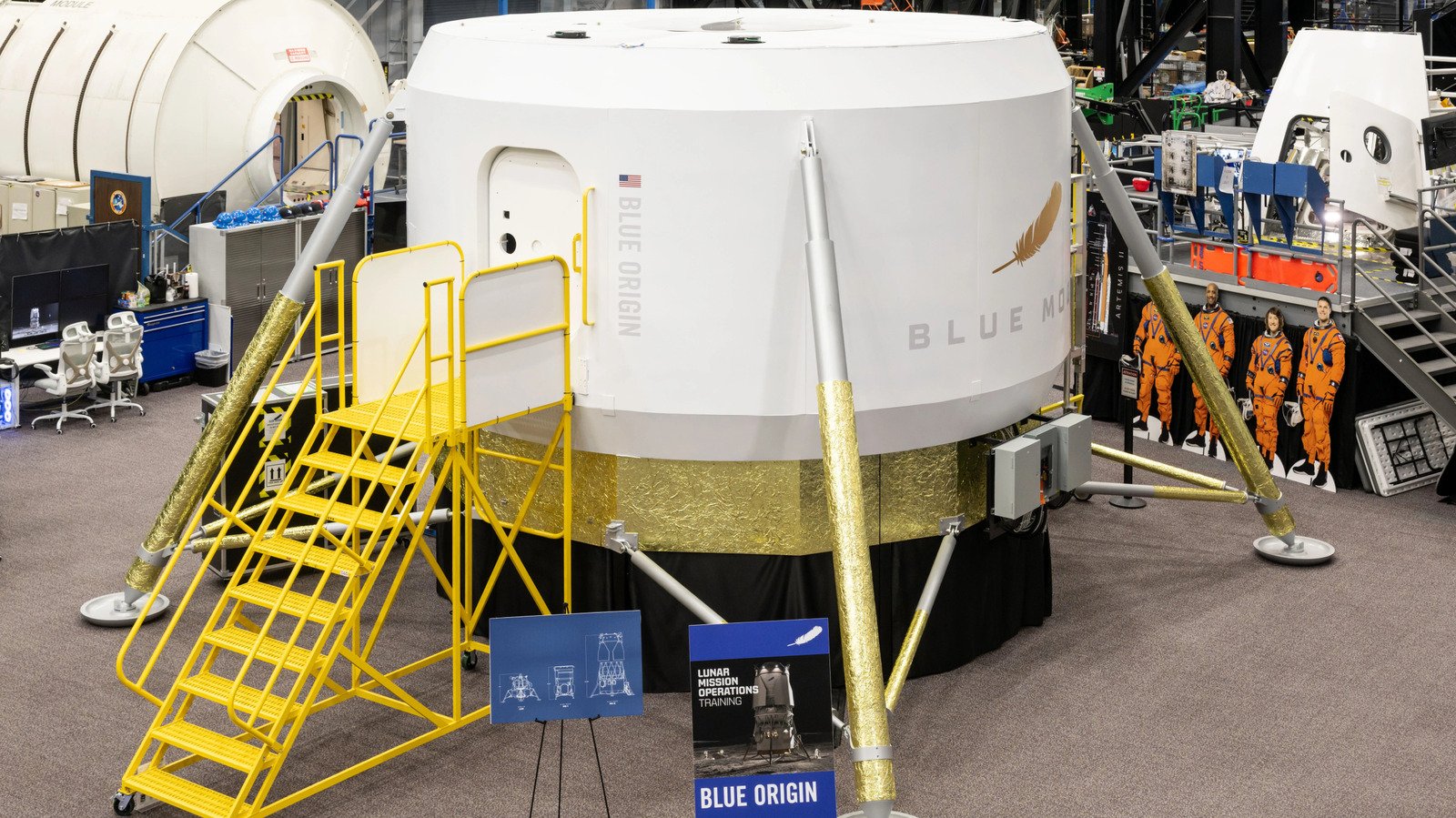
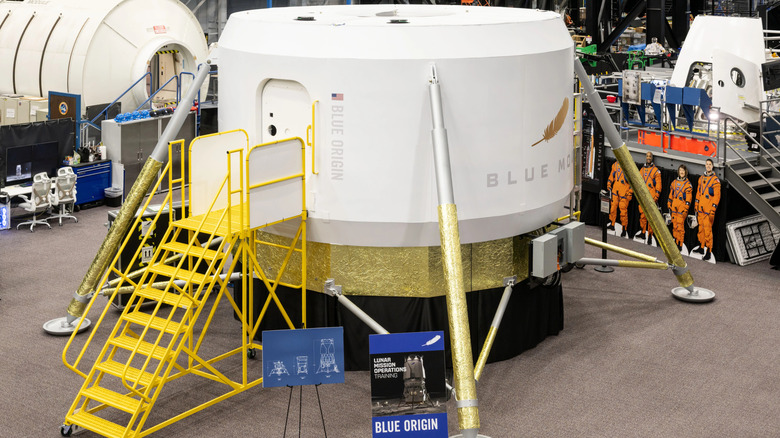
Following the success of its Artemis II crew mission, NASA is now turning its attention to the next milestone in its plan to return astronauts to the Moon. The space agency is eyeing a moon landing in 2028, and has selected Blue Origin and SpaceX to provide landers that can support humans on the surface (though neither company has yet demonstrated a moon landing). This week, NASA shared that it now has a full-scale prototype of the crew cabin of Blue Origin’s Mark 2 lander so it can begin training.
With the 15-foot-long prototype at NASA’s Johnson Space Center, the space agency and Blue Origin will be able to “conduct a series of human-in-the-loop tests, or tests with human interaction, including mission scenarios, mission control communications, spacesuit checkout, and preparation for a simulated moonwalk,” NASA explained. This mock-up includes only the crew cabin, which sits at the base of the lander – the whole thing will be 52 feet tall when the rest of the systems are integrated when it goes to the Moon. But as recent efforts have shown, landing smoothly on the Moon isn’t easy, and both Blue Origin and SpaceX have their work cut out for them to get their landers ready on NASA’s current timeline.
An unmanned version of Blue Origin’s lander, called Endurance (or MK1), is being tested in NASA’s thermal vacuum chamber ahead of its first mission this year, in which it will deliver science payloads to the lunar surface. For the next phase of the Artemis program, the Artemis III crew will fly into low Earth orbit in the Orion spacecraft and test docking capabilities with landers from Blue Origin and SpaceX, or whoever is ready. NASA has set a target of 2027 for this mission.
<a href