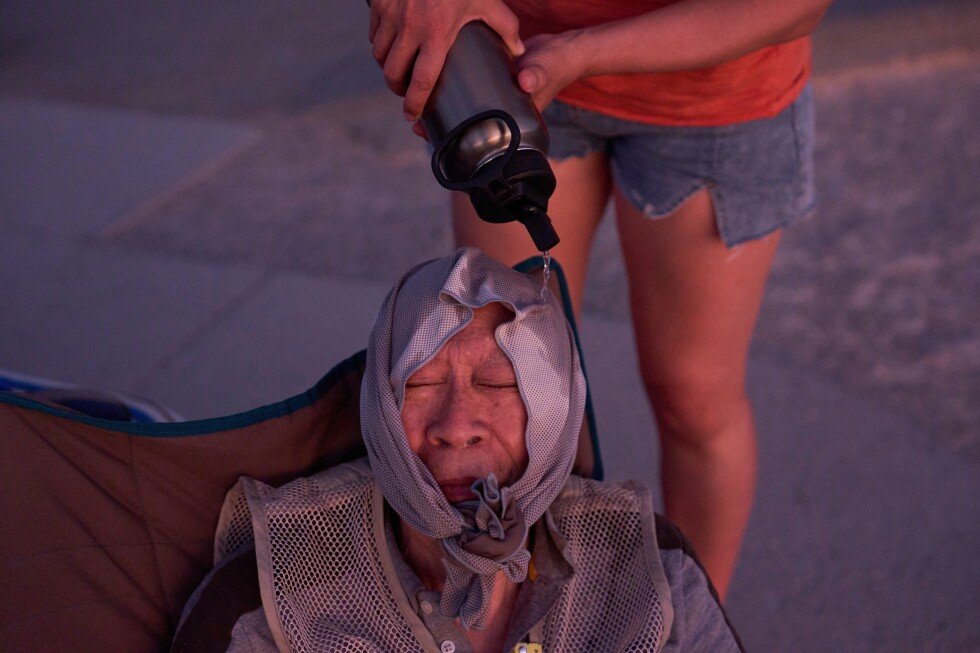
“I think we’re going to see weather events we’ve never seen before in modern history,” Jeff Berardelli, chief meteorologist and climate expert for WFLA-TV in Tampa, Florida, said Friday.
One El Nino phenomenon According to the World Meteorological Organization, it is expected to impact global temperatures and rainfall patterns from the middle of this year. While models indicate it could be a strong event, the WMO cautioned that models also have difficulty making accurate predictions in the spring.
what is el nino
El Nino is a cyclical and natural warming parts of the equatorial Pacific which then changes the world’s weather patterns. Its counterpart, La Niña, is characterized by cooler than average waters.
Berardelli said the El Niño phenomenon essentially redistributes heat across the Earth. Currently, subsurface heat in the Pacific is moving eastward across the ocean and coming from deep waters to the surface, the initial phase of El Niño.
WMO’s global seasonal climate update It was revealed that the sea surface temperature is increasing rapidly. According to Wilfran Moufouma Okia, head of climate prediction at WMO, there is high confidence about the onset of El Nino, after which it will intensify in the coming months.
WMO said El Niño typically occurs every two to seven years and lasts about nine to 12 months.
Why is it causing alarm?
It seems the predictive models are onto something, said Daniel Swain, a climate scientist at the California Institute for Water Resources. That’s because the amount and intensity of subsurface warm water anomalies — or pulses of unusually warm water that are a key part of El Niño physics — are nearly as large as we’ve seen in the historical record, he said.
The most intense events are called “Super El Niños”.
“One of the critical building blocks for this to fully materialize is, in fact, happening,” Swain said Friday. “We still don’t know exactly what’s going to happen. It’s not guaranteed that it will be a Super El Niño. But there’s a possibility that something really remarkable will happen.”
Berardelli said if the Pacific Ocean releases too much heat, it supercharges the climate system and causes catastrophic weather events. With more warming, he said, there will be more intense heat waves, worsening drought conditions in some areas, but there will also be more moisture in the air, leading to more intense flooding.
Berardelli said El Nino also shortens hurricane season in the Atlantic because the Pacific receives so much heat that it outcompetes the Atlantic. He said places like the Caribbean will be extra dry this summer and tropical systems will be less likely.
where we can see the impact
People walk through a section of the Amazon River that shows signs of drought in Santa Sofia on the outskirts of Leticia, Colombia, October 20, 2024. (AP Photo/Ivan Valencia, File)
El Nino has global effects. Across the United States, Berardelli said, it looks like this summer will be hotter than usual, with severe heat waves. Although it’s hard to get specifics about, Berardelli also expects to see more frequent daily thunderstorms across the southwestern US.
Degradation of forests due to forest fires, logging and drought, Affects about 40% of Amazon. This may increase further due to a strong El Nino in 2026.
The extra heat brought to the surface by El Nino, combined with the warming of the planet due to climate change, will lead to record-breaking global warming, Swain said. They expect to see record global hot temperatures later this year, next year, or both.
“At this point, all indicators show that next year is going to be a pretty wild year from a global climate perspective,” Swain said.
Michael Mann, a climate scientist at the University of Pennsylvania, said El Nino raises global temperatures slightly for a year or two, but it is basically a “zero-sum game.” He said it usually oscillates back toward La Niña, causing global temperatures to cool for a year or two. Mann said Friday that the worry is a long-term, steady warming trend that will continue as long as people keep burning fossil fuels.
___
Associated Press News Director Peter Prengman contributed to this report.
___
The Associated Press’ climate and environmental coverage receives financial support from several private foundations. AP is solely responsible for all content. find api standards A list of philanthropies to work with, supporters and funded coverage areas ap.org.
<a href=