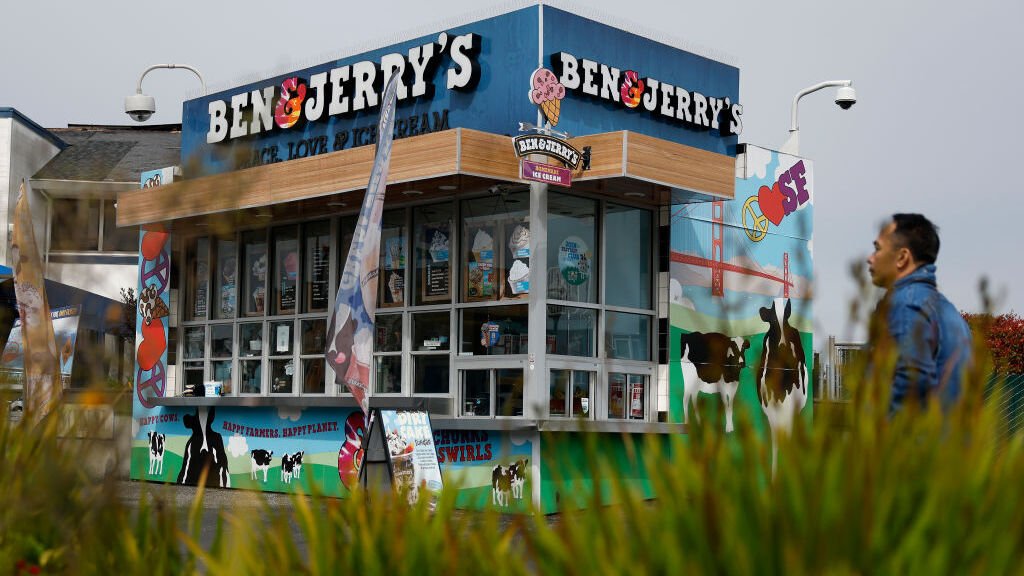
When Ben Cohen and Jerry Greenfield sold Ben & Jerry’s to Unilever in 2000 for a reported $326 million (1), they also made a promise that proved to be the most important clause in the deal: the brand would maintain an independent board of directors whose job was to protect its social mission, no matter who owned the company. (2)
This system continued for more than two decades. Until this happened.
Must read
Dairy reporter reported that as of January 1 this year, Magnum, the ice cream group separated from Unilever, had removed all of Ben & Jerry’s independent directors except one director and CEO appointed by Unilever. (3)
The independent board filed a lawsuit alleging that the move directly violated the original merger agreement. (4) As Vermont Business Magazine reports, the Ben & Jerry’s Foundation later won a court ruling to join a lawsuit that arose after Magnum stopped providing it with approved funding. (5)
Cohen is not staying silent.
“We’re turning up the heat,” he told The New York Times. (2) He has called on Magnum to sell Ben & Jerry’s to a values-aligned investor group, and has threatened a boycott of all Magnum products – including Breyers, Klondike, and Talenti – if he does not comply.
What is actually being disputed
The legal fight focuses on a governance structure that was intentionally included in the 2000 sale agreement. At the time of the acquisition, Unilever committed that Ben & Jerry’s would maintain an independent board that would focus on “providing leadership for Ben & Jerry’s social mission and brand integrity,” FoodOnline reported. (6)
Cohen and Greenfield said at the time that they expected the company to “continue to expand its role in society” under Unilever ownership. (6)
Magnum countered that it acted within its legal and contractual rights, arguing that since the removed directors had become “ineligible” to serve – some due to exceeding term limits and others due to alleged misconduct – this was treated separately from outright removal. The independent board calls this coordinated resolution. (3)
“It’s more than a contract,” Liz Bankowski, chair of Ben & Jerry’s Foundation Board of Trustees, told Vermont Business Magazine. “This is about whether a corporation can weaponize the governance structure and withhold funding when it becomes inconvenient to prior commitments and values.” (5)
Greenfield has already resigned after spending 47 years with the company. And the former board chair has filed a separate independent defamation suit in California. (4)
Read more: This $1B private real estate fund is now available to non-millionaires too. Start investing with just $10
business case for mission
This controversy is not only legal or ethical, but also financially serious. Magnum shares were trading at a 52-week low at the company’s first shareholder meeting as a public company on May 7. The stock has fallen nearly 25% from its February high, becoming a popular short-sale target among European traders. (4)
Meanwhile, the argument that purpose-driven brands are bad business is hard to say with a straight face.
According to Fortune, Dr. Bronner’s revenue grew from $4 million in 1998 to $250 million in 2025, while not investing much in traditional advertising. Patagonia’s sales have more than quadrupled in 20 years from $240 million to nearly $1.5 billion, while contributing more than $240 million to environmental nonprofits. (4)
More than 130,000 people have signed a petition urging Magnum to sell Ben & Jerry’s to values-aligned investors. David Stever, the 35-year-old CEO of Ben & Jerry’s, was also recently named CEO of Jeni’s Splendid Ice Creams – a direct competitor and certified B Corp. (4)
What investors and consumers should watch for
This case raises an obvious question relevant beyond ice cream: What exactly is the value of deal-term promises when ownership changes hands?
Even after the ownership change, Ben & Jerry’s independent board controls its structure and mission preservation under the original merger agreement, according to a detailed governance timeline published by Dairy Reporter. Magnum’s position is that his actions fall within the scope of his rule. (3)
Ultimately the court will decide who is right.
M&A expert Farzad Mukhi, managing director of advisory firm Kroll, told The New York Times that the situation is highly unusual: “I can’t think of any such case.” (2)
For consumers, the more immediate question is simple: The next time you reach for a frozen pint, at whose price are you really buying?
You may also like
Join over 250,000 readers and be the first to get MoneyWise’s best stories and exclusive interviews – candid insights curated and delivered weekly. Subscribe now.
article source
We only rely on verified sources and reliable third-party reporting. For details, see ourEthics and Guidelines.
New York Times(1),(2); Dairy Reporter (3); luck (4); Vermont Business Magazine (5); FoodOnline (6)
This article was originally published on Moneywise.com under the title: Ben & Jerry’s sold for $326 million with 1 condition. The new owner broke it – and now the co-founder wants it back
This article provides information only and should not be construed as advice. It is provided without warranty of any kind.