
There are two arguments behind McDonald’s Site Apocalypse Early Warning: a) If nuclear apocalypse is imminent, the rich and powerful will hear about it before the rest of us, and b) if those people find out missiles are on the way, they will likely jump into their planes and fly as far away from major cities as possible. It’s hard to argue with any of these premises.
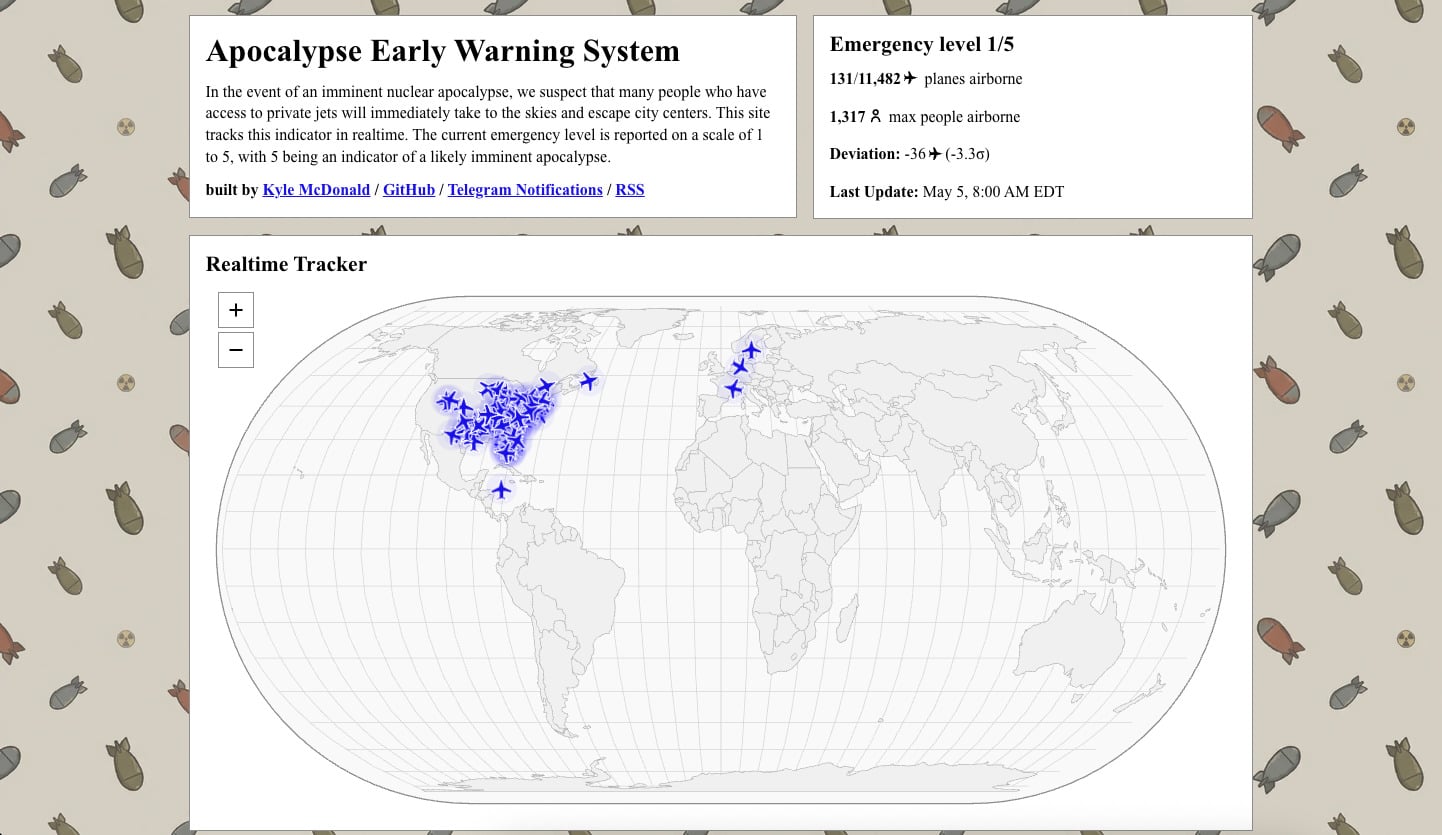
The site puts these ideas into practice by accessing public FAA registration data for what it calls “a certain group of business jets” – about 11,000 aircraft at the date of publication – and cross-referencing it with the real-time flight data site ADS-B Exchange. The acronym stands for “Automatic Dependent Surveillance Broadcast”, and it is essentially a system whereby aircraft broadcast information about their location, heading, etc.
This allows air traffic controllers to track the location of planes and allows pilots to know what other planes are nearby. The system is used around the world, and in the US, the FAA has made the technology a key part of its next generation air transportation system, describing it as “the preferred method of surveillance for air traffic control”. The whole point of ADS-B is to make the information broadcast publicly available, although a bill to “establish requirements and limitations regarding the use of Automated Dependent Surveillance-Broadcast Data” is currently before Congress.
That bill focuses on the use of ADS-B data to assess landing and usage charges, an issue on which we obviously do not feel qualified to comment. However, it seems clear that “evaluating the possibility of the world ending” does not fall within the scope of the bill – good news for McDonald and his DIY eschatology site.
So how exactly does the Apocalypse Early Warning Site use data from the ADS-B exchange? The concept is very simple: it looks at how many planes are in the air at any given time, and asks if that number is abnormally high. To determine the answer, the site compares the current number to a “recent baseline for the same time of day and week” based on historical data from the ADS-B exchange.
The difference between the number of aircraft in the air and the baseline value is then measured in the standard deviation from that baseline value, providing a simple numerical representation of how abnormal the current level of traffic is. That level is provided as an “alert level” at the top of the site, with five standard deviations and higher (i.e. an alert level of 5 or higher) being “indicative of possible impending apocalypse.”
This raises the question of what to do with this information: Clearly, if you trust McDonald’s logic, seeing the “5” at the top of the site should make you run for the hills. Real The power move here, however, may be setting up some sort of script to place a massive Polymarket bet on the end of the world as soon as alert level 5 is reached. If it turns out the warning was a false alarm, you can console yourself with the fact that the world hasn’t ended – and otherwise, then hey, at least you’ll have started your own personal post-apocalyptic survival game with lots of pretty real money.
What? Do they only accept bottle caps now? balls.
<a href