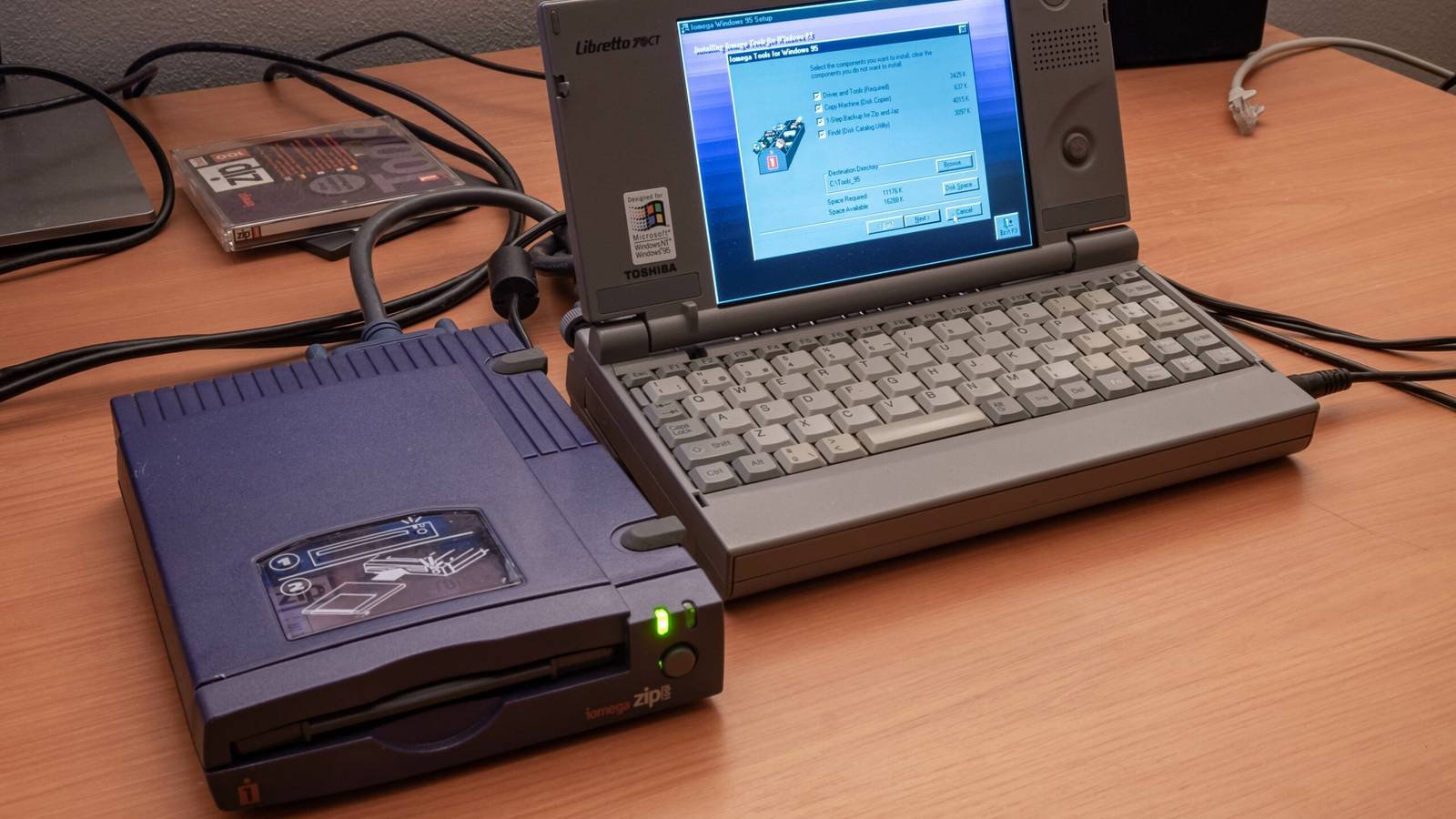
But when it comes to the history of storage media there have been a few formats broken and the Zip drive is one of the most interesting. Initially hailed as a major breakthrough for portable storage, Zip drives seemed to have immense potential, yet they failed to gain enough market presence to sustain their parent company in the future. Let’s take a brief look at what Zip drives were and why they eventually disappeared.
90s revolution
zip drive was a big step forward

In the early to mid-90s, portable storage was mostly defined by the standard three and a half inch floppy disk, which even a “young” person like me had little experience with. However, by the turn of the century this format had major shortcomings. The capacity of the floppy disk was a mere 1.44 MB, which would soon become too small for larger pieces of software. Floppy disks also felt quite fragile, and while we got “superfloppy” formats that were physically larger and had more capacity, they were too cumbersome as portable storage.
Enter 1994, when a company called Iomega introduced its version of the “Superfloppy”, a zip drive. In terms of physical size, Zip disks were only slightly larger than normal floppies, yet the initial capacity introduced in 1994 reached 100 MB, a much larger number than traditional floppy disks.
Zip drives also had major performance advantages, with read speeds averaging 1.4MB/s, as opposed to the comparatively sluggish 16kB/s speed of a conventional floppy disk, as well as a seek time of about 28ms seconds, whereas a floppy disk averaged 200ms. Zip drives weren’t as fast as desktop HDDs, but for portable storage, it was a big step forward.
Early, but brief, success
Zip drive caught on, but not for very long

With such major innovations in capacity and speed, and without the shortcomings of many other formats at the time, Zip drives managed to become the most popular of the “superfloppy” formats, and they continued to evolve relatively quickly. A few years later, in 1998, Iomega introduced the Zip 250 disk, which increased the capacity to 250 MB, and, already in the new millennium, we got the Zip 750, which took it to 750 MB.
Also, the zip drives were very cheap compared to what they were offering. A Zip drive (as in, the hardware to read disks) initially sold for $200, including a 100 MB disk, and each new disk cost $20, making relatively high capacities more attainable. Even a desktop hard drive will often cost you $200 for 500MB, so the zip drive was a logical solution for moving data around or backing it up. And when more manufacturers started producing discs things became cheaper.

5 Old Computer Hardware Items I’m Glad I Don’t Use Anymore
Life is better without these old hardware components from a different era.
It was such an attractive proposition that large computer manufacturers like Dell began including Zip drives in some of their PCs. Even Apple included Zip drives in some of its Power Macintosh models in the mid-to-late 90s.
However, things began to change towards the end of the decade as other portable formats rose to prominence, notably CDs and USB flash drives.
Big problem with zip drive
Reliability was an issue

Despite their early success, it didn’t take long for users to notice one major drawback of Zip drives: at times, they would fail. This wasn’t necessarily related to age or any particular abuse of the disc, it just happened. This was such a big event that it became known as the “click of death”, and once it happened, your drive was over.
The problem was estimated by Iomega to affect about 0.5% of Zip drives, but although this seems like a small number, when you add up to thousands of products being sold, it becomes quite widespread. This was such a big issue that, in September 1998, a class action lawsuit was filed against Iomega for common problems. Some of the complaints in that suit were ultimately dismissed by a Delaware court, but not others, and once the public became aware of the problems with Zip Drive, it became harder for the brand to make a comeback.
It didn’t help that this happened at the same time that CD-like formats were becoming more popular. CDs could store about 700 MB of data and were much cheaper to produce, making them more attractive not only to consumers wanting to save their data, but also to companies distributing software, as this cut costs drastically.

Apple Bandai Pippin: That time Apple made a game console
Apple’s Pippin was an ambitious attempt to merge computers and gaming, but it never came to fruition.
And eventually, USB flash drives became the most popular way to carry data because they were small and offered very fast speeds; USB 1.1 speeds generally matched Zip drives, but USB 2.0 came out very soon (in 2002) and increased those speeds by 20 times. There was no way magnetic drives like Zip Disk could compete.
zip legacy
Iomega tried to keep the name alive

While out of the limelight, Zip Drive still managed to build enough of a legacy to be widely adopted. Zip drives were available with all types of interfaces, whether internal or external, and as late as 2014, some aviation companies were still using zip drives to distribute updates to navigation databases.
Iomega also tried to take advantage of the ZIP name, even though it was forced to adopt other technologies. Despite having no relation to Zip Disk in terms of technology, the company eventually began making CD drives under the ZipCD name. There was also the PocketZip format, initially called Click!, a small floppy disk storage medium introduced in 1999, which was considered more portable and was used by portable devices such as MP3 players, although this format was even more short-lived than Zip drives.
Ultimately, after seeing its profits decline by the mid-2000s, Iomega was sold to a company called EMC in 2008, and in 2013, EMC and Lenovo formed a joint venture that took over Iomega’s business and removed the Iomega branding from its products. This was a major downfall for a company that invented many interesting products, including both the Zip Drive and the earlier Bernoulli box, but it is easy to see how the Zip Drive problems led to the company’s downfall.

Intel’s discontinued option for SSD could have been great
It was not successful in the past but today it will disrupt the market
<a href