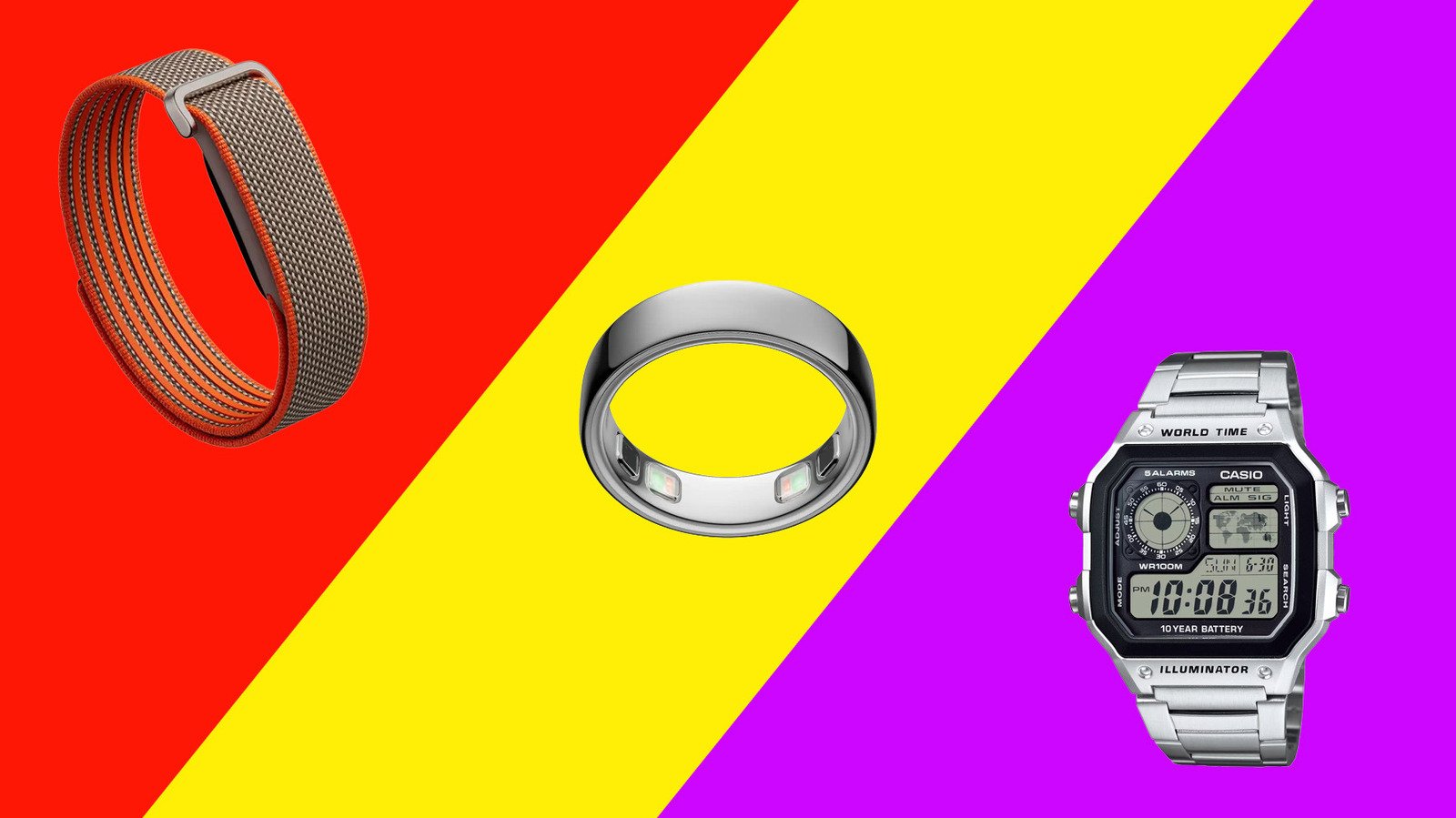
Tech has taken over our lives. We have smartphones, smartwatches and smart TVs. There are even smart fridges, smart toilets and smart sex dolls. (Or, uh, so I heard.) And with the rise of AI, Big Tech is now jumping on the smartglasses bandwagon again.
A corresponding rebellion is growing. I recently went to Barnes & Noble for the first time in over a decade. I was surprised to see how many young, attractive people there were, browsing through printed books and vinyl records. Then there is the resurgence of digital cameras, film cameras and cassette tapes.
When smartwatches started arriving in the mid-2010s, they promised to provide quick information at a glance without having to pick up your phone. In theory, this is meant to free you up to connect with the world around you. But in practice? Well, more than a decade later, not everyone thinks so.
Clearly, no one is arguing that people are abandoning smartwatches left and right. Actually, the market is continuously growing, not shrinking. But not everyone wants to keep moving in that direction.
“My smartwatch kept me connected to the things I wanted it to distance me from,” posted born-again analog watch user RadioAdam. But not everyone needs to go back to the days of Casio and Timex. Minimal wearable tech products can track your fitness without feeling like you have a second phone on your wrist.
notification surcharge
“I don’t want my wrist to communicate with me at all,” u/neomus wrote in the Whoop subreddit. “My phone is already too much of a distraction.” Of course, you can silence notifications. But at that point, you may (like these smartwatch migrants) question how much you need it in the first place.
Big Tech sold us the utopia of an always-online lifestyle. But the reality is often more like a dopamine-addiction hell scenario. And if you’re looking to cut down on devices, smartwatches are an obvious candidate for the first item on your list.
Feature (and Track) Fatigue
For example, Redditor u/Adventurous_Rice_731 switched from a minimalist Whoop to a Garmin smartwatch for a short time and immediately regretted the decision. “Went before me [workout] And I realized how often I was actively checking the screen to see if all my reps were recording,” he posted. “Overall, I found myself glued to it even during TV time.” Simple tools can not only keep you focused on the task or activity at hand, but also help you be present in the moments.
For some people, health tracking can (ironically) increase stress. Furthermore, when smartwatches and other fitness trackers measure things like sleep, stress, and recovery, they are only estimates. Those things can’t be measured directly with a wrist-worn device, only estimated through advanced algorithms. Some people don’t see much sense in using data as little more than an informed guess, as opposed to paying more attention to their body.
In this economy?
With inflation running rampant, it’s easy to take a more serious look at the value of smartwatches. Of course, it’s nice not to have to take out your phone to check messages or the forecast. But is it worth $400? If you just want health tracking, wearable devices like Google’s Fitbit Air and Nothing’s CMF Watch 3 Pro offer it at a fraction of the price.
road safety
Arguably, it’s more about applying common sense and self-control than the device itself. But there’s another factor to consider when questioning whether you need a screen on your body.
style and essence
The advantage of screenless tracking bands is that they are usually subtle enough that they can be worn with more stylish watches. These may also be easier to dress up or wear to events where smartwatches are frowned upon. And if you’re looking for something that still tells time and tracks your steps while still looking like a classic watch, there are hybrid smartwatches from companies like Withings and Garmin that may meet your needs.
choose something simple
Screen-free fitness bands are having a new moment with the recent launch of Google’s $100 Fitbit Air. The device, which impressed us in our review, is currently sold out everywhere. Whoop, the obvious inspiration for Google’s product, is another screenless contender with robust health tracking. However, it requires a subscription that ranges from $149 for the first year (then $199) to $359 annually, which may put some people off.
Then there are smart rings. Although they are more expensive (the new Ora Ring 5 starts at $399), they excel at sleep tracking and recovery metrics. Of course, they also lack a screen and haptics, so that’s one less thing to bother you with. There’s also the Samsung Galaxy Ring, a $400 competitor that’s often on sale for $300 at big-box retailers.
As a bonus, these free up space for an analog watch on your wrist. u/Th3p4l4d1n posted, “I could wear a mechanical watch and enjoy the moment more.” “Whoop allows me to do that because it has auto workout tracking.” Plus, you don’t have to worry about charging classic watches. And they won’t become obsolete in a few years.
There is no dearth of variety (in style and price) in that place. Casio, for example, has plenty of options starting at $30. Or, for that matter, go to a jewelry or department store and buy it. And while old-fashioned clocks don’t promise the moon, they won’t make you lose focus or raise your blood pressure.
<a href