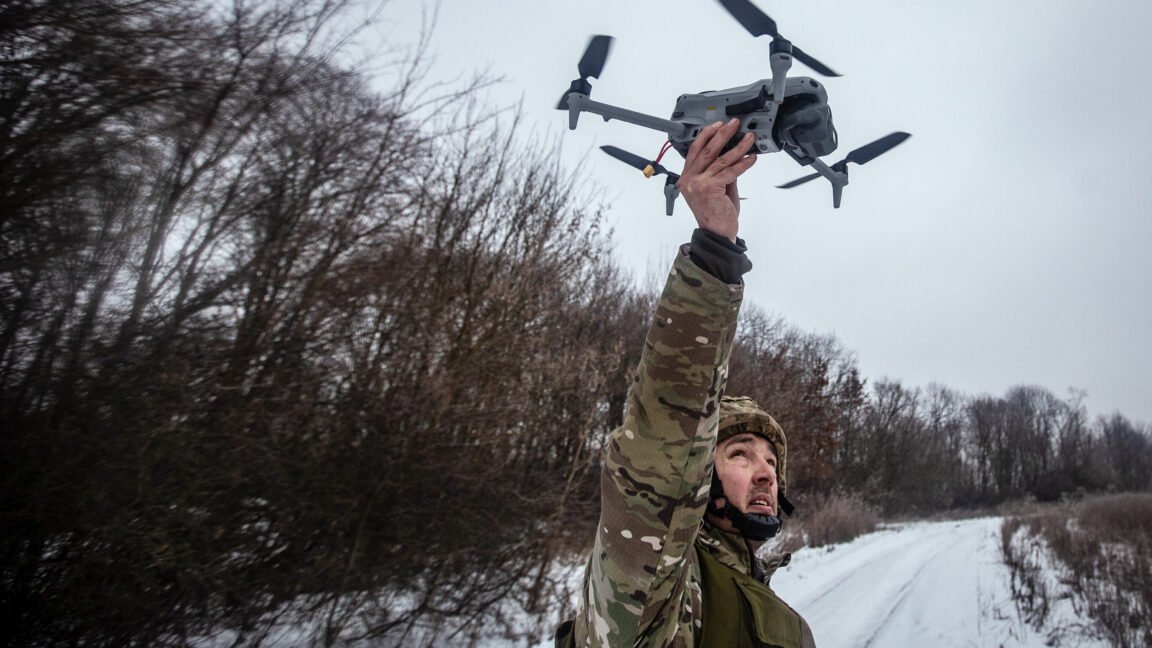
A fully autonomous drone killed Russian soldiers during battlefield testing two years ago, according to a Ukrainian drone manufacturer. If true, the incident would mark another milestone in a war that has spurred unprecedented developments in military drones, robots and AI-guided weaponry.
The one-time test was revealed by Alexander Kokhanovsky, CEO of Ukrainian drone manufacturer Aero Center, during an interview with New Scientist at a press event organized by the Ukrainian Embassy in London. Kokhanovsky described the test – which did not involve his current company Aero Center – which used quadcopter drones that were pre-programmed to fly over a front-line area before activating an AI-powered “Terminator mode”, which would seek out and attack any target in the given area.
Apparently there was no video feed or anything else to show what the “Terminator” drone targeted and attacked. But Kokhanovsky told New Scientist that “some” human-piloted drones sent to investigate found “some” dead Russian soldiers, leading to the conclusion that the fully autonomous drones had killed them.
According to New Scientist, defense company representatives at the Ukrainian Embassy event said the Ukrainian government prohibits the use of AI in the final stages of target interception. A Ukrainian military commander also told New Scientist that their drone pilots only use semi-autonomous systems that always have humans on hand to make critical control decisions. He described Ukraine’s commitment to “international humanitarian law”, emphasizing that the military always “takes great care in making decisions to prevent civilian deaths.”
The one-off nature of this experiment makes sense when considering the practical limitations of this approach along with considerations regarding international humanitarian law. Sending a fully autonomous drone to attack anything in a given area without any human operator intervention requires careful pre-planning and risks so-called “friendly fire” incidents or attacks on civilian non-combatants. It is also unclear how effective these fully autonomous quadcopter drones were at selecting and attacking targets compared to human drone pilots.
<a href