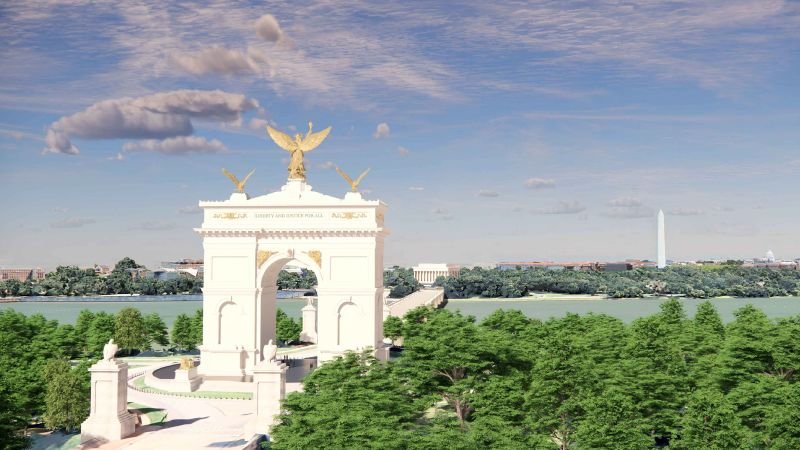
President Donald Trump’s proposed Triumphal Arch project received an overwhelmingly negative response from conservationist groups and members of the public as plans for the massive structure were first presented to a key committee on Thursday.
But the Commission of Fine Arts is still prepared to approve the project and took a preliminary vote to move the process forward. The independent federal agency, which is filled with Trump loyalists, advises the President and Congress on design plans for monuments, memorials, coins and federal buildings.
Trump has been deeply involved in the project to build an arch as he has taken significant steps to impose his style and taste on the nation’s capital during his second term. He has already added his name to the Kennedy Center and the US Institute of Peace and is overseeing the addition of a major ballroom to the White House complex.
Rodney Mims Cook, Jr., chairman of the Commission of Fine Arts, said at the meeting, “This is personal for the President.”
In a sign of its importance to the president, Interior Secretary Doug Burgum unveiled renderings for a 250-foot arch that would be 165 feet tall and 165 feet wide, with a 25-foot pedestal and a massive 60-foot gilt bronze Lady Liberty sculpture at the top, claiming it would “reinforce the city’s symbolic architectural vocabulary.”
The president has said he wants it to be the largest arch in the world, modeled after Paris’s Arc de Triomphe – but even bigger. It would be equivalent to a 16 to 20-story building, taller than the White House, the Lincoln Memorial and the US Capitol Building. The project is already facing a legal challenge from a Vietnam War veterans group over its scale and obstruction of the view of Arlington National Cemetery.
Following the Ark presentation by Burgum and lead designer Nicolas Charbonneau, the commission heard widespread concerns about the project’s scale, design, and placement. It is featured in a proposal to sit on a traffic circle between the entrance to Arlington National Cemetery and the Lincoln Memorial.

Commission Secretary Thomas Luebke said, “We had just under 1,000 commenters. It’s telling that 100% of the comments were against the project.”
Lübke read a letter from an anonymous individual warning that the project would be “completely out of scale with its surroundings” and “appears to ignore established norms that prioritize harmony with existing structures, preservation of sight lines, and respect for the symbolic hierarchy of capitals and sites.” The arch would set a “troubling precedent,” the person said.
Zachary Burt, community outreach and grants manager for the DC Preservation League, shared “serious concerns and strong opposition” to the project, particularly the Arch’s proposed placement. The arch will be located atop a traffic circle on Columbia Island, a man-made strip of land between the Lincoln Memorial and Arlington House, once the home of Confederate leader Robert E. Lee and now the centerpiece of Arlington National Cemetery.
The “visual connection” between those historic locations is not just a simple sight, Burt said. It … symbolizes the sacrifices made by our nation in the pursuit of its highest ideal. The proposal for a 250-foot-tall triumphal arch seriously jeopardizes the landscape.
After many people spoke out against the project, H. Edward Phillips III, a Tennessee attorney, defended the plan. He shared that his family members served in the military and he did not see Arch as “offensive”.
Commissioners largely expressed support for the arch. One, Trump ally Chamberlain Harris, argued that it was “a deliberate decision” to add to the DC skyline. The commission voted without opposition to continue review of the plans.

But there was also some skepticism on the committee regarding the arch’s location, including pedestrian access in a busy traffic area, the scope of the project, and its impact on a historically significant view.
Cook encouraged them to be mindful of the viewshed: “It’s the healing of this nation, that bridge, and maintaining that connection between those two structures is paramount in what you’re doing.”
The two D.C.-based bodies that Trump has packed with allies will likely approve the Ark, but it may face other more challenging reviews that require public input, including under the National Environmental Policy Act and the National Historic Preservation Act.
As part of those reviews, stakeholders are expected to be consulted, including Arlington National Cemetery, the National Park Service and the DC State Historic Preservation Office.
This arch would be just a few feet from the corridor used for flights approaching Reagan National Airport’s runway from the north, so it would require signoff from the Federal Aviation Administration.
The FAA requires developers to file notice at least 45 days before construction for any structures taller than 200 feet above ground level and lower structures located near airports or navigation facilities. And while the FAA does not issue building permits, local governments typically evaluate the agency’s findings about the safety impact of a structure before approving projects.
<a href=