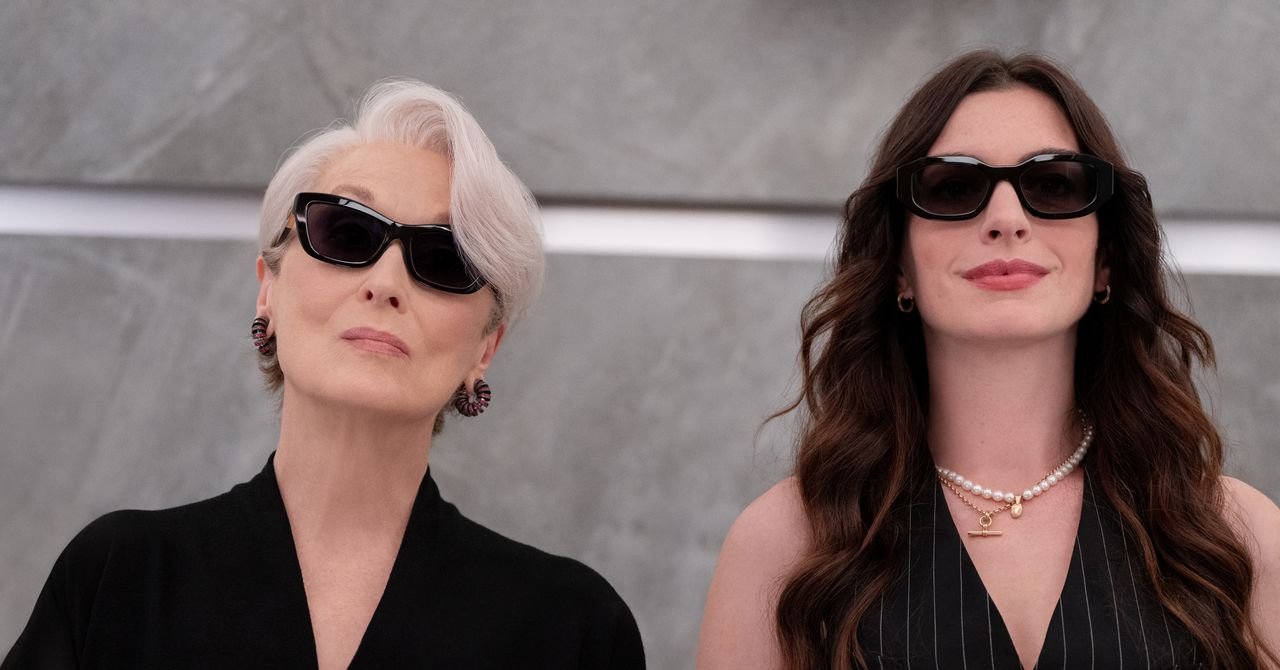
Despite such huge success at the box office, this installment has inspired several days of heated debate regarding its quality and comparison to the original. In Italy, these arguments also extend to film dubbing.
This controversy stems from the choice of voice actors in the Italian version. the devil wears prada 2Which itself is a symbol of continuity; It has the same cast as the original. Connie Bismuto is back to voice Anne Hathaway as Andy, Francesca Manicone dubs Emily Blunt as Emily, Gabriele LaVia is once again Stanley Tucci’s Nigel, and, above all, Maria Pia Di Meo, the actress who has been the familiar and expressive voice of Meryl Streep in practically all the Italian adaptations of recent years – including the terrific Miranda Priestly – Has returned for the sequel.
While many fans were happy to see these familiar voices again, other viewers noted some peculiarities, mainly due to the advanced ages of the voice actors themselves, especially Di Meo and LaVia.
Di Meo, born in 1939, is undoubtedly a master of Italian dubbing, and his performances involving great Hollywood actresses such as Jane Fonda, Julie Andrews, Mia Farrow, Barbra Streisand and Streep have made him one of the most recognizable and expressive voices of cinema in that country’s theaters.
Yet some say her performance now speaks volumes about the passage of time and the contrast between her 87-year-old voice and an energetic and edgy character like Miranda (played by a 76-year-old Streep in the original). Could this nine-year gap be too big to bridge? The same goes for LaVia, who dubs Stanley Tucci in a way that often seems a little forced.
But more than a question of age, perhaps there should be a broader discussion about dubbing in general and its effectiveness in an era in which first download and then streaming platforms have accustomed us to watching more and more content in the original language.
Even just listening to the trailers released online The Devil Wears Prada 2, A native Italian speaker will notice not only that the old sounds have become mismatched to varying degrees, but also that the pace of the lines makes them harder to follow. And what about dialogue transformation? “I’m a features editor at Runway,” Anne Hathaway’s Andy says proudly, but how many of those who live outside the newsroom know what a features editor is? And then, when Miranda’s second assistant says, “I have to pee, I drank a Venti,” how many people outside the US immediately understand that she’s referring to the Starbucks drink?
Perhaps, then, what has not aged so well is not the voices of individual dubbers, but rather a dubbing system that no longer keeps pace – in most cases – with the speed and specificity with which content is produced. However, in the face of this consideration, one cannot ignore the fact that, at least in a market like Italy, especially in the cinema, people go to see dubbed versions of films in huge numbers.
So these same online debates perhaps serve to focus attention on how many countries outside the US experience these films. And one that not only deserves greater respect, but also of a quality that is no longer completely guaranteed with today’s frantic pace.
This story originally appeared on WIRED Italia and is translated from Italian.
<a href