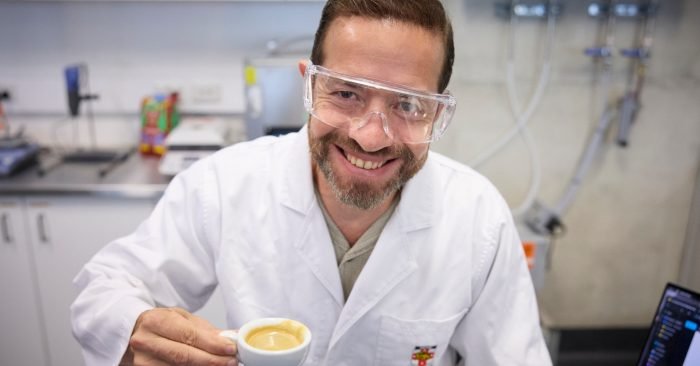
“We call it ultrasonic espresso. It’s a different process, but you get the same richness and concentration of normal espresso in less than three minutes,” says Dr. Trujillo.
“Traditionally, espresso is made by forcing hot water through coffee under pressure. But with ultrasound we can use room temperature water instead, reducing energy consumption by up to 75%.
“And when we gave our ultrasonic espresso to 100 regular coffee drinkers in a randomized test, they couldn’t tell it apart from regular espresso.”
Dr. Trujillo first developed a patented ultrasound system to turn cold-brew coffee, which typically takes 12 to 24 hours to make, into just three minutes.
However, the taste of cold-brew coffee is completely different from espresso – often described as much thinner, smoother and sweeter – while having about one-fifth the amount of caffeine.
Espresso strength using cold water
The UNSW team continued their work to adjust the ultrasound system to create espresso-strength shots without the need for hot water.
This process transformed a traditional filter basket into an ultrasonic reactor for cooking ground coffee beans. The basket produces high-frequency sound waves that help extract flavor, aroma, and body from the coffee grounds.
At the center of the system is a transducer – a small metal device that generates ultrasound by applying pressure to the side of the coffee basket that holds the ground coffee. The ultrasound causes the basket to vibrate rapidly, transmitting the vibrations through both the coffee grounds and water.
Ultrasound produces a phenomenon called acoustic cavitation, which is the rapid formation and collapse of microscopic bubbles in liquid. When these tiny bubbles collapse near the coffee particles, they act like microscopic scrubbing brushes or jets of liquid, pitting and breaking up the coffee grounds and speeding up the brewing process.
This helps break up the surface of the coffee grounds and allows the flavor compounds, oils, and caffeine to pass into the water much faster than normal at such a low temperature.
The result is a concentrated, flavorful shot of coffee comparable to espresso made from traditional machines, but produced using room temperature water and much less energy.
<a href