
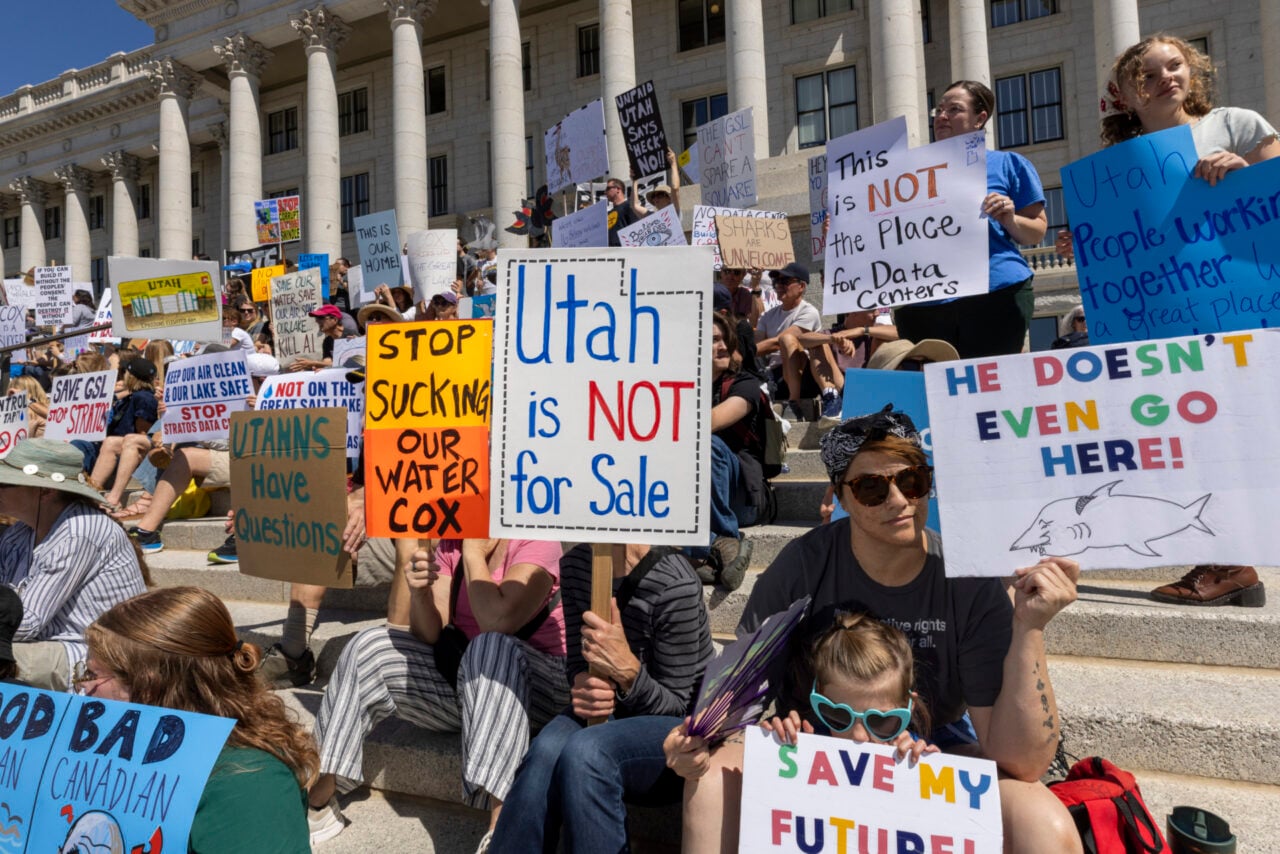
“The Committee on Energy and Commerce writes to express our concerns about evidence that strongly suggests foreign influence campaigns targeting artificial intelligence development in the US,” the lawmakers wrote in an open letter addressed to FBI Director Kash Patel and Trump’s Science and Technology Advisory Council co-chairs David Sachs and Michael Kratsios, requesting a briefing before June 18, 2026.
In the letter, Kentucky Representative Brett Guthrie, Pennsylvania Representative John Joyce and Ohio Representative Bob Latta cite independent investigations that allegedly found foreign adversaries, particularly China, “engaged in a coordinated effort to slow U.S. growth in AI development and build infrastructure that supports AI data centers.” The investigation was run by a think tank called the Bitcoin Policy Institute and an energy advocacy organization called Power the Future, whose self-described aim is to fight pro-environmental groups.
The report cited by the Bitcoin Policy Institute also claims that Senator Bernie Sanders, who calls for a ban on AI data centers, is involved in this Chinese influence campaign as he hosted a panel on the “existential threat of AI” earlier this year that included two professors from China, both of whom are leading figures in their fields.
The United States is in the midst of building an unprecedented AI infrastructure, which since its inception and even more so following Trump’s executive order on AI, has been framed as a national security imperative. The argument often made by the AI industry in its pursuit of lax regulation is that the United States is in a new era of space race, this time toward the creation of artificial superintelligence. Now the rival is China, whose AI industry is American Big Tech’s biggest competitor. Washington is concerned that if China reaches this long-conceived, highly advanced form of AI before the United States, Beijing could use the technology for military purposes. Although the United States and China are not in direct military conflict, tensions remain high, particularly over territorial claims in Taiwan.
“The United States needs to be the most aggressive in adopting AI technology of any country in the world, and that’s an imperative,” Nvidia CEO Jensen Huang told a crowd of Washington lawmakers late last year. “We have to encourage every single company, every single student to use AI.”
But things didn’t go the way Huang and the rest of the AI industry intended. Over the past year, the reputation of AI has declined dramatically as the technology’s impact on mental health, the job market, and the environment has been recognized. Much of that backlash has manifested in local outrage over data center projects, with critics arguing that massive facilities drive up utility prices, deplete water supplies, and worsen noise and air pollution.
A prime example is unfolding in Utah, where residents are pushing back against a 40,000-acre data center planned to be one of the largest in the world. That project’s owner, Canadian millionaire Kevin O’Leary of “Shark Tank” and “Marty Supreme” fame, has claimed that local opposition to his project, which is set to consume more than twice the energy consumed by the entire state of Utah, is motivated by foreign influence campaigns run by the Chinese Communist Party.
On Thursday, O’Leary partially acceded to the demands of local activists and Utah Governor Spencer Cox, saying he would shrink the proposed data center project by 75%.
<a href