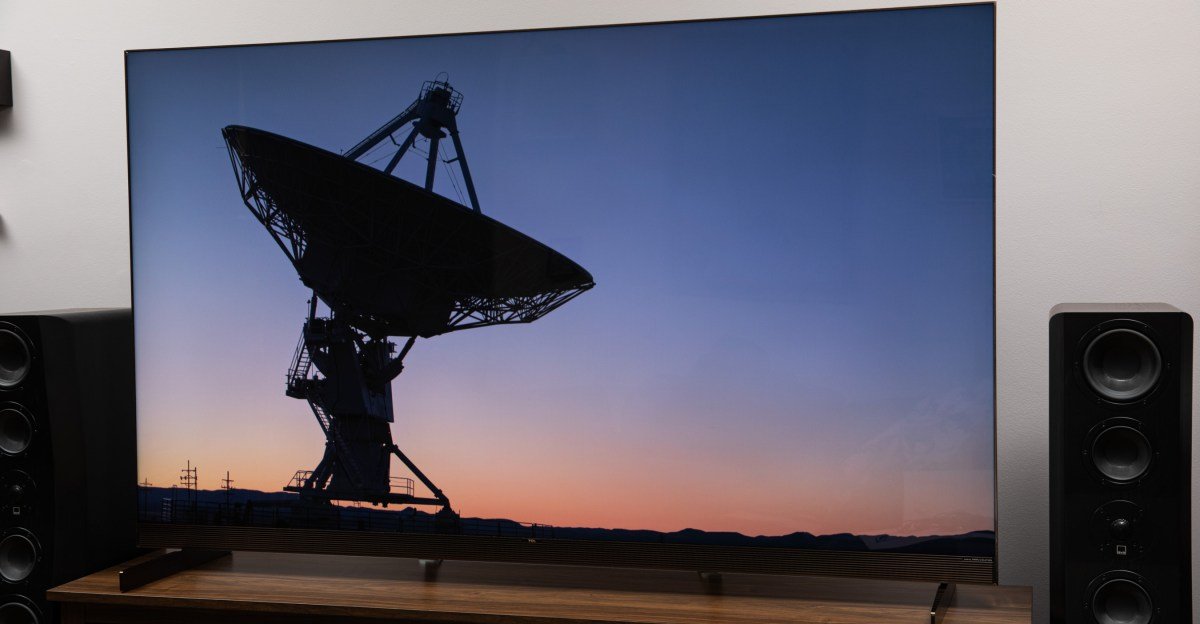
At the Los Angeles Convention Center, two 85-inch TVs were stacked together inside a Nanosys meeting room at Display Week — an annual business-to-business conference that focuses on the technology that goes into displays of all types. One TV was a mini-LED panel with super quantum dots, and the other was RGB LED – this year’s hottest TV trend. Both TVs were showing the same content at the same time to highlight the differences between the two technologies – or more specifically, to show the potential failures of RGB LED backlights compared to Super Quantum Dot (SQD), which uses blue LEDs for the backlight.
I should probably mention that Nanosys previously made quantum dots in TVs.

The TV on the right with the Nanosys Super Quantum Dots was labeled as the TCL X11L – the striped bottom grille confirms this – and the other was likely the TCL RM9L. Nanosys won’t confirm as much, but I’ve personally seen RGB LED TVs from Hisense, Samsung, LG, and Sony, and this was nothing like those. Jeff Yurek, vice president of marketing at Nanosys, informed me that both TVs were in filmmaker mode and the color was set to native to allow both to hit the scale as much as possible.
As a quick refresher, RGB LED TVs use red, green, and blue LEDs grouped into zones to create a colored backlight based on the image displayed on the screen. Theoretically, this should give the TV more vibrant and saturated colors than a mini-LED TV with a blue backlight like the X11L, without needing to rely solely on quantum dots. The primary potential issue is that the colored light provided by the backlight will bleed into adjacent pixels or zones that differ in color, resulting in what is called color crosstalk. In practice, this may cause the skin of the person wearing the bright shirt or hat to turn red. And that’s exactly what is shown in this demo.


The same video feed played on both TVs during the entire performance. A slide showed three rows: two rows of boxes containing the primary and secondary colors – blue, green, red, cyan, magenta and yellow – and a third with a thin white cross on a black background below each colored box. Then the top row of boxes will alternate between a solid box and a box with a white cross inside it. On an RGB LED TV, as soon as the white cross appeared in the top row, it was easy to see that the color of the area around the cross became slightly lighter and less saturated. Chromatic crosstalk did not occur only in the top row of boxes; The color of the box from the middle row is also clearly visible in the lower row of crosses. This is also reflected in the TV’s BT.2020 color gamut measurement, with the introduction of the white cross reducing overall BT.2020 coverage, most dramatically with the blue and green points.
But unless you’re a measurement fanatic like me, you don’t watch color blocks on your TV for entertainment. Its effect is also present on skin tone – something that, being human, is easily noticeable. Just as the color of the blocks changes to the white crosses, the colored background changes to the color of the skin; Still images of a woman’s face against a colored background caused her skin color to shift towards the background color. To make sure the color wasn’t bleeding out of my eye, unlike the TV, I used a scope to focus on only part of the woman’s face, blocking the rest from my view. I could still tell which background color was being displayed by the change in her skin color.

SQD TVs exhibited no chromatic crosstalk. It also had better contrast, reducing the number of dimming zones. The X11L is advertised as having 20,000 dining zones, although according to Rtings, the 85-inch model has 14,400 – still an impressive number. The RGB LED TV used in this comparison, I was told, has about 8,000 dimming zones. One reason the number is lower is that each dimming zone on an RGB TV requires at least three LEDs – one red, one green and one blue – and they take up space. But when the backlight is made up of only blue LEDs, a single LED can be a dimming zone, giving much finer control.
All this is conceivable in the actual material. During an action scene with fast movement and sharp cuts, I can still make out the difference as bright colors affect people around them, especially with skin tones. And in night scenes, the contrast difference was notable. If the RGB LED TV were in the room alone, without the SQD TV for comparison, I don’t think the color crosstalk would look as bright. Our eyes quickly adjust to visual problems and we stop paying attention to them. But removing the comparison does not make the problem go away.
This is not completely new information. Industry experts have been concerned about the possibility of chromatic crosstalk in RGB LED TVs since the technology’s debut at CES 2025. These concerns have increased with more RGB LED TVs coming to market this year. LG Display, a maker of exclusively OLED panels that are in direct competition with RGB LEDs, produced a video highlighting the problems a few weeks before this year’s CES.
Of course, both Nanosys and LG Display have a vested interest in downplaying RGB TV technology. An RGB LED TV’s display doesn’t even tell the story All RGB LED TV. When I reviewed the Hisense UR9 I didn’t notice any crosstalk issues, although the more I watch other RGB LED TVs, the more I think Hisense is bypassing this issue and falling back on white backlighting, not RGB, whenever there’s a lot of color on the screen. Additionally the processing capabilities of upcoming Sony RGB LED TVs may make color crosstalk a non-issue on those sets. And we’re still at the beginning of the RGB LED TV story. As technology continues to evolve and become more sophisticated, these issues should be reduced. But for 2026, at least the SQD looks to have the upper hand.
<a href