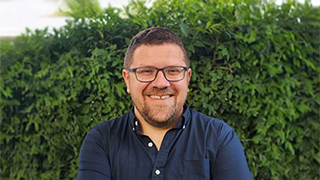
Peter Morse, Ph.D., assistant professor of physics in the College of Arts & Sciences, was recently awarded a fellowship from the Kavli Institute for Theoretical Physics (KITP) at the University of California, Santa Barbara.
For Morse, this honor is a way to take the support he received at Seton Hall and turn it into something meaningful – a desire growing naturally from the place that has become his academic home. “One of the things that made this possible is seeing what kind of institution Seton Hall is and what kind of institution we are becoming,” he said.
We are a place that has always been deeply committed to teaching and the success of our students, and over the past several years, we have also achieved rapid expansion in our research activities, and seen those efforts translate into tangible results. This combination is exactly what the KITP Scholar Program is looking for.
The KITP Fellowship is specifically designed for faculty at primarily undergraduate institutions: universities like Seton Hall that are building strong research cultures with students at the center. “The purpose of the KITP program is to help faculty fully integrate into the broader research community,” he explained. “In some ways, it’s designed to build a bridge between outstanding institutions like Seton Hall and large research centers around the world. And it’s very much in line with what we’re doing in the College of Arts and Sciences.”
Those bridges start closer to home. Morse immediately found this fellowship in the “highly nurtured soil”, as he puts it, that he found in his college and department. “For this fellowship, I received a lot of guidance from Jose Lopez, Ph.D., professor of physics and director of the Office of Grants and Research Services, my faculty advisor, who helped me think about which grants and opportunities to pursue,” he said. “They helped refine the application and consider how it fits into the long-term research strategy. And Mehmet Alper Sahiner, Ph.D., department chair and professor of physics, gave me important advice on how to adapt the application.”
Jonathan Farina, Ph.D., dean of the College of Arts & Sciences and professor of English, has also been a steadfast supporter of this effort, supporting the comprehensive approach to research, student success, and faculty development that this fellowship represents.
Morse said this institutional support is building the future of the physics program as well as her own career. “One of the things we’re always encouraged to emphasize is collaboration, how to connect our students and our work to the broader world,” Morse said. “The College and the department have been incredibly supportive of this, and this fellowship is a solid testament to how real those connections are made.”
That vision is already translating into opportunities for students. Building on the momentum gained from Morse’s appearance at last year’s APS (American Physical Society) Global Summit, two Seton Hall graduates, Maxwell Flores and Collin Doyle, are set to present at the 2026 APS Global Summit, with the full support of the Physics Department for both their research and the outreach leading up to it. Morse said, “I would like them to see these conferences not just as places to give speeches, but as networks that can open doors to graduate school, jobs, collaborations, fellowships, and all kinds of new possibilities.”
Returning to his KITP fellowship, Morse is clear about who he hopes will benefit first: the students. He said, “The projects and collaborations I create at KITP don’t just stay there; I bring them back and put the students at the center. In the best scenarios, I send my students to work with my colleagues at their home institutions.” His first presentation in Santa Barbara will highlight the work of his graduate student Maxwell Flor on jamming transitions, part of an ongoing collaboration with researchers at Duke University and Sapienza University of Rome. “So, this is not just speculation; this is a concrete example of how these networks can help a student’s project grow. And I hope it will lead to new projects for other students as well.”
Morse has a clear vision for this development, based on his collaboration with Francesco Zamponi, PhD, a leading theoretical physicist at Sapienza University of Rome. Now, they’re expanding that partnership into Pipeline for Student Success. “We are continuing to create research projects that students can get involved in,” Morse said. He said he is actively seeking funding to send Seton Hall students to Zamponi’s group in Europe. “That’s the path I’m trying to create.”
He also explains why the institution that offers the fellowship is so important. KITP is recognized as one of the world’s top two institutions for theoretical physics, distinguished by programs that gather leading scientists from around the world. “This is where long-term collaboration begins,” Morse said. “For a department that values teaching and is accelerating its research like ours, this fellowship turns reach into impact and helps our students see how far their work can go.”
Categories: Nation and World, Science and Technology
<a href=