They hit NVIDIA’s AI systems directly
AMD’s big pitch for 2026 appears to be: “Who needs cloud AI processing when you can do it all locally?” At CES this year, the company unveiled its Ryzen AI Halo PC, a Mac Mini-sized system that can crank out AI tasks. Today, AMD announced it will start with Ryzen AI Max 300 CPUs starting at $3,999, and we can also expect future models with new Ryzen AI Max 400 chips. Preorders begin in June.
While expensive, AMD positions Halo as a cost-effective alternative to paying higher monthly AI computing fees. If you’re spending $773 per month to use 6 million daily AI tokens — which is not an uncommon scenario for many developers — then Halo could pay for itself within six months. And for more demanding work, AMD says its $4,000 Radeon R9700 Pro GPU could break even within three months for people paying $2,253 per month to use 18 million daily tokens.
If it’s not already obvious, these are not devices made for regular consumers. Instead, AMD is competing directly with NVIDIA’s DGX Spark AI PC, which now goes for $4,699 after launching at $4,000. While NVIDIA’s AI PC can only run Linux, the Ryzen AI Halo can run either Windows or Linux, as it’s powered by an x64 chip. Another advantage? Halo has 50 TOPS NPU And A Radeon GPU with 40 compute units, while the DGX relies entirely on NVIDIA’s Blackwell GPU for Spark AI work. Both systems also have 128GB of integrated system memory, which is necessary for running larger models. Notably, it has more memory than the Mac Mini or Mac Studio, both of which are popular among AI developers.
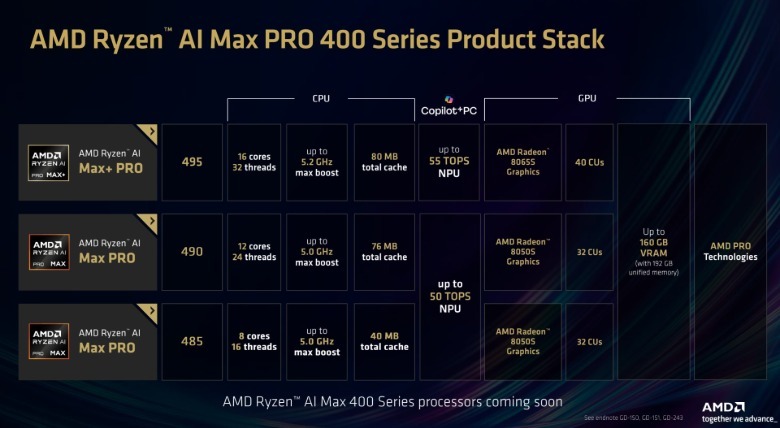
As for those new Ryzen AI Max 400 chips, they’ll be led by the AI Max+ Pro 495, a 16-core chip with 5.2GHz boost speed, 55 TOPS NPU, and Radeon 8065S graphics. Those chips will also support up to 192GB of integrated memory, allowing up to 160GB of GPU VRAM. Spec-wise, it’s only slightly faster than the AI Max 395, which has a 5GHz CPU boost clock speed, but we’ve yet to see comparison benchmarks from AMD. The company says Ryzen AI Max 400 chips will be available in the third quarter of 2026.
<a href