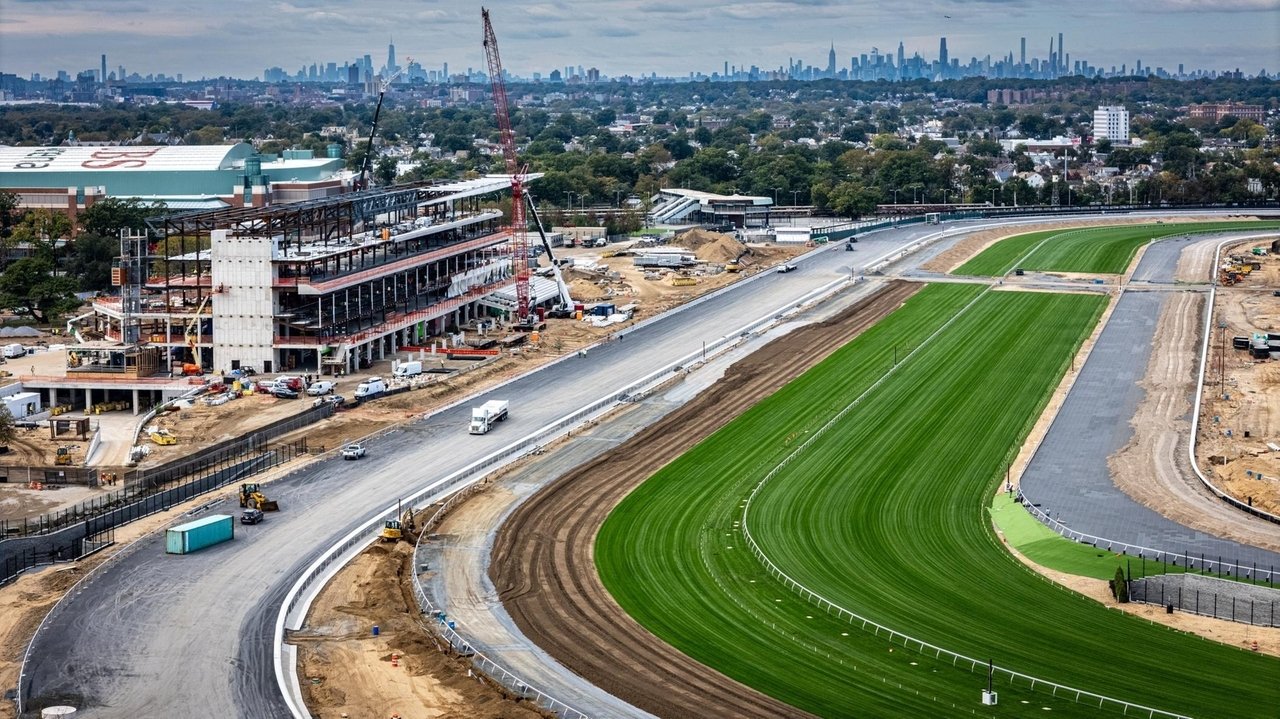
The opening day event will be the first race at Belmont Park since July 9, 2023, when it closed for an ongoing $575 million renovation project, which also includes construction of a new grandstand. The Grade 1 $1 Million Jockey Club Gold Cup will highlight the first day of racing and will be televised by Fox.
The new grandstand will not be at full capacity yet as construction is expected to be completed and the facility will be fully operational in April 2027. New York State contributed $455 million to the project through a loan to NYRA.
“The new Belmont Park will provide a stage to showcase the best racing in North America,” Andrew Offerman, NYRA’s senior vice president of racing and operations, said in a statement. “With this in mind, we have arrived at a stakes program that reflects the importance of the fall racing season, emphasizes key weekends throughout the meet, and establishes a strong foundation ahead of the 2027 Breeders’ Cup World Championships. We look forward to September 18 and the next chapter in NYRA history.”
The Breeders’ Cup will be run at the new Belmont Park October 29-30, 2027.
The third and final Belmont Stakes will be run at the bucolic Saratoga Race Course on June 6 before returning to its namesake home next year.
NYRA’s fall meet runs through Dec. 6 at Belmont Park.
An all-weather synthetic track is also coming soon and is expected to be open for training by the end of spring. It will be the fourth oval to go with a 1 1/2-mile main dirt track and two interior turf courses.
“It’s going to be a huge boon,” Michael Dubb, a member of the NYRA board of directors since 2008, told Newsday in a recent telephone conversation. “Because the problem with horse racing is that the number of horses is decreasing and a lot of grass horses can’t race here in the winter. But grass horses are able to race on synthetic.”

Andrew Gross joined Newsday in 2018 to cover the Islanders. He began reporting on the NHL in 2003 and has previously covered the Rangers and Devils. Other assignments include the Jets, St. John’s and MLB.
<a href=