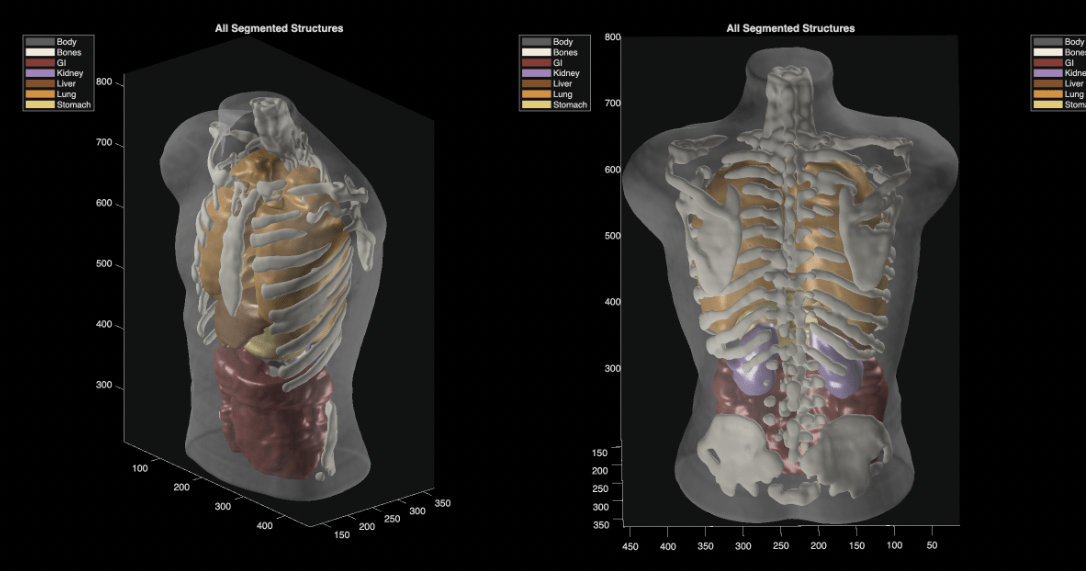
MidJourney CEO David Holz recently showed off the company’s first hardware product and plans to build a San Francisco spa, which he admitted is a bit different from the “cat pictures” produced by its AI image generator. Named The Midjourney Scanner, it’s an ultrasound-based full-body scanner that uses a ring of sensors to capture vertical slices of the inside of your body, initially looking at your muscle, fat, bone and organ structure. Holz said that ideally, you could do it once a year or every day, as the goal is to “achieve image quality equivalent to MRI in many ways.”
He mentioned that one way he would use it would be to see how his body changes in response to changes in diet and workout, adding, “I’m not the most measured man on Earth yet, you know, but I’d probably do it daily. [measurable information]. One set of job listings advertises the company’s goal as seeking to “build and launch the world’s first full-body ultrasound CT scanner, ultimately bringing safe, fast and high fidelity preventive scanning to billions of people through a magical spa experience.”
The MidJourney scanner was developed in partnership with ultrasound tech company Butterfly Network, which said it uses “40 Butterfly Ultrasound-on-Chip™ imaging modules per system.”
The scanning process begins by stepping onto a platform that is lowered into the water on rails through a ring of thousands of transducers that create ultrasonic waves and then records and analyzes the waves as they pass through your body and creates detailed 3D images, it said, adding that the scan will take about 60 seconds. Holz said about a dozen people have been scanned so far.
It begins with stepping into a shallow pool of golden light. Then you start descending into the water. Your body passes through a ring of sensors underwater, each using its echolocation to act like a dolphin. The sensors send ultrasonic sound waves from every angle into your body. With enough waves and enough angles, we create an image of what’s happening inside your body.
It combines those sensors with two petaflops of processing power. But after watching the livestreamed reveal, I’m still not clear on what MidJourney’s AI image generation technology actually has to do with the MidJourney medical effort, beyond a substitute business for otherwise unused AI computation.
Holz hopes to install 10 scanners at the MidJourney Spa location in San Francisco’s Union Square that will open before the end of 2027, and offer to scan the hands of attendees at its launch event. The MidJourney Spa will feature a gym, sauna and scanning rooms equipped with cold plunge as well as hot tubs where visitors will get into the water for scanning.
He noted that various medical applications will require FDA approval, but for now, MidJourney Medical says it is working on “body composition maps,” which do not require the same level of approval as diagnostic imaging. It also says that “libraries of scans” created by users can be shared with doctors, AI health tools or others, and “we take data privacy seriously – more details on our data policies will come as we get closer to launch.”
Holz suggested that eventually these scans could be better than MRI, without radiation, powerful magnets or other complicating factors, to get a look at what’s going on inside people’s bodies “really quickly.” In response to a question, he envisioned a future where the FDA would have a range of tools to look for “weird” things and allow people to “try to get as much data as possible.”
<a href