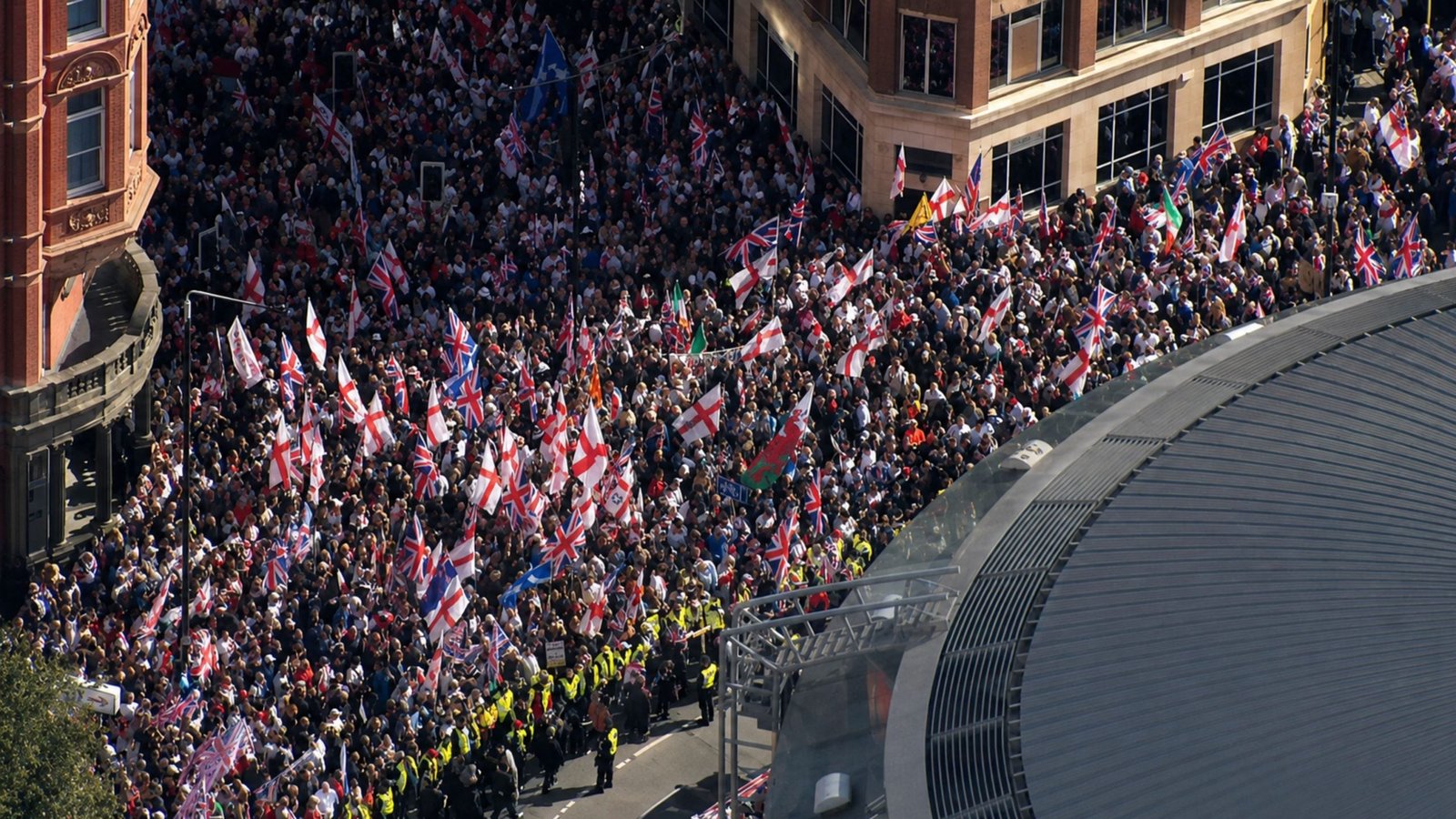
Live facial recognition will scan the faces of people attending the “Unite the Kingdom, Unite the West” rally in the borough of Camden, the first time this technology has been authorized for use at a protest in the UK. The rally was organized by activist Tommy Robinson, who says the rally is for “national unity, free speech and Christian values.”
Drones will fly from above and search for suspects.
MORE: “Nothing to fear” is back: UK High Court clears the way for police facial recognition
Deputy Assistant Commissioner James Harman said that Live Facial Recognition (LFR) will be deployed “in an area likely to be used by people attending the Unite the Kingdom event in the Camden area of London,” but that a pro-Palestine march marking “Nakba Day” taking place in London on the same day with an estimated 30,000 attendees will not face the same biometric surveillance.
Biometric identification has reached from the streets to political gatherings and, once that hurdle is overcome, there has never been a question as to whether it will be used more widely. This is then.
Reform UK leader Nigel Farage reacted to the deployment. “The Unite the Kingdom rally on Saturday should be considered no different from the pro-Palestine march on the same day,” Faraz said. “The fact that two-tier justice is being applied against patriotic Britons is outrageous.”
The Met justified its decision by citing “intelligence which indicates that some of the people in attendance are likely to pose a threat to public safety.” This turns the entire protest into a surveillance zone based on the expected behavior of an unspecified portion of the attendees. The face of every person passing through Camden tomorrow afternoon will be compared to a watch list, whether they are a suspected criminal or someone who has just come across a flag.
This deployment does not exist in isolation at any protest. Two days before LFR was announced at the rally, the Met published the results of a six-month pilot in Croydon that indicate where facial recognition is headed in the UK.
For the first time, the Met installed live facial recognition cameras on lampposts and existing street furniture rather than using dedicated police vans.
Remotely monitored fixed cameras kept an eye on Croydon’s High Street from October 2025 to March 2026.
The move from WAN-based deployment to placing cameras on public infrastructure is a big deal. Vans are visible, temporary and require a physical police presence. Lamppost cameras blend into the built environment and can be activated whenever officers decide they are needed.
The Met’s figures tell a story. The cost of secrecy lies in telling others.
In six months, the system scanned more than 470,000 faces. It made 173 arrests in 24 separate operations. The Met presented this as an arrest every 35 minutes and claimed a 10.5% drop in local crime, including a 21% reduction in violence against women and girls.
“These results show why live facial recognition is such a powerful tool when used carefully, openly and in the right places,” said Lindsay Chiswick, national and MET lead for live facial recognition.
He added: “We will continue to use the fixed cameras in Croydon as part of our regular live facial recognition deployment which plays a vital role in keeping London safe.”
Run those numbers separately and they look less triumphant. Of the 470,000 people whose biometric data was taken and processed, 99.96% had no connection to any crime.
For each arrest, faces of about 2,717 people were scanned and compared with the police watch list. The Met subjected the entire community to biometric surveillance to catch those it could not find through actual policing and now plans to make that system permanent.
Parliament has never voted on live facial recognition. No law explicitly regulates its use. Police forces write their own policies governing when and how they deploy it, and the Met is now expanding from mobile vans to permanent cameras on public infrastructure, with no democratic mandate for change. The technology was introduced, tested and normalized entirely outside parliamentary oversight.
Yesterday’s deployment in Camden crosses another line. Facial recognition at a protest creates a biometric record of political participation, even if the data is supposedly deleted after some time.
Those who might attend a legitimate demonstration now know that their faces will be captured and compared to police databases. Some will stay at home. It is monitoring who exercises democratic rights and the Met has decided that it has to choose which demonstrations trigger that effect.
<a href