When LEGO announced its tech-packed Smart Bricks at CES, we were impressed by its capabilities – enough to give it our Best in Show award. But when the first Star Wars set actually launched in March, we were less excited. All that promise of clever conversation and creative play was ultimately reduced to a few voices barking and flashing lights, with the smartest features we saw at CES nowhere to be found.
Today, LEGO announced the second generation, which features 12 new sets launching this summer, promising Pokémon play and some smarts we’ve been missing. After a few hours of training and fiddling with the new set this morning, it’s clear that the Smart Brick Is Getting smarter, but LEGO is taking the slow path to delivering on the promise it made in January – and is still struggling to implement one of its most obvious selling points: official sound effects.
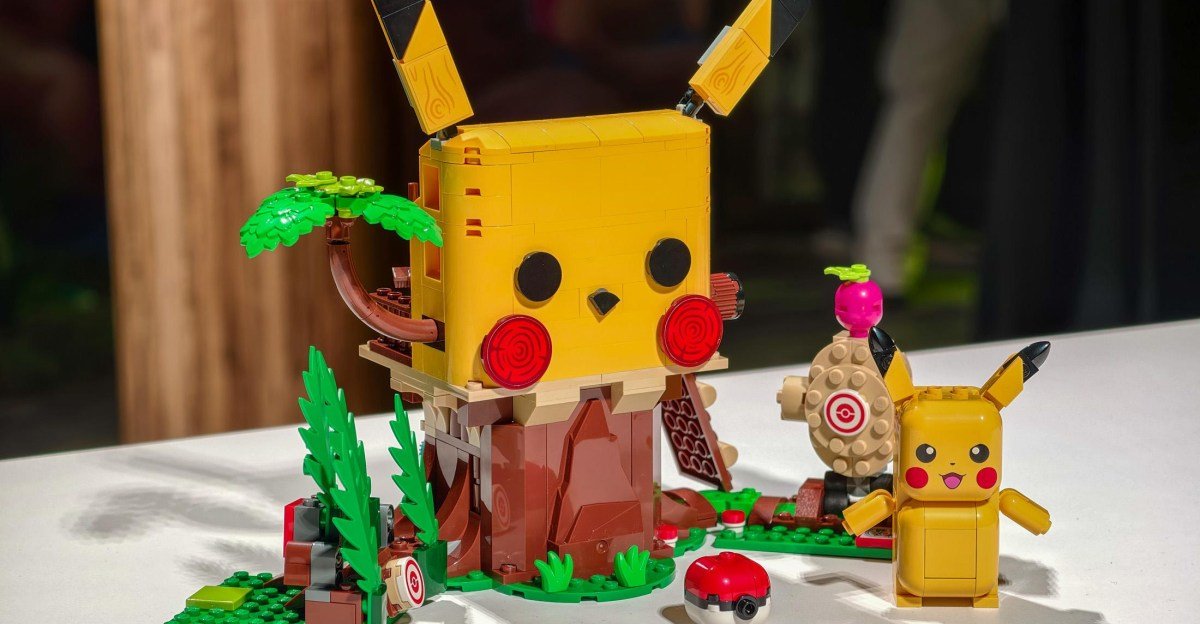
The 12 sets announced today are now available for preorder, but won’t go on sale until August 1st. Only two sets are “all-in-one”, meaning they include at least one smart brick and a charger, giving you everything you need to use the smart features: a $69.99 Pikachu set with a treehouse and a smart brick, and a $119.99 battle set that includes Charizard and Jolteon, which also includes two smart bricks. The other 10 sets, ranging from the $14.99 Jigglypuff to the $89.99 Battle Between Cubone and Gengar, are what Lego calls “compatible” — meaning they include smart tags that can trigger certain effects and interactions, but not the smart bricks needed to run the whole thing.

LEGO has worked to add some complex interactions that were missing from earlier Star Wars sets, most excitingly in the ability for two Pokémon to battle. Combining two Smart Brick-connected Pokémon figures together — and yes, you’ll need two bricks, which means buying either the Charizard set or something from the Star Wars line — triggers Battle Mode. As 8-bit battle music plays, kids can fight by moving two figures at each other through the air: moving faster triggers a low-damage quick attack, holding the figure back for a few seconds triggers a stronger move, and pulling it back helps avoid damage. After a minute or two of back-and-forth, accompanied by flashing lights and victory music, one Pokémon will win.
Federico Begher, Lego’s SVP of product and marketing development, said the combat is intentionally simple. The four basic mechanics – shaking to start the fight, two types of attacks, and dodging – are the “sweet spot” in a kind of open-ended game that “can’t be too complicated, can’t be overwhelming.” It’s far from a perfect recreation of the games’ turn-based combat, but it at least takes a little skill, mostly mastering dodging and learning when to use a charge attack.
There Is There is something else going on behind the scenes too. Not all Pokémon are created equal, and some are naturally stronger than others. After all, Mewtwo should always have the edge over Pikachu. Type advantage also applies, so Squirtle will often beat Charmander. Each Pokémon’s Smart Tag, hidden inside its body except when you add or remove the Smart Brick, shows its type along with its Pokédex number, and different types of Pokémon even make different sound effects – a charge of electricity for Pikachu, a wave of water from Lapras.

Then there is training. Tapping a Pokémon on the training tag puts it into training mode, at which point tapping it against targets built into the set (or other objects of your choice, or simply waving it in the air – the accelerometer in the Smart Brick is doing most of the work here) will level up your Pokémon, making it stronger in its next battle. Before you get too excited, none of this is permanent: the increase in power from training only lasts until the Smart Brick is removed from that Pokémon (or its battery drains), so you can’t train a squad over time. A representative from Lego said this is partly due to the design – in their testing, kids seem to enjoy repeating the training loop from the beginning – although I suspect this is mostly hampered by the technical limitations of the Smart Brick.
These limitations are also partly to blame for the most glaring flaw of these new sets: None of these Pokémon say their names, nor do they make distinctive, recognizable noises from the games or cartoons. it is One I wanted Lego Pikachu to do this, and it can’t do that, instead making generic critter sounds and making weird lightning effects. Previous Star Wars sets had similar limitations, with Darth Vader’s heavy breathing but no recognizable sounds for the lasers and minifigs. Technical limitations come down to the Bricks’ runtime synthesizer, which generates sounds in real time using a system similar to MIDI, and its low memory, which forced Lego to limit how many sound effects it packed into it. There’s another practical concern, though: not all Pokémon around the world have the same names and noises. Pikachu may be Pikachu wherever you go, but in Japan, Squirtle is the Zenigame. Unlike the games, Lego bricks are not localized, and so any sound effects have to work wherever the toys are played with. Kids will have to say “Pika Pika” for themselves, so they never hear a Pokémon name that doesn’t sound right to them. Maybe that’s why Luke Skywalker didn’t talk either – not every child expects him to speak English.
1/4
The 12 sets vary in size and complexity, ranging from an 88-piece Jigglypuff kit to 831 in the battle between Umbreon and Garchomp, though most contain at least a few moving parts, such as Gengar’s dangerously moving tongue. Some of those larger sets are rated 10+, although the simpler sets are for ages six and up. Larger sets also create larger Pokémon, although all of them remain interactive in battle. They’re relatively strong, and the LEGO staff I spoke to said the kits went through repeated testing and iterations to narrow down their weak spots, but since both training and fighting involve rapidly killing the figures, they’ll likely eventually fall apart. In an unfortunate mid-battle collision, my Charmander was destroyed by a massive hit from Bulbasaur, though luckily LEGO had a “toy doctor” on hand for immediate repair. It’s still less clear how much variety there is when you drag Pokémon from one set to interact with a prop from another set outside of battle – they should always work together, but I didn’t have enough time to see how many unique effects are produced with unusual combinations.
The Pokémon Smart Play Kit is a clear step up in complexity compared to Star Wars options based on battles alone, creating a level of screen-free gameplay in and around open-ended creative play. But Lego has yet to release sets that use some of the more advanced features shown at CES, including interactions that change based on the precise positioning of characters, tags, and bricks. This feels like a step forward, proof that Smart Play can offer much more than just flashing lights and jiggle sounds, even if its true potential has yet to be realized.
Photography by Dominic Preston/The Verge
<a href