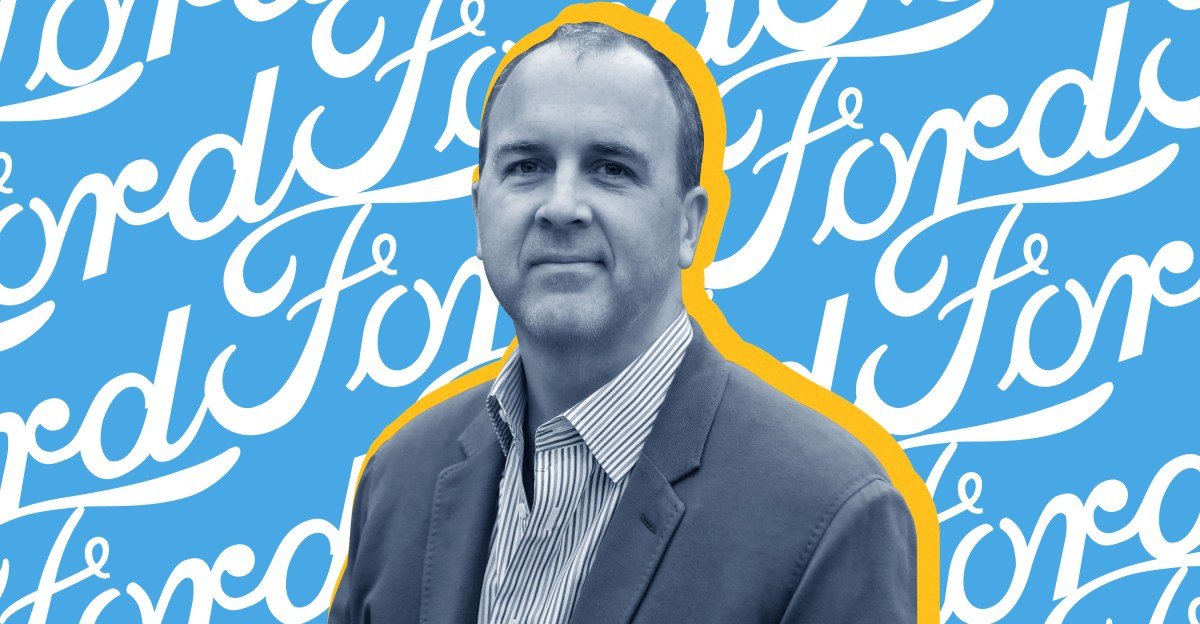
Doug Field, who left Apple five years ago to lead Ford’s billion-dollar bet on electric vehicles and software, is stepping down next month. He will be replaced by Alan Clark, a former Tesla engineer who now leads Ford’s California-based Skunkworks lab. Clark’s new position will be vice president of advanced development projects, and he will continue the effort to develop Ford’s universal electric vehicle (UEV) platform.
The change comes less than five months after Ford announced a major $19.5 billion cutback on its EV investments as well as the discontinuation of several electric models, including the F-150 Lightning pickup truck. The company canceled plans to build a next-generation electric truck, codenamed T3, and an electric commercial van. Instead, Ford will focus on hybrids as well as its existing lineup of gas-powered trucks and SUVs as it continues work on its uEV platform, which will eventually underpin an entire family of low-cost EVs starting with a $30,000 midsize truck in 2027.
Ford also said it is creating a new “end-to-end organization” called Product Manufacturing and Integration, aimed at leveraging its existing vehicle platforms for “digital evolution.” The team, which will be led by Kumar Galhotra, Ford’s chief operating officer, will be responsible for growing the automaker’s EV and digital products across the company.
In a briefing with reporters, Ford CEO Jim Farley praised Fields for building a strong team that shaped Ford’s high-tech capabilities. Field, for his part, said that he has not decided on his next role. Asked whether it was unfair to abandon the UEV platform before it was in production, Fields said he was satisfied with “handing the baton” to the company’s industrial and manufacturing team.
“This is really quite an opportune time, because I came to Ford to partner with people who know how to industrialize at scale,” Fields said. “The product has reached a level of maturity where I am completely dependent on the experts at Ford – who know how to bring it to a factory like Kentucky, how to run it at high volumes, build it with the highest quality and keep it affordable. That’s why this transition point is an opportune time for me to pass the baton and pass the torch.”
“That’s really why this transition point is an opportune time for me to pass the baton and pass the torch.”
– Doug Field
Farley outlined several upcoming changes at Ford, including a plan to refresh 80 percent of its North American vehicle portfolio and 70 percent of its global portfolio by 2029. These updates will include new electric architectures, enhanced internal experiences, higher levels of automation and a new generation of integrated services and software products, he said. By the end of the decade, 90 percent of Ford’s vehicles will feature entirely new electric architectures, including zonal and partially zonal systems.
Losing Fields is the latest blow to Ford’s years-long quest to transform its vehicles from analog gas-guzzlers to sleek, digitally sophisticated electric vehicles. At the time of his appointment, the only car company with a fast, seamless and satisfactory software experience was Tesla. Legacy automakers like Ford can only watch with envy as Elon Musk’s company releases monthly over-the-air updates that have surprised and delighted many of its customers. Ford wanted the same, and so he hired Fields to lead the effort. In addition to leading Apple’s secret car project, Fields also served as chief engineer at Tesla, overseeing the design of the Model 3.
During Field’s tenure, Ford introduced several new features, including its popular and highly rated BlueCruise hands-free driver-assistance system. Introduced Ford Digital Experience, a new Android-powered infotainment system that enhances smartphone mirroring rather than blocking it. And the automaker launched its Skunkworks project to design its next-generation EV.
Still, there were some setbacks. Ford scrapped its higher-cost next-generation electrical architecture, also known as FNV4 (for Fully Networked Vehicle). The platform was expensive, leading to a $5 billion loss on EVs and software by 2024, but it was also an important effort to update and improve Ford’s software experience. At the time, Fields said it was more cost-effective to adapt Ford’s third-generation architecture – FNV3, now rebranded as FNV3.X – across the entire range of the lineup rather than creating a new platform with more limited applications.
This is not the first time Ford has looked at organizational changes to improve its financial position. In 2022, the automaker split its entire business into two separate units: one focused on electric vehicles called Model E, and the other focused on gas-powered trucks and SUVs called Ford Blue.
<a href
современные кухни на заказ в спб https://kuhni-spb-59.ru
заказать кухню в интернете заказать кухню в интернете
freehold condos for sale in phuket freehold condos for sale in phuket
частный нарколог на дом частный нарколог на дом
роликовые шторы роликовые шторы
скачать с ютуба видео в хорошем качестве https://skachat-video-s-youtube-10.ru
slot malaysia slot malaysia
кухни в спб на заказ кухни в спб на заказ
кухни на заказ в спб недорого https://kuhni-spb-57.ru
вызвать капельницу от запоя вызвать капельницу от запоя
лечение наркомании на дому https://narkolog-na-dom-voronezh-10.ru
капельница от алкоголя капельница от алкоголя
нарколог нижний новгород нарколог нижний новгород
выведение из запоя в спб https://vyvod-iz-zapoya-na-domu-sankt-peterburg-22.ru
нарколога на дом москва нарколога на дом москва
intelligence test online intelligence test online