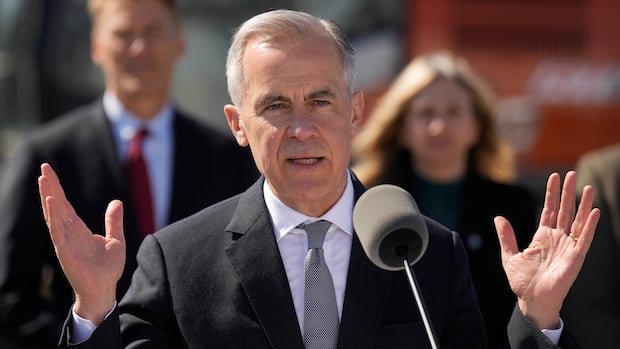
The Canada Strong Fund “will serve as an investment vehicle to finance key projects of national interest and will work in partnership with the private sector,” Carney said in a video posted online.
Carney said in the video that Canadians will be able to contribute to and benefit from the fund by investing with the private sector and international partners.
“If you have some extra money, we’ll make it easy for you to invest in a fund to help make Canada stronger for all,” he said.
In a statement, the federal government said the fund would include projects in “clean and conventional energy, critical minerals, agriculture and infrastructure”.
At a Monday press conference at the Canadian Museum of Science and Technology in Ottawa, Carney said the fund will start with an initial endowment of $25 billion.
“Over time, the fund will grow through asset recycling and reinvestment, creating even greater opportunities for future generations,” Carney said.
When Carney was asked where the $25 billion would come from given Canada’s financial situation, he said Tuesday’s spring economic update The news would put Canada’s fiscal position in a stronger position than it was when Carney’s government projected a deficit of $78.3 billion for the recently ended fiscal year.
“For the numbers to be better, you have to be on top of them and we’re on top of them,” Carney said.
Recent increases in the price of oil due to the war between Iran and the United States and Israel have boosted revenues in Canada’s oil-producing provinces and in turn increased how much revenue the federal government collects.
Carney says this time will be different
Carney said the Canada Strong Fund will be managed by an independent Crown corporation that will report to Parliament, and his government will consult on “specific aspects of the fund” over the next few months.
Describing the fund as “essentially a national savings and investment account”, Carney said the fund was being designed to “increase wealth for future generations”.
“It will be Government of Canada funds, but more importantly, it will be the people’s funds. It will be your funds,” Carney said.
To allow people to contribute to the fund, the federal government will launch a “retail investment product”, like a mutual fund or pension plan, where Canadians can buy into the fund and earn dividends.
“This will give Canadians a direct stake in our country’s long-term prosperity and help build long-term national wealth,” the government said in a statement.

Prime Minister Mark Carney on Monday announced the Canada Strong Fund, the country’s first national sovereign wealth fund, with an initial federal government investment of $25 billion over three years. Carney said the fund is ‘designed to increase wealth for future generations of Canadians.’
Carney also said that major projects his government is trying to build, like the Canadian Pacific Railway, will be built mostly by private companies.
As in the 1870s, Carney said, “the federal government would support these projects through loans, grants, and other incentives.”
Carney evoked the spirit of major infrastructure projects that have defined Canadian history, but said the proposed plans would be different from things like the Canadian Pacific Railway, which was built by displacing Indigenous people from their lands, where workers worked under “terrible conditions” and the only people who benefited from those projects were the companies that built them.
Carney said indigenous people would be full partners in the projects through equity participation; that the projects being financed would be built by Canadians in “high-paying union jobs”; And because the government is investing in this fund, all Canadians, whether they invest directly or indirectly as taxpayers, will benefit.
Projects of National Interest
Bill C-5, Carney’s legislation to speed up approvals for major infrastructure projects identified as “nation-building” passed Parliament last June.
The second part of the bill, the Building Canada Act, enables the federal cabinet to select projects, approve them in advance, and override federal laws, environmental reviews and the permitting process.
The legislation increases the approval time from five years to two years by introducing a “one project, one review” approach rather than sequentially going through the federal and provincial approval processes.
The Major Projects Office (MPO), which Carney created last August, is the central place to make pitches, lodge complaints or express concerns about major projects.
When he announced the MPO, Carney said it would “help structure and coordinate funding from the private sector, provincial and territorial partners” and help the federal government ensure taxpayers get value for money.
Carney said projects financed through the fund would not be limited to those of national interest, which would have to meet certain criteria to receive that classification.
“In my judgment, it won’t be limited to that. We will consult on the specifics, so it’s a broader range than the C-5 in particular,” he said Monday.
<a href