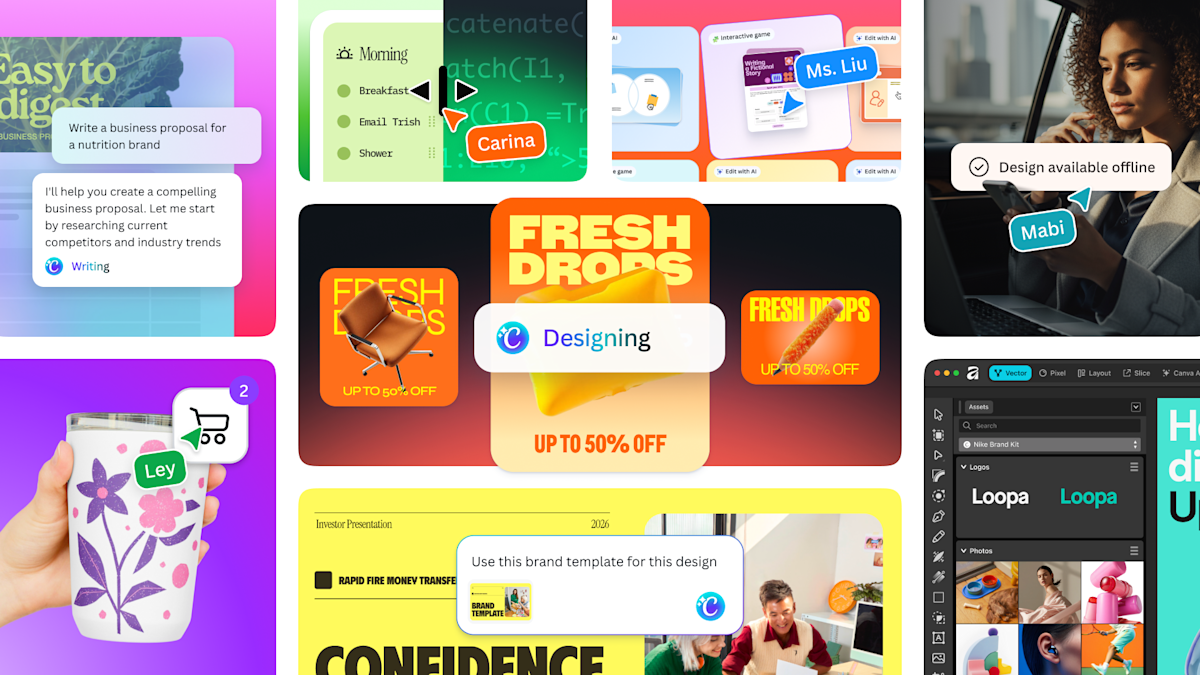
Adobe isn’t the only company releasing a new AI assistant this week. Today ahead of its Create event in Los Angeles, Canva announced Canva AI 2.0. Building on its existing AI assistant, the company is touting this release as its most significant update since the platform first launched in 2013, and the culmination of years of investment to build its own foundational design models.
As you can imagine, it all starts with a conversational interface that allows you to describe an idea or goal and the system will begin generating a design to match. Under the hood, there’s a new orchestration layer that allows models to use all of Canva’s different tools to complete complex, multi-step tasks. For example, the company suggests you can use Canva AI to create a multi-channel ad campaign, and the software will generate everything you need to get it off the ground.

If editing is required, the company says Canva AI avoids the pitfalls of many other image creation models. It is possible to edit each visual element generated by the system, as if they were created with a traditional image editor. As a result, you can do things like replace images and change fonts without affecting any other part of the design. To bring everything together, Canva has built persistent memory into the tool. The more you use Canva AI, the better the system will become at implementing your personal tastes and style for future generations. According to the company, it also has a reference window that is long enough to maintain consistency until the final design is reached.
Along with those enhancements, Canva is adding support for new workflows that expand what you can do with its software, starting with connections that allow its models to pull data from other apps, including Notion, Slack, Zoom, Gmail, Google Calendar, and others. Users can also schedule Canva AI tasks to complete in the background, and the company has also included in-depth research capabilities in the tool.
The coding function previously introduced by Canva has been upgraded to include support for HTML import, allowing users to bring any HTML file or AI-generated experience into Canva’s visual editor to make changes to its design without breaking things. For brands, the company is also introducing a tool that can process their visual identity and apply it to new and existing designs.

Canva’s updated coding agent now supports HTML import. (Canva)
To a casual observer, it might seem like Canva is chasing trends, but Danny Wu, the company’s AI chief, argues that the new AI tools represent a natural evolution for Canva. “This is something we’ve been dreaming of and working on for a long time,” he told Engadget. “Even before ChatGPT existed, we wondered, ‘What if we don’t have a template that matches your needs?’ …So I wouldn’t describe it as a pivot or a shift, we’ve been wanting to offer these types of capabilities as part of our mission to simplify design.
If you want to try out Canva’s new tools, Canva AI 2.0 is available as a research preview starting today. The first 1 million people to visit the Canva website will get the first access, with availability gradually expanding to more users over the coming weeks. As before, access to Canva’s AI features is included in the company’s free offering, though it’s also introducing a new AI Pass add-on that significantly raises the rate limit for users.
<a href