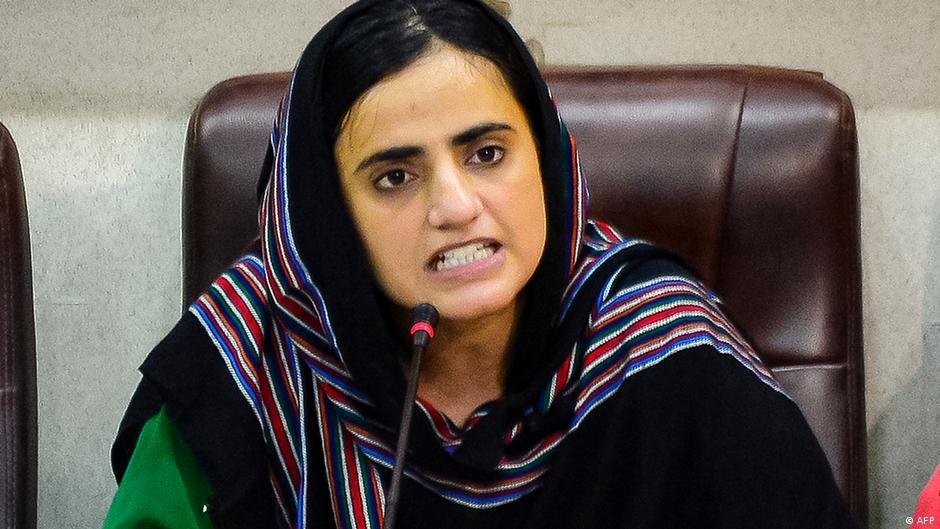
Mehrang Baloch, 33, is a prominent campaigner against alleged enforced disappearances in Balochistan and a leader of the Balochistan Unity Committee (BYC). On 25 June, he was convicted of murder and terrorism along with fellow activist Sibgatullah Shahji. Both activists boycotted the trial and have denied the allegations against them.
Baloch’s lawyer Israr Jattak said the activists would appeal the decision. Jattak recently met the couple and informed that they are in good mental and physical health.
“The court is using the law as a weapon against us. The court and the judicial system have exposed themselves through this decision,” Baloch told DW through his lawyer.
The decision was sharply criticized by human rights organizations. The Human Rights Commission of Pakistan called for a review of the decision, saying that the state “has continued its policy of treating fundamental rights advocacy in the same way it treats extremism, resulting in administrative and judicial decisions that are one-sided and biased.”
Balochistan government spokesman Shahid Rind told DW that the prosecution was conducted impartially, emphasizing that the case was supported by “undisputed evidence” and was not politically motivated.
Why was Baloch accused?
Baloch and Shahji were arrested in March 2025 and are being held in HUDA district jail in Quetta, the capital of Balochistan.
According to the prosecution, Baloch did not physically assault the paramilitary force personnel. Instead, prosecutors alleged that he incited and led a mob during the July 2024 protests in Gwadar, and that the mob attacked security personnel.
He said Shabbir Ahmed, a paramilitary soldier, got separated from his comrades and was beaten to death by the protesters.
“These charges are being used to create an environment where political dissent is criminalized and the demand for human rights is equated with hostility against the state,” Baloch said in a statement issued from jail earlier this month and posted on BYC’s official social media accounts.
From doctor to activist
Mehrang Baloch is a medical doctor turned human rights activist and a leading figure in the Baloch Yakjehti Committee (BYC), a human rights movement based in Balochistan.
His activism began when his father Abdul Ghaffar Langov was reportedly forcibly disappeared in 2009. His body was later recovered in 2011.
Since then, she has become one of the most prominent voices campaigning against alleged enforced disappearances in Balochistan and for human rights.
According to his colleagues, Baloch’s activism focused on peaceful protests, sit-ins and marches. As leader of BYC, he organized families of missing persons, organized public demonstrations, and called for justice, accountability, and dialogue through non-violent means.
unrest in balochistan
Balochistan is the largest and poorest province of Pakistan. The mountainous, mineral-rich region of the South Asian country has a dry desert climate and is sparsely populated. It is the center of the ethnic Baloch minority, whose members say they face discrimination and exploitation by the central government in Islamabad.
These tensions have fueled a separatist insurgency seeking greater autonomy, or even independence, for Balochistan and a greater share of its natural resources. He points out that despite the province having vast natural resources such as gold, diamonds, silver and copper, his community is one of the poorest in the country.
The Balochistan Liberation Army (BLA) is the strongest armed group dominated by ethnic Baloch separatist groups. BLA militants regularly target Pakistani security forces and the China-Pakistan Economic Corridor (CPEC), a billion-dollar project linked to Beijing’s Belt and Road Initiative (BRI).
For decades, efforts for autonomy or independence have faced violent repression by Islamabad.
Will this decision silence non-violent activism?
Analysts believe that Baloch’s life sentence will potentially lead to further restrictions on political debate in Balochistan.
Central BYC activist Sammy Deen Baloch said the decision could have its greatest impact on peaceful political activism, sending a troubling message that even non-violent, democratic efforts can be severely punished.
“For decades, many people in Balochistan have lost faith in state institutions and believe that peaceful struggle is ineffective. Despite this widespread skepticism, many activists have worked to promote the idea that grievances can be addressed through democratic commitment, nonviolent mobilization, and peaceful political action,” he told DW.
He said that when complaints remain unheard and peaceful avenues are blocked, support for armed resistance is more likely to grow.
Sammy Deen said, “When nonviolent activism is silenced, some people lose confidence in peaceful methods and may turn to armed groups instead.”
Dialogue at the crossroads?
S in Singapore. Abdul Basit, senior associate fellow at the International Center for Political Violence and Terrorism Research (ICPVTR) at the Rajaratnam School of International Studies, suggested that the move could worsen existing political divisions in Balochistan, further damaging trust between the state and ethnic Baloch, who already feel marginalised.
“This will definitely deepen the crisis and it is counterproductive for the state. It will push peaceful protesters towards extremism and will narrow the gap between peaceful protests and extremism,” Basit told DW.
He believes that a lasting solution cannot be achieved through security actions alone and will require genuine political dialogue and greater public trust.
“Dialogue is the only way to resolve this issue politically,” Basit said. “For Islamabad, the strategy is to create space for a political solution to counter-terrorism, but this will not be an easy task as nationalist political figures have been sidelined.”
Activist Sammy Dean agrees, but says the government’s prosecution of Baloch, whom many in Balochistan consider a peaceful activist, will complicate future efforts toward dialogue.
“If peaceful groups are continually silenced and their concerns are not addressed, people may stop trusting in political discussions, making it harder to resolve conflicts peacefully,” he said.
Edited by: Ole Tangen Jr.
<a href