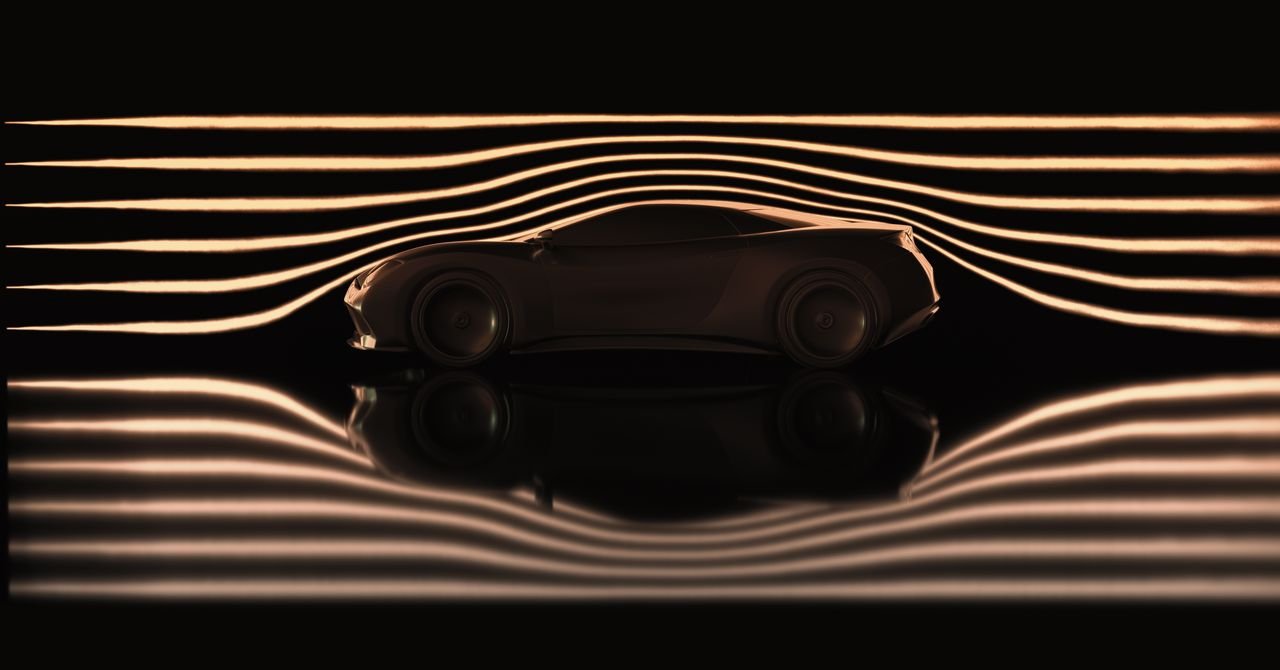
When a plane or car moves at high speed, a thin layer of air is formed on its surface called the boundary layer. This boundary layer has two states: laminar flow, in which air flows systematically, and turbulent flow, which is chaotic.
The longer the air remains in laminar-flow conditions with low friction, the less air resistance decreases, but as air speed increases, it converts to turbulent flow. The key to reducing aerodynamic drag is to delay this transformation into turbulence.
For more than 80 years, a fundamental principle of aeronautical engineering has been that an object’s surface must be smooth to reduce aerodynamic drag. The basis was based on the results of a 1940 study by Ichiro Tani, a Japanese scientist who demonstrated a relationship between surface roughness (an indicator of the condition of the machined surface) and turbulent transitions, arguing that surface roughness, which was unavoidable with the manufacturing technology of the time, prevented laminar flow from being realized.
However, in 1989 Tani reinterpreted experimental data on pipes with rough surfaces obtained by fluid engineer Johann Nicolaus in the 1930s, suggesting that “roughness does not necessarily merely promote turbulent transitions and increase fluid resistance.” (In physics, air is considered a fluid.) Inheriting this idea, a research group led by Yasuaki Kohama of Tohoku University demonstrated in the 1990s that fibrous rough surfaces, which have fine fibrous irregularities on their surface, have a transition delaying effect under certain conditions.
The same Tohoku University research team recently announced a discovery that significantly advances this idea. Aiko Yakino, Associate Professor at the Institute of Fluid Science, Tohoku University, and her research group were the first in the world to demonstrate that aerodynamic drag can be reduced by 43.6 percent by applying distributed micro-roughness (DMR), a surface roughness so fine and irregular that it cannot be detected with the naked eye.
This technology is fundamentally different from the Rivulet (“shark skin”) process, a known air-drag-reduction technology. The corrugation process mimics the fine longitudinal grooves in shark skin, and by creating grooves about 0.1 mm wide along the direction of airflow, it aligns vortices occurring near the wall surface of turbulent airflow regions. DMR, on the other hand, delays the switch from laminar to turbulent flow through random and microscopic irregularities. The flow fields it affects and the mechanisms it uses are based on completely different concepts.
Precise measurement in wind tunnel without support bars
A major factor in this achievement was the use of a new wind tunnel method. Traditional wind tunnel experiments had structural limitations: the support rods and wires required to support the model obstructed airflow, negating the minute changes in air resistance caused by micro-scale roughness.
The world’s largest 1-meter magnetic support balancing system (1m-MSBS), owned by the Institute of Fluid Science of Tohoku University, has fundamentally solved this problem. This device can blow a streamlined model approximately 1.07 meters in length inside a wind tunnel without contact using electromagnetic force. Because it does not use any support rods or other means, it completely eliminates interference with the air flow around the model.
Yakino and his team accurately measured the total drag coefficient on smooth and DMR-coated surfaces across a wide range of Reynolds numbers, from 0.35 x 10⁶ to 3.6 x 10⁶. (Reynolds number is the ratio of inertial and viscous forces within a fluid; it is a major predictor of whether the fluid flow will be laminar or turbulent.
<a href