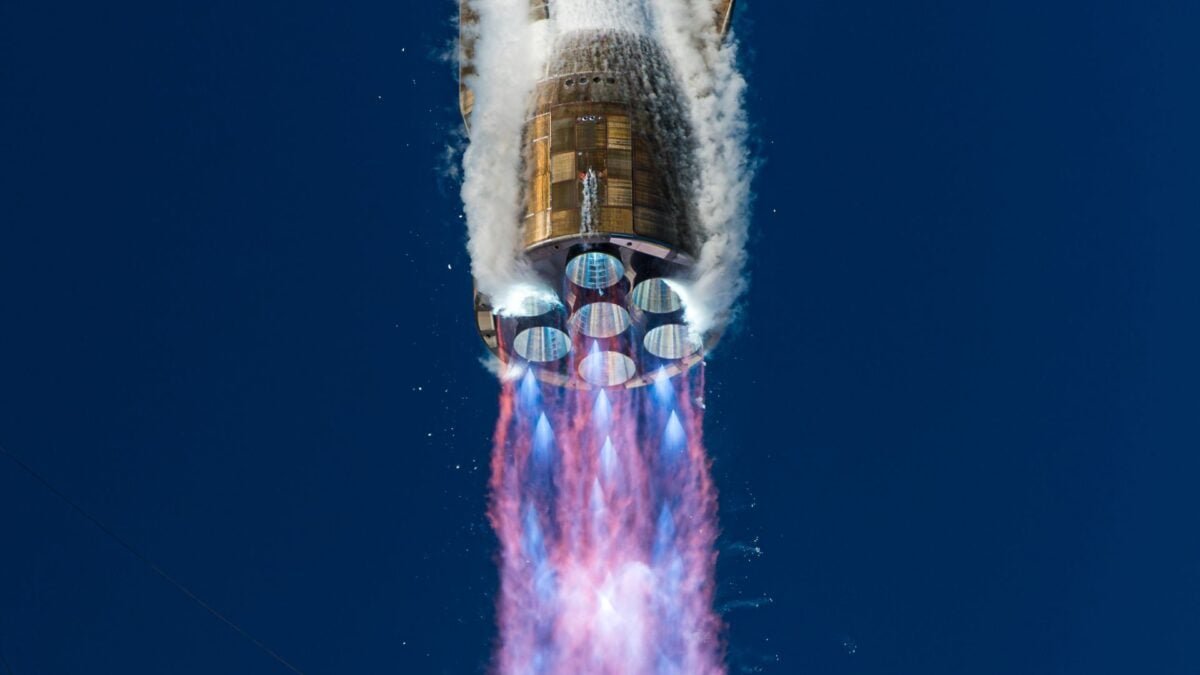

The plans were revealed in a job opening posted on the company’s website, detailing the responsibilities of a potential senior manager to oversee production of New Glenn’s upper stage, Ars Technica reports. The job posting includes an ambitious timeline to increase production to 60 by the third quarter of 2028 from the current rate of 12 second stages per year. By 2029, Blue Origin wants to be able to produce 100 new Glenn upper stages a year.
That’s a lot of rockets for the company founded by Jeff Bezos, which has faced multiple delays in getting New Glenn ready for liftoff. The rocket has flown three times since its launch in January 2025.
more rockets please
Blue Origin’s job posting refers to tank construction for Quattro, an advanced upper stage for the New Glenn rocket that will have four BE-3U engines instead of the two currently used to power the booster. The upcoming version of the New Glenn will also have nine engines in the first stage of the rocket instead of seven.
The company plans to operate both versions of New Glenn simultaneously, with the upgraded version more suitable for missions to the Moon and other deep space destinations.
New Glenn is designed to be partially reusable. The rocket’s first stage booster is designed to land on a droneship so it can be refurbished and reused, while the upper stage is currently designed to launch only once. Recently revealed production rates for New Glenn’s upper stage suggest that Blue Origin is considering increasing the rocket’s launch cadence to 60 flights per year.
aim high
Ahead of its inaugural flight in 2025, the New Glenn was in development for more than a decade, but faced numerous setbacks and delays due to technical issues. The rocket was to be launched in 2020, but the launch date kept getting postponed again and again. This led NASA to decide to remove its Mars Escapade mission from New Glenn’s inaugural mission, ultimately concluding that the rocket would not be ready in time for the mission’s launch window.
New Glenn eventually launches NASA’s twin ESCAPADE Mars probe on November 13, 2025, during its second flight. However, things did not go according to plan for its third mission. The rocket was carrying AST Spacemobile’s Bluebird 7 satellite when it lifted off from Cape Canaveral Space Force Station on April 19, but it later malfunctioned and sent its payload into a low orbit. The Federal Aviation Administration grounded New Glenn while Blue Origin investigates the crash.
While Blue Origin is looking to strengthen its rocket’s position in the heavy-lift vehicle market, there may still be a few more complications before it can prove its dependability to its customers. The New Glenn rocket’s projected production rate, while ambitious, may be a little too ambitious at this point.
<a href