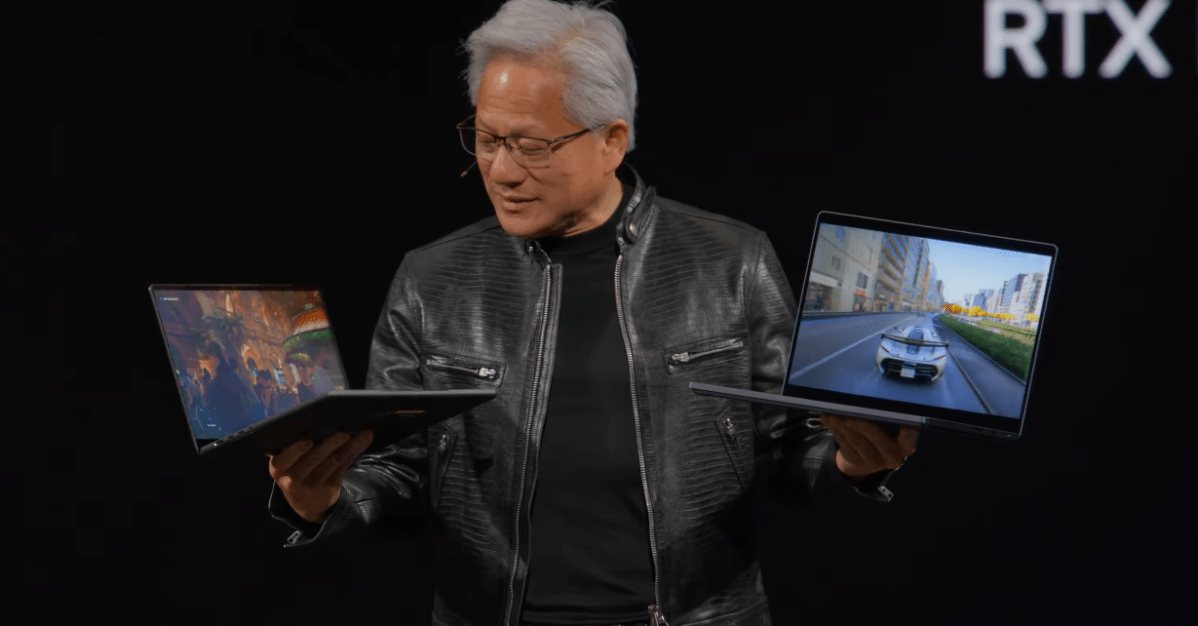
Nvidia’s announcement that it’s entering the consumer laptop chip arena with RTX Spark is huge. Apple has proven for years that Arm-based chips can perform incredibly well while providing great battery life – at least on Macs. In the Windows world, performance isn’t quite matched under Qualcomm chips, mostly in the graphics department. There’s clearly still untapped potential, and Nvidia is promising to deliver on it.
This could be the moment to surprise us with a new generation of extremely capable chips for Windows, as Apple did in 2020 with the introduction of the M1. But why does this launch in 2026 seem simultaneously exciting and terrifying?
The Nvidia RTX Spark sounds like a monster of a laptop chip: 20 CPU cores, 6,144 GPU CUDA cores, and 128GB of integrated LPDDR5X memory. Its integrated graphics are said to be on par with an RTX 5070 laptop GPU — though Nvidia didn’t reveal anything specifically about performance metrics or actual benchmarks. As my colleague Sean Hollister pointed out, it’s basically a GB10 chip from Nvidia’s DGX Spark mini-PC. Nvidia calls it a “superchip” and “the most efficient PC chip ever built,” while Microsoft is touting its Spark-equipped Surface Laptop Ultra as “the most powerful thing we’ve ever made.”

It shouldn’t surprise anyone that Nvidia CEO Jensen Huang spent most of his time introducing the RTX Spark laptop talking about AI and agents. Much of the two-hour Nvidia keynote was about agents and “CPUs for agents,” which Huang said is Nvidia’s “new key growth driver.” But beyond the local AI calculations that RTX Spark laptops will be capable of, they’re also being aimed at creators. Adobe is also onboard with optimized versions of Photoshop and Premiere.
It’s Nvidia, Microsoft and Windows laptop makers taking aim at Apple’s MacBook Pros. It is not clear yet Who MacBook Pro (M5, M5 Pro, or M5 Max), but it looks like these laptops will be expensive. The lineup announced so far for the fall includes the Surface Laptop Ultra, Dell XPS 16, Asus ProArt P14 and P16, Lenovo Yoga Pro 9n, MSI Prestige N16 Flip AI Plus, HP OmniBook Ultra and OmniBook X14, and unnamed models from Acer and Gigabyte. Existing or similar models in this lineup generally start at $2,000 to $2,500 and above (apart from some of the more modest configurations of the OmniBook X).
This isn’t surprising considering the RTX Spark has 128GB of RAM. If you look at AMD’s Strix Halo APU with 128GB of RAM – the closest analog to the RTX Spark but built on x86 – you have options like Asus’ ROG Flow Z13 for an MSRP of $3,300 and the ProArt PX13 GoPro Edition for $3,000. That Nvidia DGX Spark desktop is the one with the GB10 chip on which the RTX Spark is based? One of them costs about $4,700. So how much do you think a Spark laptop with 128GB memory will cost? Too Add things like a keyboard, trackpad, battery, and 15-inch mini LED touchscreen?

Nvidia said there will be RTX Spark chips with smaller amounts of RAM, but thanks to Ramageddon, many laptops with 16GB or 32GB of memory are also getting expensive – especially when new models come out.
Nvidia could have demolished everything else in the performance department when these laptops arrived in the fall, but the difference between this and Apple’s M1 moment was that Apple started with the cheapest MacBook Pro as well as the more affordable Mac Mini and MacBook Air. This meant the average buyer was able to feel the benefits immediately, and lots of early sales also meant early incentive for developers to prioritize adding support for new chips. It took almost another year for Apple to catch up with the revived MacBook Pros with the M1 Pro and M1 Max.
Nvidia isn’t aiming for an M1 moment as much as it is trying to get to an M1 Max or even an M1 Ultra moment. And this is being done at a time when computers are becoming increasingly expensive and consumer spending power is declining. That’s why the MacBook Neo took the tech world by storm with its price of $599. Is the same at $2,499?

When these new laptops arrive in the fall, they will be Four Viable chip options across a range of Windows laptops: Intel, AMD, Qualcomm, and Nvidia. It’s already nice to have three options: AMD options generally offer great performance at the expense of some battery life, Qualcomm offers the absolute best battery life and standby time but sadly game support is poor, and Intel is often a balanced option that maintains full x86 compatibility.
With Nvidia in the mix on Arm, we may get another option with stronger battery life and a lot more graphics power. There’s also at least a chance that gaming on Arm will get closer to parity with the wide compatibility that x86 Windows gamers are accustomed to. Microsoft and Nvidia are using Riot Games to port their anti-cheat software to Arm for games like valiant And League of Legends And working with other developers using EZ Anti-Cheat, BattleEye, and Denuvo is a big win for Windows on Arm.
I’d love to see more competition, because it’s nice to have all this choice. The latest chips from Intel, AMD and Qualcomm are great in their own ways. I welcome the Nvidia option which performs well and has exceptional battery life but doesn’t lack games like the Mac. But even if the RTX Spark heralds a massive change, the rising tide of prices is sure to drive many away.
<a href