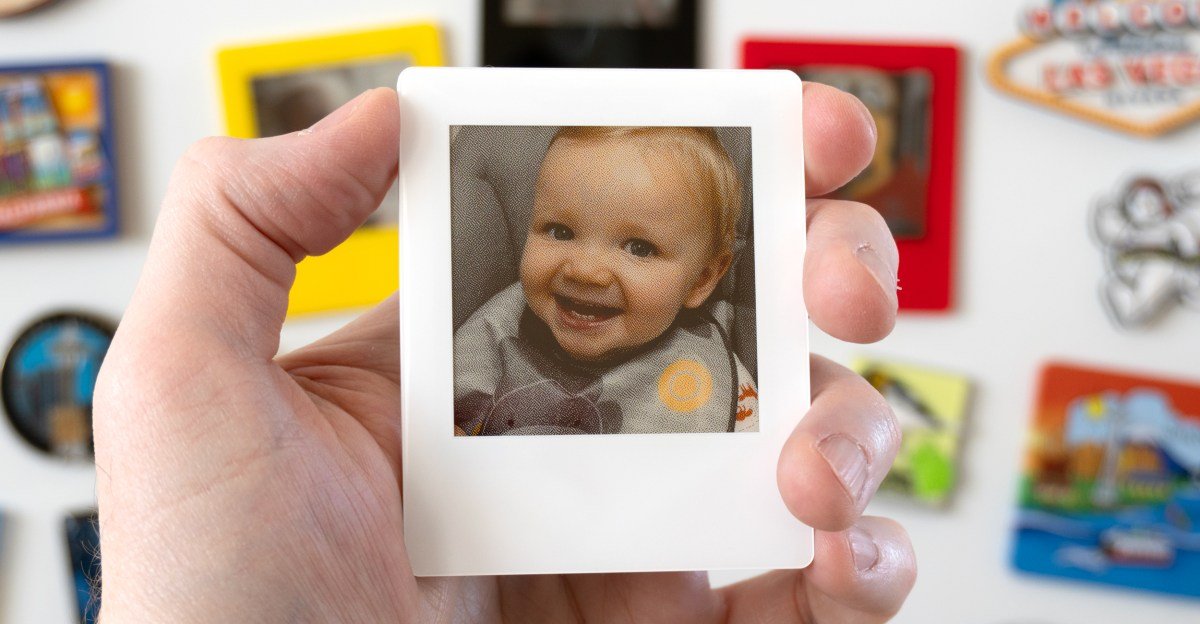
I love when my friends have their fridges covered in Polaroids. It’s often a visual crash course of what’s going on in their lives, describing recent adventures, get-togethers, and other fun moments. But I don’t like the idea of lugging around a useless instant camera or paying a premium for instant film with hit-or-miss results. That’s why I’m impressed by these magnetic digital polaroids from a little company called VidaBay. They look like instant photos, but use NFC technology and color E Ink screens so you can change the image as often as you want without charging the battery.
At about 4 mm thick and 2.5 inches in size, the Vidabay NFC e-Paper Fridge Magnet – also known as the Snap – reminds me of Xteink’s tiny X3 e-reader, but it has no buttons, ports, or connectors. The Snap Aura Ink is like a much smaller version of a digital photo frame that you can stick on your fridge.
The Snap uses the same kind of NFC chip that doubles as your smartphone as your credit or debit card. Images are transferred wirelessly by aligning your smartphone’s NFC antenna with the antenna located inside the bottom left corner of the Snap using the accompanying mobile app.
It takes about 25 to 30 seconds for Snap to change the displayed photo. While the actual image transfer is a 10-second process, the rest of the time is used to refresh the Snap’s E Ink screen. Unlike devices like the Kindle ColorSoft, which use a black and white e-paper screen with colored filters so that screen refresh is almost instant, the Snap uses e-paper with multiple colored pigments that take longer to refresh. The results are looking better, but you’ll have to wait a little longer for them.
The process of updating a Snap with a new image using NFC is easy once you get the hang of it, but it may take a few tries to get there. Out of the box the device comes with a plastic screen protector printed with a guide so you know how to position your smartphone to ensure the NFC antennas line up. But the guide only works for iPhone. Android is also supported, but it depends on where your device’s NFC chip is located, which may take some trial and error. The Snap and your smartphone also have to be very close for NFC pairing to work – much closer than a case will allow. This process didn’t work with my iPhone 16 Pro inside the leather Nomad case, and even the thin silicone case protecting my OnePlus 12 was too thick for the NFC transfer to succeed.
One of the many advantages of E Ink’s display technology is that, similar to Etch A Sketch or Magna Doodle toys, once an image is created it remains on the screen without any additional power. This is why e-readers have such excellent battery life. The Snap comes with a 2.5-inch E Ink screen, and while it uses the color technology you’ll find in large, vibrant and expensive E Ink posters, it’s actually a repurposed Spectra 3100 screen that E Ink developed specifically for retail use as electronic shelf labels.
They’re cheap, but the Snap’s color screen is also limited to displaying only black, white, red, and yellow, which limits its ability to reproduce colors accurately. This is a big compromise, but not necessarily a dealbreaker. The VidaBay mobile app lets you crop, zoom, rotate, add filters, and make basic brightness, contrast, and color saturation adjustments to images selected from your phone’s camera roll. Because the transfer process can take more than 30 seconds, the app also produces a preview of how the image will look on Snap’s four-color screen.
After using the Snap for a few weeks, I have a better idea of which images will look good on its E Ink screen and which won’t. Bright photos with a lot of contrast work well, as do photos with a color palette leaning toward reds and yellows. The blue and green areas in an image become completely desaturated rather than disappearing, but the results are not entirely unpleasant. The limitations of the Spectra 3100 screen result in truly colorful images reminiscent of the lo-fi aesthetic of classic Polaroid photographs.
The Snap has no screen lighting so it looks best in a well-lit area. The device also has a non-removable plastic cover over the E Ink panel, which protects it but also produces a lot of glare and reflections. Removing this for future versions would definitely improve viewing angles and image quality.
At $35.99 each (currently discounted to $29.99), the Widabay Snap comes close to impulse buy territory. When I first covered them earlier this year I was skeptical about how effective the screens many grocery stores now use to display prices could be for displaying photos and memories. But the price, and the fact that the Snap never needs charging, more than outweighs its color fidelity limitations. Instant photos may still be cheaper per shot, but Snap is a good alternative if you don’t have an endless budget for film. Either way, your fridge is a blank palette just waiting to be decorated with memories.
Photography by Andrew Liszewski/The Verge
<a href