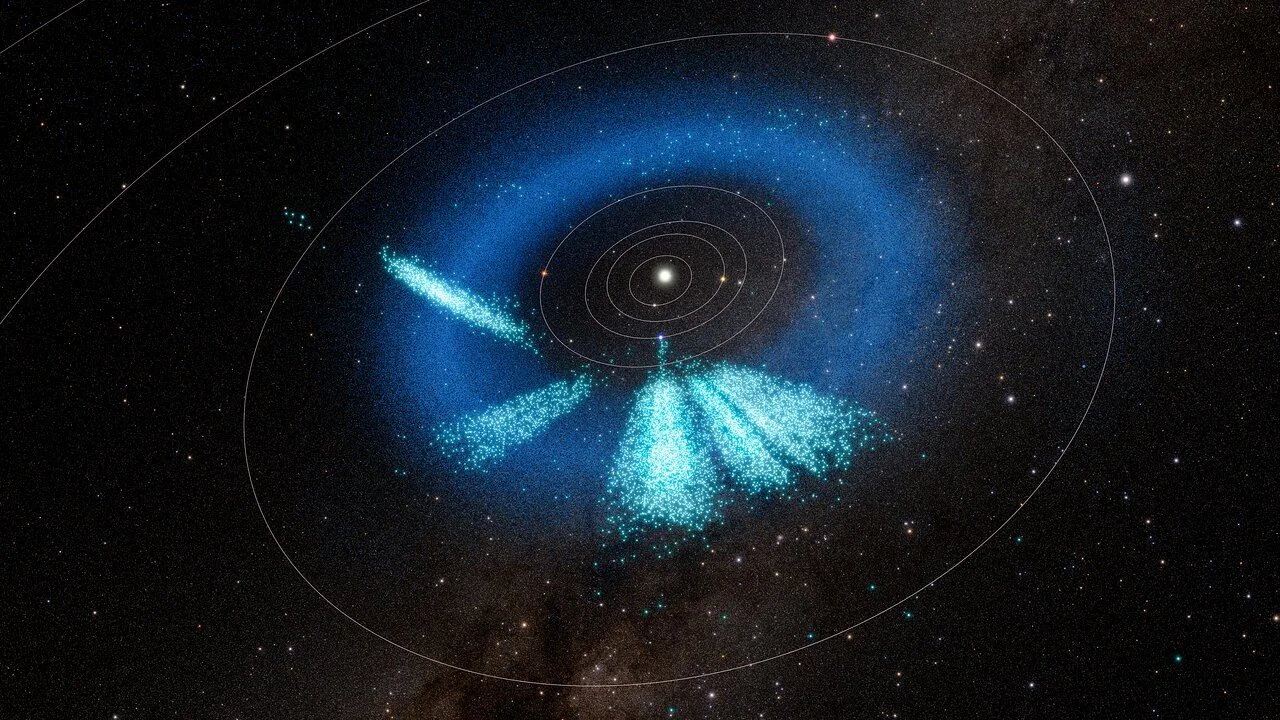
This is the largest single batch of asteroid discoveries in the past year. These discoveries were the result of 1 million observations lasting a month and a half, which included more than 11,000 new asteroids and more than 80,000 previously known asteroids. The new data was acquired as part of Rubin’s early optimization surveys and is a testament to Rubin’s sophisticated instruments. It also offers a preview of the impact Rubin will have on solar system science when the LSST mission launches next year.
University of Washington faculty member and Rubin Solar System principal scientist Mario Juric explained in an official press release:
This first major submission since the Rubin First Look is just the tip of the iceberg and shows that the observatory is ready. What used to take years or decades to discover, Rubin will discover in months. We are beginning to fulfill Rubin’s promise to fundamentally reshape our catalog of solar systems and open the door to discoveries we have not yet imagined.
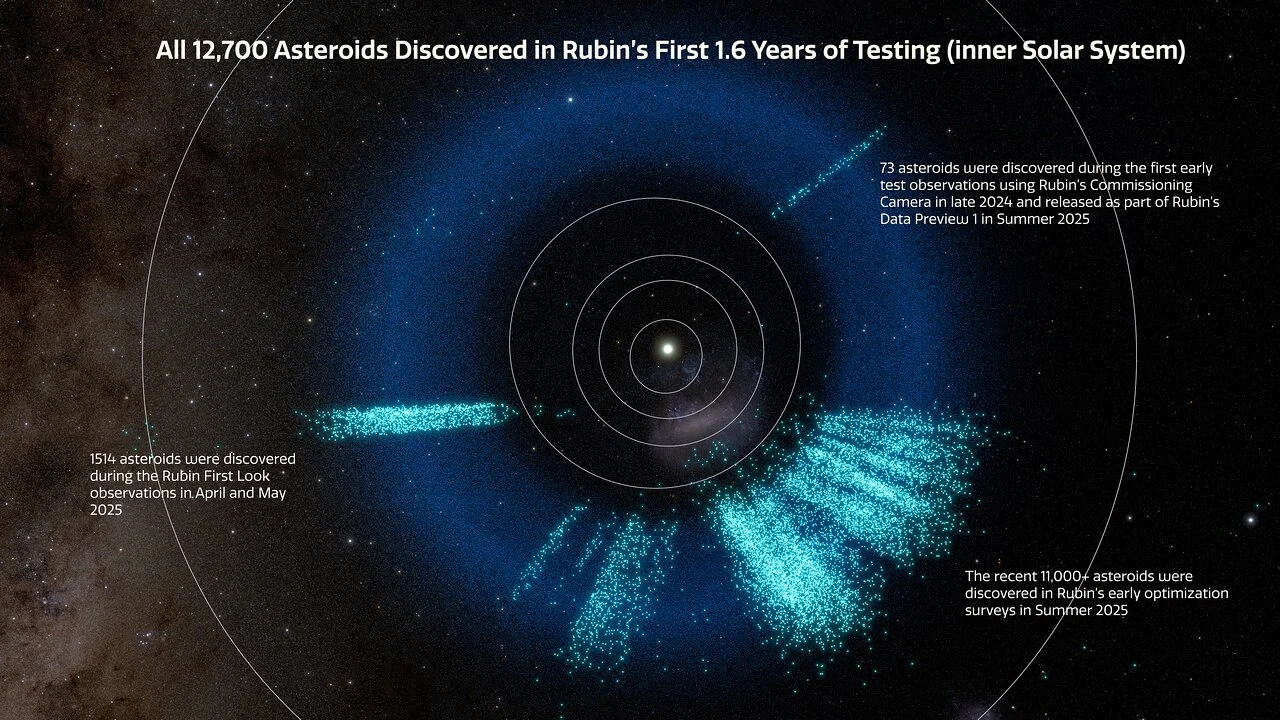 *A rendering of the inner Solar System, showing the asteroids discovered by Rubin in light teal. Known asteroids are dark blue. Credit: NSF-DOE Vera C. Rubin Observatory/NSF NoIRLab/SLAC/Aura/R/NASA/Goddard/ESA/Gaia/DPAC*
The dataset includes 33 previously unknown near-Earth objects (NEOs), the largest of which has a diameter of approximately 500 meters (1640 ft). This is especially important because some NEOs are classified as potentially hazardous objects (PHOs), which could impact Earth in the future. None of the newly discovered objects pose a threat to Earth. Once fully operational, Rubin is expected to reveal about 90,000 new NEOs, doubling the number of known NEOs larger than 140 m to about 70%, some of which may be PHOs. This would make Rubin an important part of planetary defense.
The dataset also includes approximately 380 trans-Neptunian objects (TNOs), two of which have very large, elongated orbits. At their farthest point (periapsis), both of these objects (provisionally designated 2025 LS2 and 2025 MX348) are about 1000 times further from the Sun than Earth. This places them among the 30 most distant minor planets known. The newly discovered objects are a significant addition to the 5,000 TNOs discovered over the past three decades, representing a significant advance in the study of these icy, distant objects.
Former MPC director Matthew Holman, a senior astrophysicist at the Harvard & Smithsonian Center for Astrophysics (CfA), led the work on the TNO discovery pipeline. “Searching for TNOs is like searching for a needle in a haystack – out of millions of twinkling sources in the sky, teaching a computer to sift through billions of combinations and identify those that are likely to be distant worlds in our solar system requires novel algorithmic approaches,” he said.
With Kevin Napier, a research scientist at CFA, Holman developed algorithms to detect distant Solar System objects with Rubin data. He added, “Objects like this offer an exciting probe into the outermost reaches of the Solar System, telling us how planets began to form in the Solar System’s history, and whether a hitherto undiscovered 9th giant planet might still be out there.”
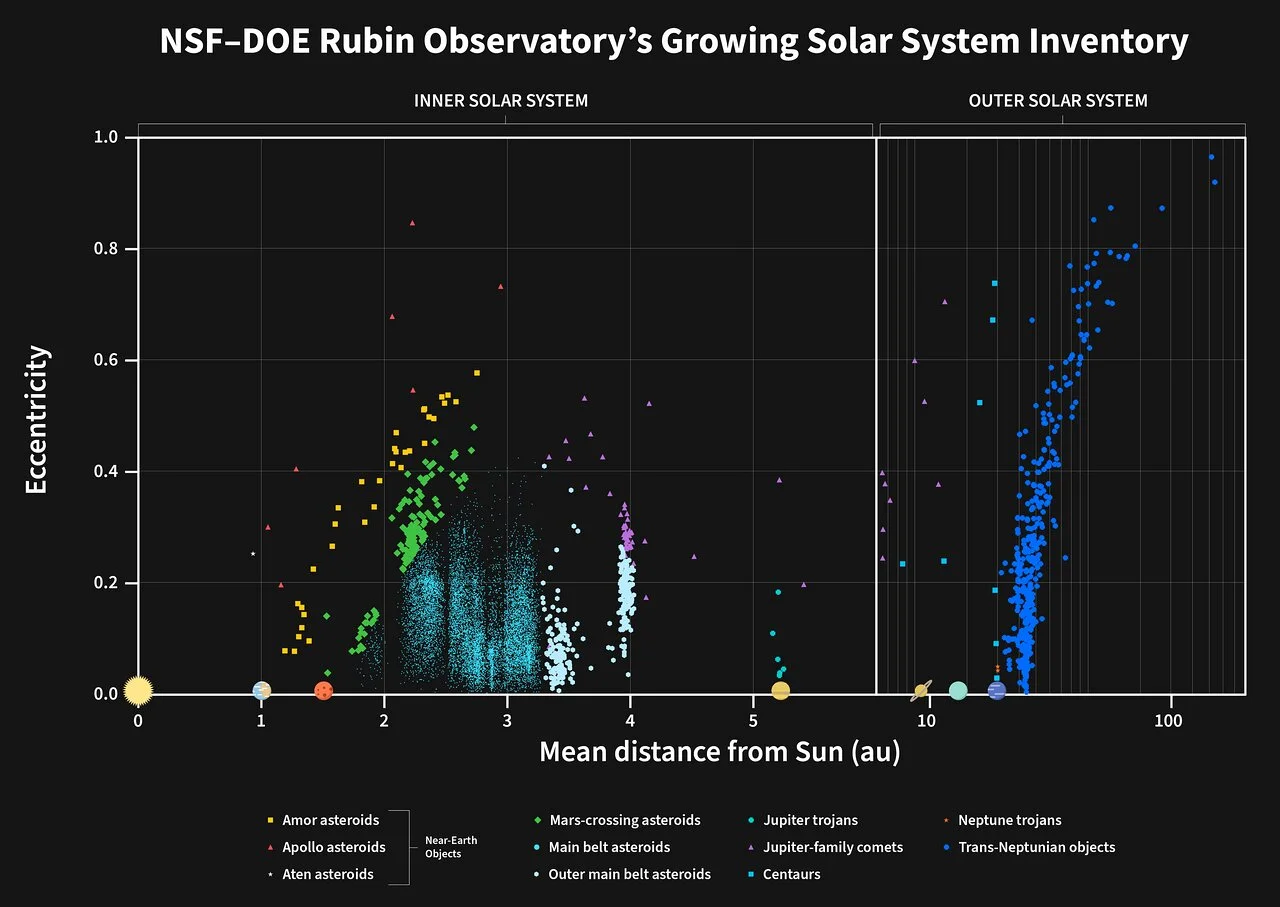 Orbital distribution of 11,097 newly discovered asteroids from the NSF-DOE Rubin Observatory’s Initial Adaptation Survey. Credit: NSF-DOE Vera C. Rubin Observatory/NSF NoIRLab/SLAC/Aura/R/NASA/Goddard/ESA/Gaia/DPAC*
Ari Heinz, a research assistant at the University of Washington, teamed up with Jacob Kurlander, a graduate student at the University of Washington, to create software that made it possible to track them. As he noted:
Rubin’s unique observing rhythm required a whole new software architecture for asteroid discovery. We built it, and it works. Even with early, engineering-quality data, Rubin discovered 11,000 asteroids and measured the more precise orbits of thousands more. It seems clear that this observatory will revolutionize our knowledge of the asteroid belt.
The MPC’s validation of this large group of asteroids also means that the entire scientific community can access the data, refine the orbits, and begin analysis immediately. And these discoveries are just the beginning, considering that LSST hasn’t even launched yet! During this ten-year survey, scientists expect Rubin to discover this many asteroids every two to three nights for the first few years. This would triple the count of known asteroids and increase the number of known TNOs by about 10 times.
The discovery was made possible by Rubin’s unique combination of a large mirror, his LSST digital camera (the largest ever built), and highly sophisticated software. These capabilities, combined with advanced data pipelines, are enabling the detection of faint, fast-moving objects in our solar system. Rubin can survey the sky with about six times more sensitivity than most current asteroid searches, allowing it to detect smaller and more distant objects than ever before. This will improve our understanding of the Solar System and its evolutionary history.
People are encouraged to visit the Rubin Orbitviewer site and Small Body Explorer to learn more about the newly discovered asteroids and interact with them virtually.
Further reading: Rubin Observatory
<a href