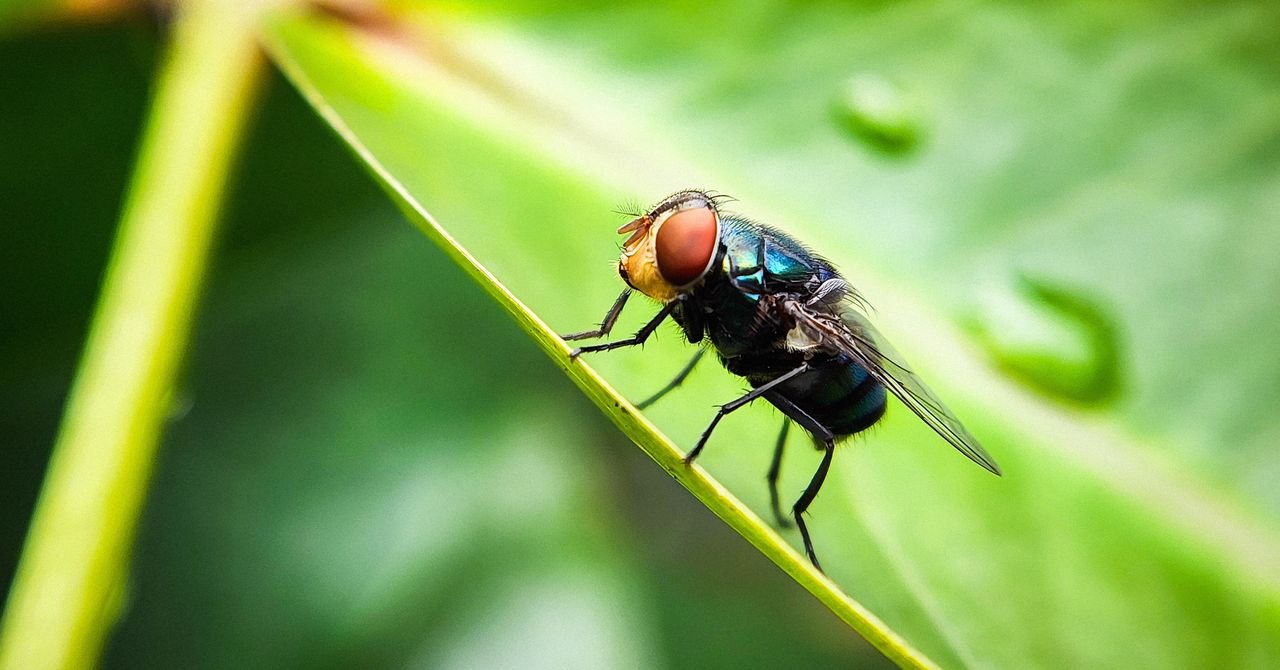
Extirpated in the US in 1966 and as far south as Panama by 2006, its recent reemergence in Mexico makes it likely that the screwworm will eventually re-enter the country, with modeling suggesting this could happen as soon as the summer of 2025. It took a little longer, but the screwworm is here. And to prevent an outbreak, officials are using a tried-and-true technique: releasing lots of adult screwworm flies.
Screwworm infection occurs when female flies lay their eggs in open wounds or other body parts of warm-blooded animals. When the eggs hatch, maggots emerge and feed on living tissue before turning into flies. As adults, screwworm flies do not bite or eat flesh. In the 1930s and 1940s, scientists thought that if they could stop female flies from reproducing, they could break the cycle. At that time, New World screwworm killed hundreds of thousands of cattle annually, mostly in the American South and Southwest.
In the 1950s, USDA researchers made a breakthrough when they applied radiation to male screwworms and rendered them sterile. When released into an infested area, the sterile males mate with wild female insects and lay non-viable eggs. No children are born and the population decreases. Known as the sterile insect technique, it was first used successfully on the island of Curaçao, off the coast of Venezuela. It took only seven weeks to eradicate the pest, and the effort saved the goat herds on the island that were an important food source.
The technique takes advantage of the fact that female New World screwworms only mate once in their lifetime. “The sterile insect technique is probably the most spectacular example of a completely successful biological control mechanism,” says Sally DeNotta, associate professor of veterinary medicine at the University of Florida. “The life cycle stops. No offspring are born. It has been very successful.”
For years, the dense expanse of rainforest between Panama and Colombia known as the Darien Gap served as a biological barrier where sterile flies were released to prevent the northward spread of screwworms. But in 2022, insects started breaking the barrier.
To stop the outbreak in South Texas, the USDA has closed off about a 12-mile area around infected calves and is using targeted releases of sterile screwworm flies from trucks. This is in addition to the 4 million sterile flies already airdropped per week into the region. Anticipating screwworms moving north, in February, the agency shifted its efforts to disperse 100 million sterile flies per week to focus on the area along the U.S.-Mexico border.
“Although this development poses a serious threat to our livestock and wildlife, it should not cause us concern,” USDA Secretary Brooke Rollins said during a House Agriculture Committee meeting Thursday.
He said about 400 million flies per week were required to defeat back screwworm. Currently, the US can only produce about 100 million flies per week in a facility located in Panama.
A sterile insect facility in Mexico closed in 2012, but USDA is investing $21 million to help renovate and convert an existing fruit fly facility in Metapa, Mexico to produce an additional 60 to 100 million sterile flies per week. According to the USDA, the facility is expected to be operational this summer.
<a href