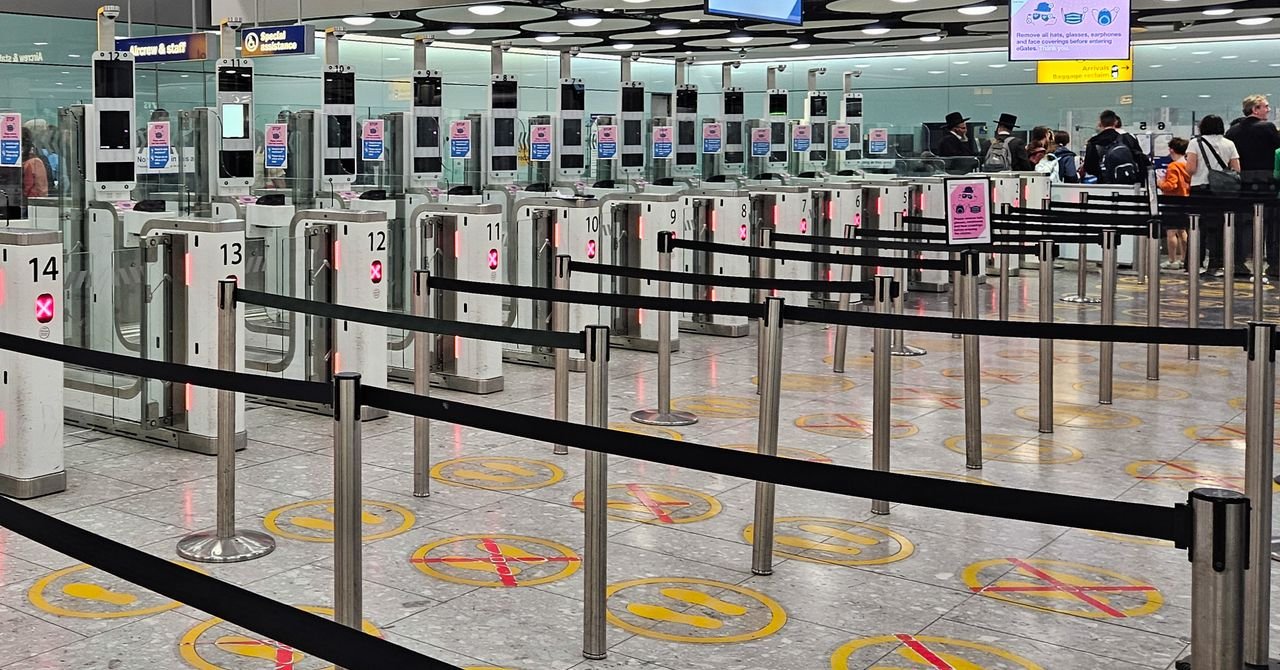
While the Home Office says face scanning is designed as an “additional” tool for border officers and will not “replace or overrule human judgment”, it did not answer questions about how it plans to use the technology in real-world environments. “In cases of uncertainty,” the spokesperson says, “individuals will always be treated as children until further evaluation.”
expansion of estimates
The UK government first announced its plans to use facial age assessments along with border staff decisions to assess migrants in July 2025. Since then, the Home Office has delayed the rollout of the system until 2027, saying it would use “cutting-edge AI technology” to “crack down on fraudulent claims”, with the aim of stopping “adults attempting to cheat the system”.
Over the past five years, AI face scans have emerged as a key component of controversial online age verification programs, as lawmakers have mandated social media platforms, porn websites, and some retailers to check the age of their users. It has also been tested at some bars and shops in Britain. Facial age estimation works by analyzing someone’s facial features – with underlying systems trained on millions of age-labeled faces – to produce an estimated age. In controlled laboratory tests, the best algorithms can tell a person’s age to within about 2.5 years.
However, results can vary significantly depending on the algorithm, a person’s gender, demographic details and other factors. Poor quality images, such as poorly lit images, can substantially degrade system performance. (An example: people have tricked some systems by using images of video game characters.) It appears that the Home Office is aware of the potential problems with the technology and is still pushing ahead with its programme.
The leaked Home Office report, prepared in April 2025 and completed before the government purchased face-scanning technology, details testing of seven FAE algorithms against more than 2.5 million images. However, the internal report said there were “substantial deviations” in the unnamed “best performing algorithms” when tested on images of sub-Saharan Africans. On average, that system also predicted that a 17-year-old would outlive an 18-year-old, and it performed worse on women.
Thousands of people make asylum claims in Britain each year, many of whom arrive in the country after dangerous, physically demanding journeys in small boats crossing the English Channel. Currently, border personnel who suspect the age of someone claiming to be under 18 may assess their physical appearance, responses to interview questions, and general behavior to make a preliminary judgment about their age. These initial age estimates are made at the “first visit”, the Home Office guidance says. According to official figures, since 2010, 40 percent of people facing age assessment have been classified as adults.
The leaked Home Office report said its findings were based mainly on testing that used high-quality images taken from documented people, and could mean the algorithm’s accuracy rates would be worse in practice. The Home Office has indicated that the FAE technology will assist immigration officers who are assessing age when working at the point of first encounter.
<a href