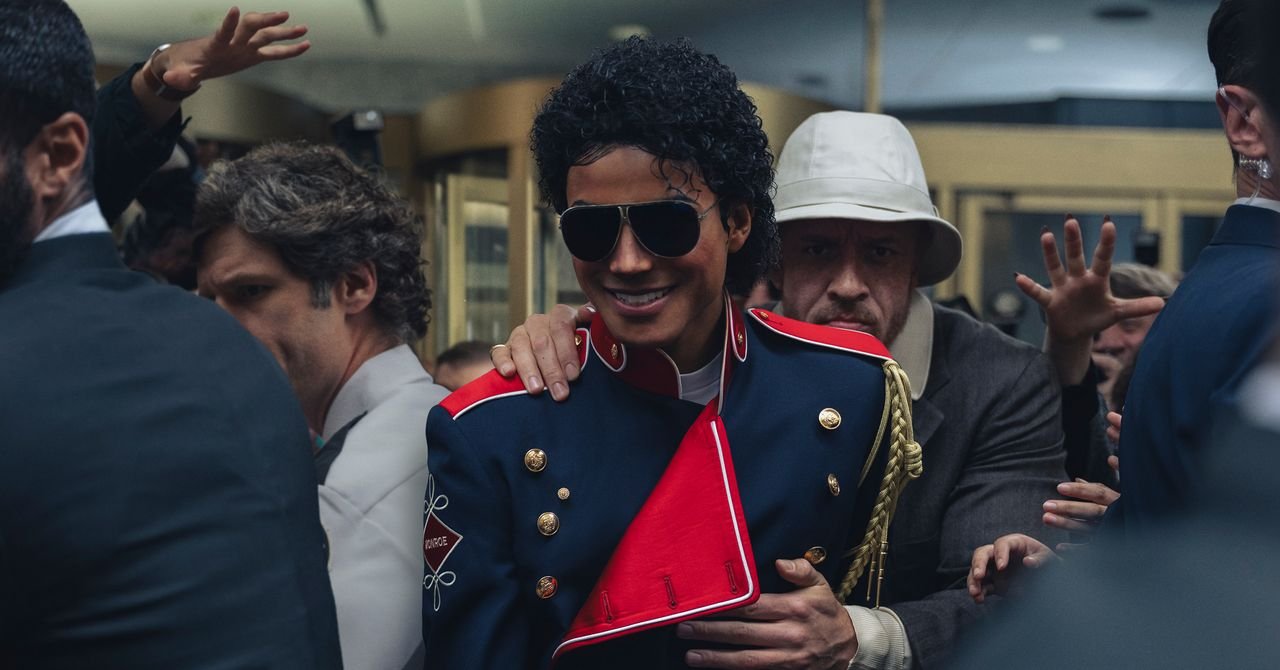
If this is the case, michael-A new film about pop singer Michael Jackson, which is on track to have the biggest opening ever for a music biopic with an estimated $70 million at the US box office, despite critics saying it glosses over the reality of who Jackson really was – intends to take the King of Pop’s place as a symbol of artistic virtuosity.
The film’s release has sparked an online civil war between those wanting to reclaim Jackson’s music and myth, and those wanting to see any celebration of him as a failure of accountability.
Musically, Jackson was in a class of his own. In pre-social media days, before AI artists charted on billboards and he became an online meme, Jackson was the epitome of monoculture: 13 number one singles, countless awards, twice inducted into the Rock and Roll Hall of Fame. Even after his death, he remains one of the best-selling music artists of all time. But his legacy was also defined by multiple allegations of sexual abuse, a sometimes eccentric personal life, and Jackson’s on-record admission of sharing beds with underage boys. “This guy was worse than Jeffrey Epstein,” director Dan Reed leaving neverlandThe 2019 Emmy-winning HBO documentary about Jackson’s alleged sexual misconduct was recently reported to The Hollywood Reporter.
Director Antoine Fuqua, who maintains Jackson’s innocence, never intended to completely avoid the allegations that would be leveled against Jackson later in life. According to him, the basic cut of michael It includes a re-enactment of the 1993 police raid on Neverland Ranch, where Jackson’s first accuser, Jordan Chandler, was strip-searched to verify his physical description. But the scene was ultimately deleted along with the entire third part of the film – reshoots cost a total of $15 million – because there was a legal clause in the agreement with Chandler that prohibited the depiction of his experience on screen.
The result is a film that stops abruptly in 1988 and erases the most controversial two decades of Jackson’s life. Instead, the film emphasizes Jackson’s musical legacy – the story’s plot is structured around career-defining musical moments, such as the making of the “Thriller” video – over the more controversial aspects of his personal behavior.
Scrutinizing the Neverland Ranch scene, but also choosing to write entirely about any alleged misconduct by Jackson, is not surprising, given that the Jackson estate had approval over the use of his music, essentially granting it veto power over the final cut of the film. One argument that keeps coming up on social media is that critics should judge michael On their own terms, rather than what they think it should have been. “It seems like people wanted a movie [that] It was never supposed to exist,” said one X user. “So it was never supposed to be erotic or introspective”
Jackson’s fans argue that the allegations should not eclipse his musical and artistic legacy, thereby sidelining the artist from work, while critics say that a biopic should present a complete picture of Jackson, no matter how unflattering that picture may be. As film critic Shawn Burns put it on X, it ended “with the release of Bad Winning the Heisman is like the end of the OJ biopic.” Artist Harmony Holliday wrote that a good Michael Jackson movie would be “part tragedy, part sham,” drawing attention to how the film lacks the real kind of interiority that made Jackson so polarizing.
Critic Alison Wilmore said in Vulture, “Watching it feels more like being frog-marched through a wax museum than watching a movie, with each milestone resembling a bizarre, uncanny-canyon and no interiority.”
<a href