
Newman, who is 98, has served on the U.S. Court of Appeals for the Federal Circuit since 1984. Established in 1982, the Federal Circuit hears appeals in cases involving international trade, patents, trademarks, veterans’ benefits, and money claims against the U.S. government.
During his more than four decades on the Federal Circuit, Newman has written more than 300 dissenting opinions, earning him the nickname “The Great Dissenter.”
But three years ago, the Judicial Council for the Federal Circuit, which consists of circuit judges in active service, suspended Newman from hearing cases. The court’s chief justice, Kimberly Moore, also told Newman she could either retire or consider senior status, a form of semi-retirement in which judges are assigned lighter cases.
After Newman refused either option, Moore entered an order identifying a judicial complaint against the then-96-year-old judge and finding that “there is probable cause to believe that Judge Newman’s health has left him without the capacity to serve as an active judge and that his habitual tardiness is prejudicial to the efficient administration of justice.”
Bill O’Leary/The Washington Post via Getty Images 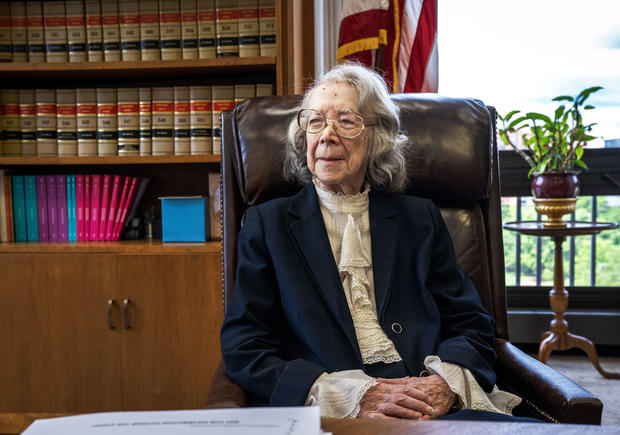
Moore’s filing cited health problems Newman faced in the summer of 2021 and a fainting spell in 2022, and said Federal Circuit judges and staff had expressed concerns about Newman’s inability to handle his workload.
A special committee of Moore and two federal circuit judges examined Newman’s fitness to continue serving and ordered the judge to submit to neurological and neuropsychological testing. The panel also requested him to hand over medical records and attend an interview.
While Newman provided expert reports from two doctors, the committee recommended that Newman “not be allowed to hear any cases” for a year, subject to renewal. The Judicial Council approved the recommendation in September 2023.
Newman asked a panel of the Judicial Conference of the United States, the policy-making body for the federal courts, to review his suspension, although it rejected his arguments in February 2024.
The Federal Circuit renewed Newman’s suspension for another year in September 2024 and again in August 2025.
Amidst his suspension, Newman filed suit in the Federal Circuit against Moore and his associates, seeking to block the Judicial Council from taking action against them in the future. The judge argued that the panel violated the Constitution by effectively removing him from office despite the protection of lifetime tenure and denied him due process.
The U.S. Court of Appeals for the District of Columbia Circuit ultimately ruled against Newman, finding that the Americans with Disabilities Act prevents plaintiffs from bringing certain constitutional challenges to the authority of the Judicial Council.
Urging the Supreme Court to take up her case, Newman’s lawyers claimed that Moore was bypassing the Constitution’s protections for federal judges in an effort to sideline a judge she did not want to work with. He also accused federal circuit judges of trying to silence a colleague who frequently dissents.
“The administrative removal of a judge who is famous for disagreeing with his colleagues, coupled with a judicial refusal to review the merits of actions by those same colleagues, undermines the judicial independence that is a vital cornerstone of our constitutional design,” Newman’s lawyers wrote in a filing. “Every judge who has differences of opinion with his Chief Justice or his colleagues must now worry whether similar tactics could be used to remove them.”
The Justice Department, which represented Moore and the other justices, urged the Supreme Court to dismiss Newman’s case.
The New Civil Liberties Alliance, which is representing Newman, said it was disappointed by the high court’s rejection of the appeal, but said it would continue to push for his reinstatement.
“This is a dark day for the independence of the federal judiciary,” Mark Chenoweth, the group’s president, said in a statement. “The certiorari denial in this case means that Judge Newman’s due process and other complaints about the way Chief Judge Moore and the Federal Circuit Judicial Council have treated them will never receive a merit decision from an Article III court. This is completely inexcusable and truly inexcusable.”
<a href=