Last year, the first few months of data from the US grid suggested that feared data-center-driven demand growth was becoming reality. Demand rose nearly 3 percent, leading to a rise in coal, interrupting a long-term declining trend. But during the year, both trends slowed significantly.
A year later, it all seems to be a thing of the past, as the US has returned to its usual pattern: slow growth, renewables driving coal out of the grid. One oddity is that hydroelectric production has increased without a corresponding increase in capacity, possibly due to unusually warm weather in the western US that has caused the snow cover to melt early. There may be consequences at the end of the year.
push out fossil fuels
Aggregate demand in the US in the first quarter of 2026 grew only 1.5 percent compared to the same period a year earlier. Often, demand changes during this part of the year are driven by weather-related heating demand. But the US had an unusual combination of weather conditions for the start of 2026, with the western half sweltering in unseasonably warm temperatures while the eastern half faced a deep freeze. So we’ll probably need data from more of the year before we know much about the modest increase in demand we’ve seen so far.
As has been the case for some time, the biggest trend on the US grid was the growth of solar power. Compared to the same quarter a year ago, solar power grew by 24 percent. By itself, this was enough to meet 80 percent of the growing demand. Overall, production of major renewable energies (wind, solar and hydroelectric) increased by 11 percent compared to the same period last year, or about 1.8 times the increase in demand.
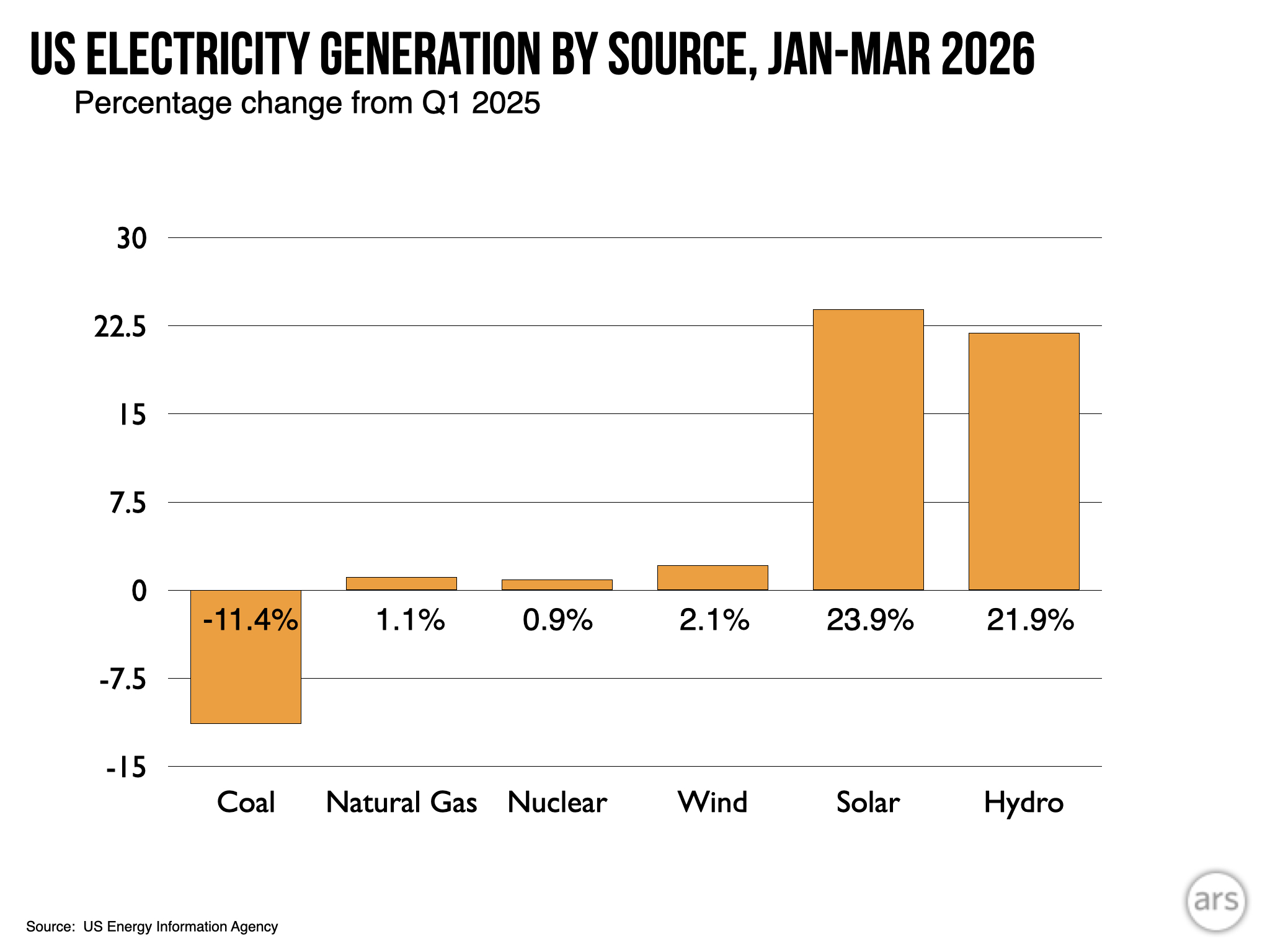
Wind and hydro are up, coal is down compared to the same period a year ago.
Credit: John Timmer
Wind and hydro are up, coal is down compared to the same period a year ago.
Credit: John Timmer
Given that renewable growth far exceeds demand, there was nowhere for fossil fuels to go but decline. Overall, they found a decline of about 3 percent year-over-year, with the absolute change being similar in magnitude (if not sign) to the increase in demand. But natural gas use actually increased slightly in the first quarter, which meant coal suffered even more, with its use falling by more than 10 percent. This may change as global natural gas prices rise due to the Persian Gulf conflict, but this was not yet a major factor in this data.
<a href