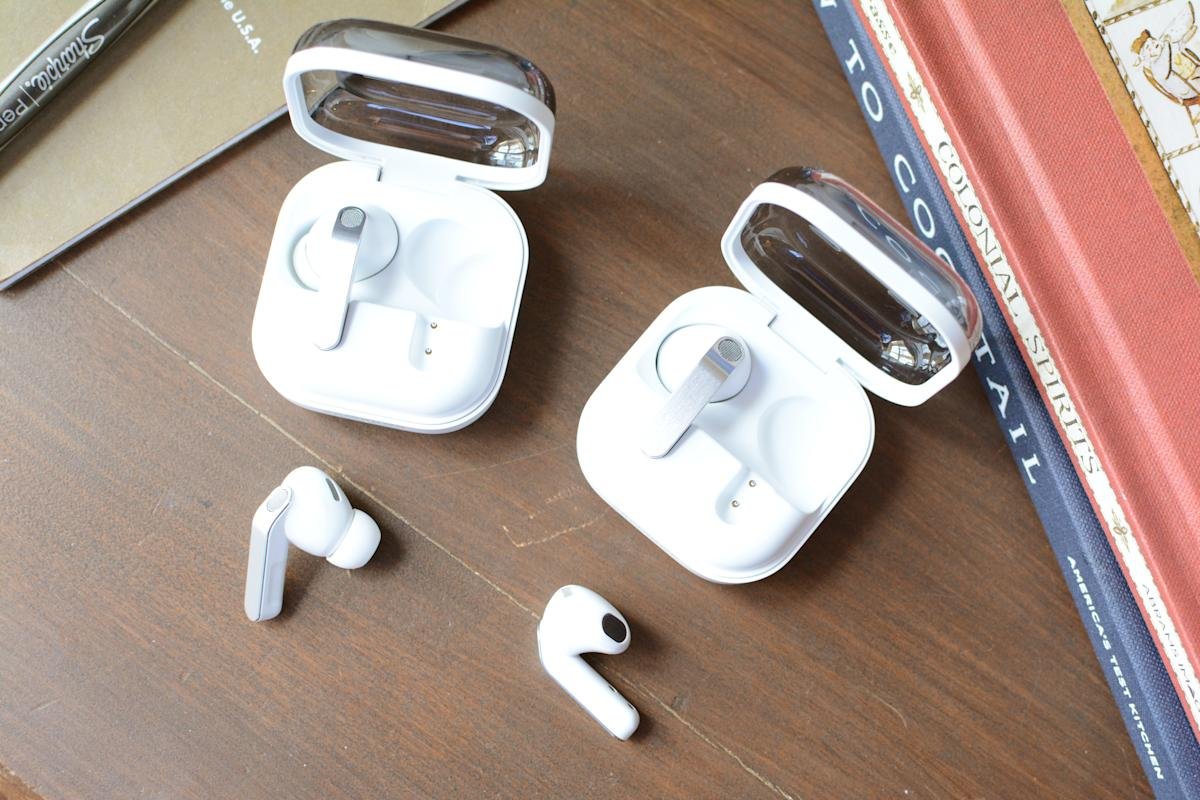
Samsung faced criticism for the Galaxy Buds 3. The company’s imitation of Apple’s AirPods was pretty obvious last year when it opted for a stem or “blade” design after several generations of placing touch controls on the main housing of its earbuds. The Galaxy Buds 4 and Galaxy Buds 4 Pro continue that trajectory, as Samsung keeps adding new features in direct parallel to the AirPods. The good news is that both models have been improved in various ways, while their prices remain the same.

Samsung/Ngadget
- sophisticated design
- great audio
- lots of features
- The design is still unproven
- ANC’s performance is good, not great
- Many features require a Samsung phone

SAMSUNG
The Galaxy Buds 4 offer good sound and the benefits of an open fit, but need work on ANC. They’re still an attractive option for Galaxy phone owners looking to save money on the Galaxy Buds 4 Pro.
- sophisticated design
- great audio
- lots of features
- Open fit has its advantages
- The design is still unproven
- ANC is barely useful
- Many features require a Samsung phone
- Constant fit adjustment due to open design
A sophisticated design that’s still very familiar
On last year’s Galaxy Buds models, Samsung introduced its “blade” design and overall shape that clearly took inspiration from Apple’s earbuds. While it’s all the same on the Galaxy Buds 4 lineup, Samsung has made some improvements that at least give its earbuds a more polished look.
The angular “blade” is gone from both the open-fit Galaxy Buds 4 and the silicone-tipped Galaxy Buds 4 Pro. That stem is now a flat panel with a thin metal covering, but it’s still called the Blade (thanks, Samsung). And thank god, the gimmicky blade lights on the previous Pro models are now gone. Both the Galaxy Buds 4 and 4 Pro have an indented area that accepts both swipes and presses for onboard controls, a design choice that makes that area easier to find by touch alone. Furthermore, the overall shape of both Galaxy Buds 4 models is almost the same, and they are both roughly the same size.
One big change for the Galaxy Buds 4 Duo is the charging case. Since the buds now lie flat instead of sitting vertically in the case on previous models, Samsung has gone back to their rounded square shape from older generations. However, the company kept the translucent lids, so you can clearly see whether the earbuds are in the case or not without opening it.
Aside from their styles (the Buds 4 are open fit while the Pro have ear tips), a notable difference between the two is their ingress protection (IP) levels. The Galaxy Buds 4 Pro are rated IP57, which is good enough for protection against dust and complete submersion up to three feet for up to 30 minutes, while the Galaxy Buds 4 are rated IP54. That latter number means you’re only protected against dust ingress and splashes of water.
Useful features if you have a Samsung phone

samsung buds 4 pro (Billy Steele for Engadget)
A few years ago, Samsung offered iPhone users the same features as Galaxy phones. Those days are long gone. Just like Apple does with AirPods and Google does with Pixel Buds, Samsung requires you to pair a Galaxy phone to get the most out of a pair of Galaxy Buds 4 or 4 Pro. However, if you choose an open-fit model, you will have to sacrifice some features.
Let’s start with the tools that are available on both versions. You can expect Adaptive EQ 2.0, 360 audio with head tracking, Auracast, automatic switching, head gestures, and both touch and swipe controls across the board. Both models also offer AI assistance via Bixby or Gemini.
The voice features are where both models mainly differ. The Galaxy Buds 4 Pro have voice detection that automatically reduces the volume and activates ambient sound mode when you start speaking. The expensive version also offers hands-free access to the AI assistant without touching the earbuds or your connected device.
Almost all of these things require a Samsung phone. Sure, you can use the basics like iPhones and Macs – ANC, onboard controls and ambient sound. But more advanced items like voice detection, head gestures and automatic switching won’t be available there. As before, there’s an app for Android users with non-Galaxy phones, but things like UHD audio and high-quality calls aren’t available on those devices. If you have a Galaxy phone, everything is baked into the Bluetooth menu, like Apple does with AirPods.
surprisingly good sound quality

Samsung Galaxy Buds 4 Pro (left) and Samsung Galaxy Buds 4 (right) (Billy Steele for Engadget)
I expect good sound from the Galaxy Buds line. I usually go into any new Samsung audio review knowing that I’ll get at least average audio quality. On last year’s Galaxy Buds 3, sound performance was well above average for both sets, and that continues on the two latest models as well. However, if audio is your main priority, the Galaxy Buds 4 Pro are a better choice.
As Samsung did with the Galaxy Buds 3 Pro, this year’s 4 Pro feature a two-way driver setup with an 11mm “super-wide” woofer and a 5.5mm planar tweeter. While the woofer is larger than the one inside the 3 Pro, the tweeter is smaller. Those components combine for surprisingly good sound quality for a pair of Samsung earbuds. When I first put the Galaxy Buds 4 Pro in my ears and played the electro-tinged sound of Aya, I was really surprised Hexagonal! The driving bass line on “Off the ESSO” is energetic yet nuanced, the vocals are cutting and clear, while the synths and other percussive elements pierce through the mix. The Galaxy Buds 4 Pro deftly handled everything I threw at it, from the heavy metal of Spiritbox to the sweet acoustic tunes on Muscadine Bloodline’s 2025 release.
The Galaxy Buds 4 are not a sonic slouch by any means. It’s true that you’ll get deeper bass and more overall clarity and detail from the Pro model, but potential buyers who desire an open fit don’t need to sacrifice much in the sound department. There’s still punchy bass and crisp highs, with enough midrange to adequately fill the gaps. I noticed the biggest difference on that Aya track, where the bass isn’t as deep or detailed and the rest of the mix isn’t as dynamic as it is on the Galaxy Buds 4 Pro.
Active noise cancellation that still needs work

Samsung Galaxy Buds 4 Pro (left) and Galaxy Buds 4 (right) (Billy Steele for Engadget)
While both Galaxy Buds 4 models offer active noise cancellation (ANC), the Pro version has what Samsung calls Adaptive Active Noise Cancellation 2.0, while the other side has just Adaptive Active Noise Cancellation. The company didn’t go into much detail about the differences, except that the ANC performance is better on the Galaxy Buds 4 Pro. I guess, so 2.0.
ANC performance was a major issue on the Galaxy Buds 3 and this continues on the Galaxy Buds 4 as well. Samsung hasn’t managed to crack the noise cancellation code on open-fit earbuds like Apple has done with its “regular” AirPods. In fact, the ANC on this new model makes such a minor difference, I’d bet most customers would prefer to trade it for longer battery life (or a lower price). I only left it on because my battery was dead, otherwise I wouldn’t use it at all. It’s definitely more like active noise reduction than outright cancellation.
Thankfully, noise cancellation on the Galaxy Buds 4 Pro is a different story. It’s still not going to silence the world like the second-generation Bose QuietComfort Ultra earbuds, but Samsung’s tech is good enough to make it useful in most situations. I found it particularly efficient at blocking out moderate level continuous noise, such as a clothes dryer, fan or white noise machine. It is the sudden swing of the racket where the pro struggles. The Buds 4 Pro also do a good job of suppressing human voices, much to my family’s dismay.
Call and voice quality

Samsung Galaxy Buds 4 Pro (left) and Galaxy Buds 4 (right)
Every audio company claims its special sauce is the key to clear calls, and Samsung is no different. The company claims its combo of 16kHz Super Wideband mode, DNN noise reduction and personalized beamforming mic delivers “calls so clear, they’re amazing.” Of course, that promise requires the Galaxy S26 series phones – and not just the earbuds.
I was surprised at how good my sound sounded in quiet environments as both of these earbuds deliver sound quality that is clear and crisp. If you go to a noisy place, both models will completely block out any background roar, but your sound will sound a little digital on the other end. This was more pronounced on the Galaxy Buds 4, but it’s noticeable on both versions. That’s because of all the audio processing that Samsung is doing to mute those distractions.
On top of all that, the ambient sound mode on the Galaxy Buds 4 Pro is very natural, meaning you won’t be shouting to make yourself heard during a call or meeting.
Competition
If you’re looking for the best earbuds to use with Samsung phones, the Galaxy Buds 4 and 4 Pro are your best choices. Then, just like Apple does with AirPods and Google does with Pixel Buds, Samsung continues to provide Galaxy loyalists with the most advanced and most useful features. If you don’t really care about that tuning, the second-generation Bose QuietComfort Ultra earbuds are currently my top choice. That set won’t surprise you with the features, but the combination of excellent sound quality and best-in-class ANC performance makes them hard to beat. Plus, multipoint Bluetooth connectivity provides easy switching between the Galaxy S26 and MacBook.
wrap up
With each passing year, Samsung gets closer to offering Galaxy phone users a true true AirPods rival. The company really only lags behind Apple in two areas: hearing health and heart rate tracking. Samsung currently offers the option to increase volume on its earbuds, but it doesn’t have hearing tests or Apple’s hearing protection devices. The biggest update on the AirPods Pro 3 last year was the addition of heart-rate tracking, which would be a great base for a fitness-focused version of the Galaxy Buds.
Everything else continues to improve according to the familiar formula. Samsung has beefed up the overall sound quality and ANC performance, even if the noise cancellation capabilities of the Galaxy Buds 4 are somewhat weak. The design changes offer a more premium look and the gradual addition of modern features like head gestures helps the company keep pace with the competition. While the Galaxy Buds 4 and 4 Pro are both good, Samsung really needs to make major changes to its earbuds with new features to make the AirPods worth buying for iPhone users.
<a href