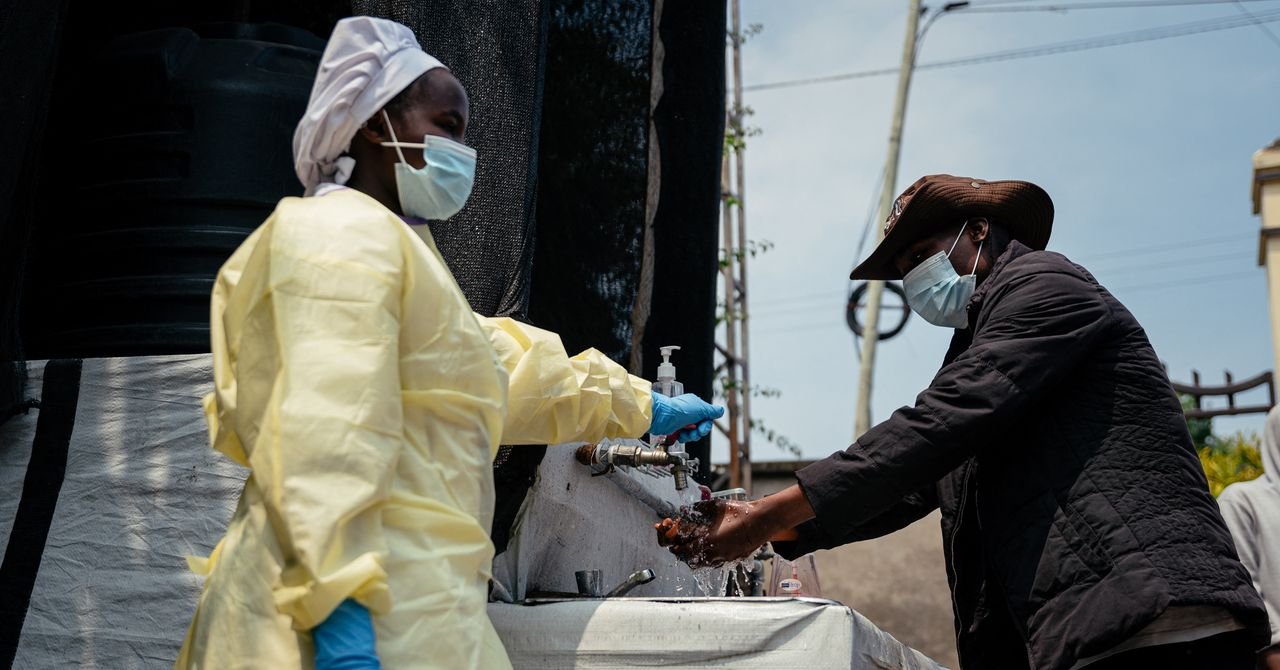
“We are no longer able to get some supplies,” Amadou Bokom, country director in the Democratic Republic of Congo for the anti-poverty nonprofit CARE, told WIRED. “Because of that, we are not able to respond immediately.”
Bokom says basic medical equipment such as masks and hand sanitizer, as well as components needed for testing, are in short supply due to funding cuts.
WIRED spoke to more than a half-dozen global health experts who explained how the Trump administration’s move to close the United States Agency for International Development (USAID), among other cuts in funding, in the lead-up to this Ebola outbreak has created a strained, increasingly fragmented disease prevention and response system, with a severely depleted workforce already struggling with burnout.
“We are very far behind in this outbreak,” says a current employee of the Centers for Disease Control and Prevention (CDC) who has experience with the outbreak. “It’s a perfect storm.”
The World Health Organization (WHO) declared the Ebola outbreak an emergency “of international concern” on 16 May. There is no vaccine or treatment for this strain of Ebola, known as Bundibugyo. As of May 19, there were more than 530 confirmed cases and 134 deaths, and both numbers are rising rapidly. According to the CDC, 25 to 50 percent of people infected with this strain will die from it.
“People really need to understand that if it’s not handled carefully, it’s going to go haywire very easily,” Bocom says. “It’s really important that we need to react fast to stop this.”
The outbreak was first identified in the Ituri region of the Democratic Republic of Congo, an area that borders South Sudan and Uganda and is known as a transit route for refugees. In Uganda’s capital Kampala, such people have already been confirmed, who had come there from Congo. Travelers frequently cross the border to the region, especially at this time of year, with thousands of pilgrims expected to travel from Congo to Uganda for an annual event. Although Uganda has postponed the festivities due to Ebola fears, it is unclear how quickly word of the cancellation will spread, especially in rural communities.
In February 2025, when Elon Musk’s so-called Department of Government Efficiency (DOGE) dismantled USAID, the billionaire told Trump administration officials that DOGE had “accidentally” cut funding for Ebola prevention and then reinstated it. However, as WIRED reported at the time, the life-saving work on Ebola and other infectious disease prevention was not restored. DOGE also cut CDC, depleting another major global health player. In April 2025, the Trump administration directed the US National Institutes of Health studying Ebola to halt its research.
Before the DOGE cuts, USAID was a key part of the DRC’s infectious disease prevention, treatment, and containment policies. The US Embassy in Kinasha, the country’s capital, noted in 2024 that the agency had provided treatment to 11 million people for deadly diseases such as tuberculosis and HIV that year alone, and it had also played a key role in stopping six prior Ebola outbreaks.
“Right now we’re missing a big player in the response,” a current CDC employee with experience in the outbreak told WIRED. “We coordinated really, really closely with USAID during these outbreaks, because we may be able to get public health responders and public health response out quickly – that’s one of our jobs and our goals in these outbreaks at CDC – but USAID can get materials and money faster, and that was one of their specialties.”
<a href