NASA this week announced the four-person crew that will lead its Artemis III mission in 2027: NASA astronauts Andre Douglas, Frank Rubio and Randy Bresnik with ESA’s Luca Parmitano as pilot of the flight. Plus, Parker Solar Probe takes another trip around the Sun, solar power overtakes coal in May, and more. Here’s this week’s science news.
Parker Solar Probe’s 28th flyby
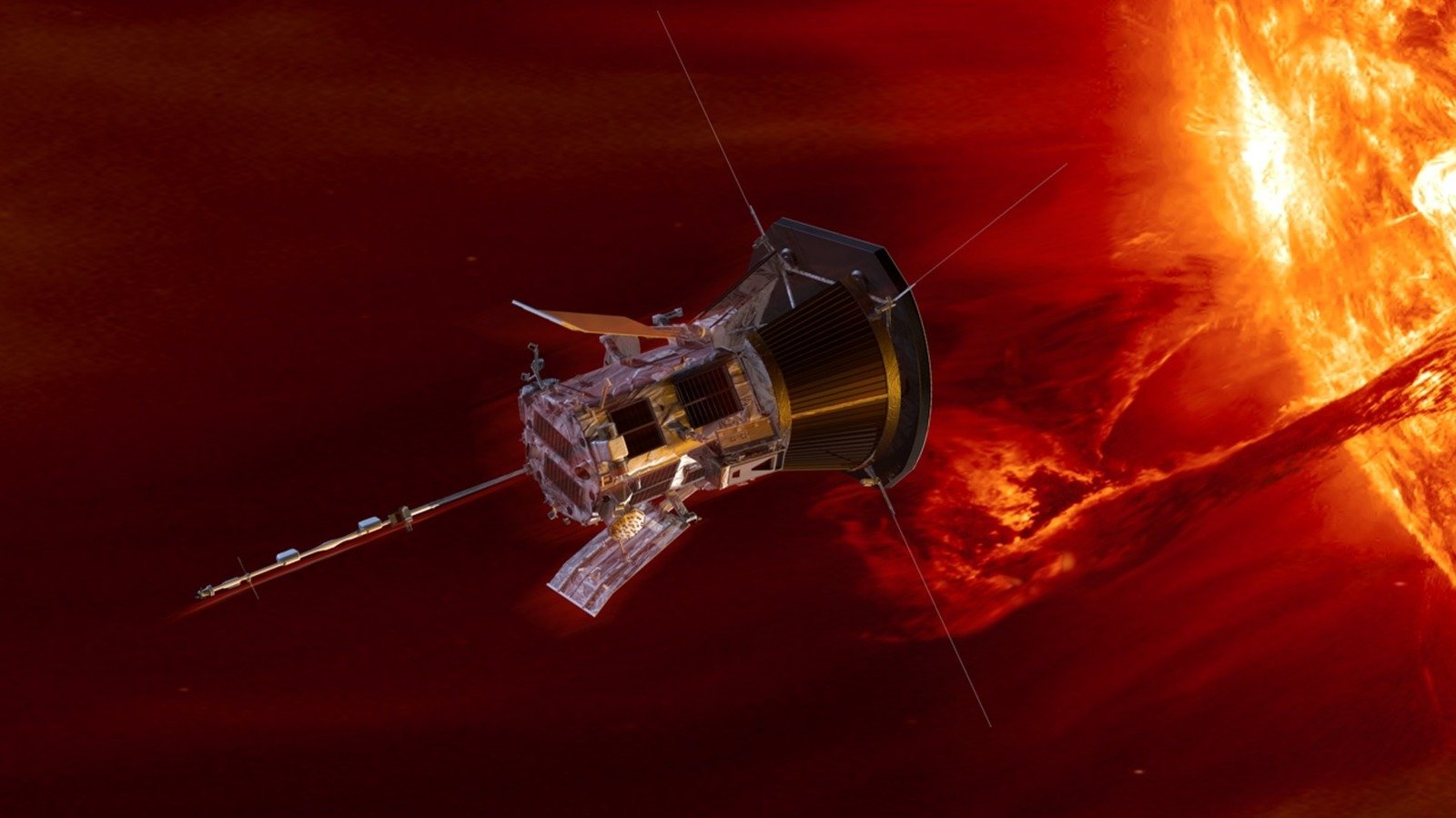
NASA’s Parker Solar Probe made another close pass around the Sun this week, passing 3.8 million miles from the surface and reaching a speed of 430,000 mph. This marked its 28th flight, and matched the speed and distance records set for the first time in December 2024. It has since touched those numbers five times. The spacecraft began its latest approach on June 3, and broadcast a beacon tone on Thursday to signal to the team that all is well.
Parker Solar Probe has been studying our star for eight years, and is slowly getting closer to the surface. It was launched in 2018 and made its first close approach to the Sun, when it came within 15 million miles of the Sun’s surface. For its first flight, it reached a maximum speed of 213,200 mph. Despite the harsh conditions around the Sun – the heat shield reaches an estimated 1,700 degrees Fahrenheit when the spacecraft is closest to the Sun – Parker’s team says the probe is still going well after all this time. Below the heat shield, the Parker probe is protected by a thermal blanket, which has maintained a constant spacecraft temperature during these flights.
“Temperature stability is a key indicator of the health of the spacecraft,” said John Wirzburger, Parker Solar Probe mission systems engineer at the Johns Hopkins Applied Physics Laboratory. “This tells us that the heat shield is not deteriorating. If it were cracking or weakening, we would see temperatures going up due to more heat leakage.”
Parker is observing the solar wind and activity, tracking changes in the Sun’s 11-year cycle. The space probe arrived at the Sun near the quiescent period known as solar minimum, and remained there long enough for it to reach solar maximum, which was confirmed to be in 2024. This occurs when solar activity peaks, giving rise to sunspots and phenomena such as solar flares and coronal mass ejections. Solar activity will soon begin to gradually decrease as we move into the next phase. The Parker probe has a front-row seat to all of this, gathering unprecedented data that will help us better understand our star and its effects on space weather.
Solar overtakes coal for the first time in America
May 2026 was the first month on record in which solar generated more electricity than coal in the United States, according to a report from energy think tank Amber. Despite pressure from the Trump administration to revive the coal industry, according to Ember, “Solar supplied a record 12.8 percent of U.S. electricity, while coal fell to 12.2 percent, the fourth-lowest monthly share ever.” Total generation from solar power last month was a record 45.5TWh, making it the third-largest source of electricity in the country, Amber reports.
Coal was just behind at 43.4TWh in May, but that was down 11 per cent compared to the same period last year. And in April, it fell to its lowest monthly total ever recorded, at 39.3TWh. According to Amber, “Coal generation’s share of the U.S. mix has nearly halved over the past five years, falling from 19.7 percent in May 2021 to 12.2 percent in May 2026.” “In contrast, solar energy’s share in the mix doubled from 5.4 percent to 12.8 percent over the same period.”
Solar power still lags behind gas and nuclear power, but Amber’s analysts say clean energy is still on an upward trend, even if policy is changing in the other direction. According to Ember, in March, “renewables collectively generated more electricity than gas in the US for the first time.”
Enjoy this timelapse of the southern lights as seen from space
Earlier this week, an astronaut aboard the International Space Station shared a breathtaking timelapse video of the Aurora Australis (southern lights). Jessica Meyer, who is the spacecraft commander for NASA’s SpaceX Crew-12 mission, captured footage from the Dragon spacecraft docked on the ISS. “Unlike previous auroras I’ve seen, this one danced straight beneath us and put on quite a spectacular display,” the mayor wrote on social media. “I am surprised by this [sic] A thought-provoking incident.”
A timelapse view from our @SpaceX Dragon of the spectacular southern aurora seen in yesterday’s post, which is the result of a recent solar event. Unlike previous auroras I’ve seen, this one danced straight below us, and put on quite a spectacular display. I am surprised by this… pic.twitter.com/ReztjH3x9H
– Jessica Meyer (@Astro_Jessica) June 7, 2026
Astronauts can get some of the best views of the aurora, but viewers on the ground have also been getting a great view lately. NOAA’s National Space Weather Prediction Center issued G2 and G3 geomagnetic storm watches last week, indicating to enthusiasts that auroras may be visible in more areas than usual. In the Northern Hemisphere, the aurora were predicted to be visible in Canada and North America, while viewers in Australia and New Zealand had a chance of seeing the southern lights.
Before you go, be sure to check out these stories, too:
<a href