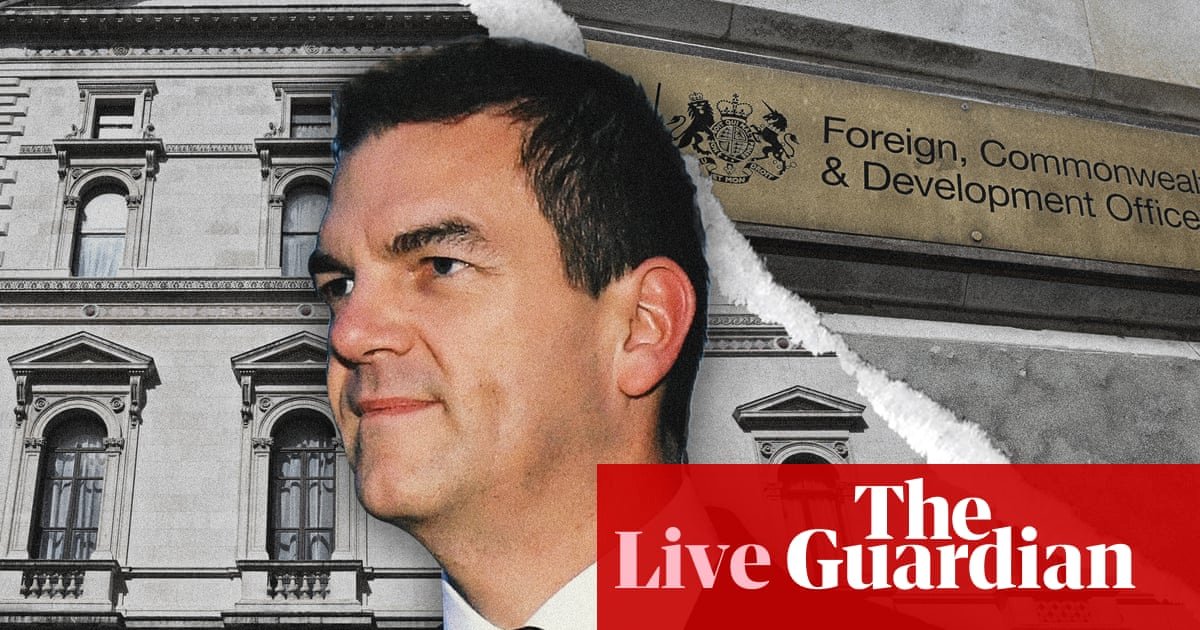
Robbins ‘thrown under the bus’ by Number 10, says former senior civil servant
Sir Olly Robbins was “basically thrown under the bus” as a result of the “biggest diplomatic crisis” in over 40 years, according to Simon McDonald.
Appearing on BBC Radio 4’s Today programme on Saturday, Lord McDonald, an ex-permanent secretary in the Foreign Office, described Robbins as a “scalp” that the government needed after the Guardian revealed that Peter Mandelson had been appointed as ambassador to the US despite failing his vetting process.
When asked if Robbins had been “basically thrown under the bus”, Lord McDonald replied:
Yes. This story broke on Thursday morning in a piece in The Guardian – within the news cycle Olly Robbins had been required to resign.
This shows to me that Number 10 wanted a scalp and they wanted it quickly and I cannot see that there was any process, any fairness, any giving him the chance to set out his case, and that feels to me wrong.
McDonald also said that the fallout from Mandelson’s appointment had been “the biggest crisis in the diplomatic service” since he joined the Foriegn Office in 1982.
Closing summary
We’re wrapping up our coverage of todays events, below is a recap of the latest developments. Thanks for joining us.
-
Lord Simon McDonald, the former head of the Foreign Office, has called the Peter Mandelson security vetting scandal is the biggest crisis for the diplomatic service in decades. Speaking on the Today programme, Lord McDonald also claimed that Olly Robbins, who was the permanent secretary of the Foreign Office until Thursday when he was asked to step down due to the scandal, was “thrown under a bus” by the prime minister, Keir Starmer and that “No 10 required a scalp and wanted it quickly.”
-
Scottish first minister John Swinney has joined four other major party leaders in calling for Keir Starmer to step down as prime minister due to the scandal. Swinney, whose statement follows those made my Kemi Badenoch, Nigel Farage, Ed Davey and Zach Polanski, has lambasted Starmer for his “incompetence”, describing it as “staggering” and “startling”.
-
Swinney has also rejected criticism about his governments implementation of a ruling from the Scottish supreme court on sex and gender. Swinney said that he was “satisfied the Scottish government has taken the necessary steps to implement the supreme court ruling”, despite his former colleague Joanna Cherry labelling him as a “coward” who is “too afraid” to push the issue.
-
Green Party MP Hannah Spencer has accused Labour of “offensively caricaturing” working-class people by claiming that they would be opposed to a ban on greyhound racing in England. Spencer comments come after culture secretary Lisa Nandy said that the government had “absolutely no plans whatsoever” to ban dog racing in England, despite similar bans being implemented in Wales and Scotland.
John Swinney has said that he is “satisfied” that his government has followed last years landmark ruling on sex and gender from Scotland’s supreme court, despite a former MP saying that he has failed to implement it.
Speaking in Dundee, Swinney stated that he was “satisfied the Scottish government has taken the necessary steps to implement the supreme court ruling” despite heavy criticism from Joanna Cherry, a former MP and colleague of Swinney who left the party last year.
Cherry, who told the Times that she was “absolutely disgusted by the SNP, and ashamed of being a member” has heavily criticised Swinney and his predecessors on the SNP stance on sex and gender, labelling Swinney a “coward” and saying they have been “too afraid” to stand up to the party on the issue.
The supreme court’s ruling, made in April 2025, stated that for the purposes of the Equality Act 2010, sex is based on birth sex and not acquired gender, a distinction that Cherry had been a longtime campaigner for.
Keir Starmer should resign over Mandelson appointment fallout, says John Swinney
The Scottish first minister John Swinney has called for Keir Starmer to step down as prime minster after new revelations regarding Peter Mandelson being appointed as the US ambassador despite failing the vetting process have come to light.
Swinney has become the fifth major party leader to call for Starmer to go, following similar statements made by the leaders of the Tories, Reform, the Lib Dems and the Greens.
Speaking in Dundee on Saturday, Swinney said that he had “no reason to doubt” that Starmer was telling the truth about his understanding of the process, but still stated that the prime minister’s “incompetence” regarding it was “staggering”.
Swinney said:
“I have no reason to doubt that the prime minister only found out this week, but if he did, it demonstrates a startling level of incompetence that he only found out this week.
“This issue has been kicking around for months and the prime minister has made very definitive statements to the House of Commons and to other media events where he has definitively said the full vetting process was carried out and left the impression it had been successful.
“Clearly, he hadn’t checked that point and that is a staggering level of incompetence on the appointment of an ambassador to the most significant ambassadorial role.”
Swinney went on to say that Starmer was “not up to the job” and that despite admitting his mistake he had shown “a level of incompetence that should worry us all about his capacity to be prime minister and that’s why I don’t think he can carry on being the prime minister.”
Here are some of the latest images from Manchester, where both Britain First and anti-fascist protesters are gathering:

Hamish Mackay
Away from Westminster, Greater Manchester Police says there will be a “significantly increased police presence across the city” today as it prepares for a far-right protest.
The march, organised by Britain First, is due to begin from Store Street at 1.15pm and finish at St Peter’s Square at around 2pm, GMP said.
Counter-protesters are also present.
Assistant Chief Constable Rick Jackson said:
Our officers will police without fear or favour, ensuring those exercising their right to protest can do so safely, while intervening when behaviour crossing the line into criminality.
We’ll bring you updates from that march here. In a slightly unusual turn of events, GMP is also live blogging the protest.

Helena Horton
On Friday the Cabinet Office released a template page from the summary document produced by UKSV after Mandelson’s vetting. The document would be used by a vetting officer to summarise their findings.
It lists three rankings for possible “overall concern”: low, medium and high. In the next box, there is a space for a vetting officer to list the outcome of the assessment with their “overall decision or recommendation”. Again, there are three options: clearance approved, clearance approved “with risk management” or clearance denied.
According to multiple sources, the UKSV process in Mandelson’s case concluded there was a “high” overall concern and concluded “clearance denied”. It was this recommendation that was overruled by the Foreign Office, which employed a rarely used authority to grant him clearance anyway.
Of the process, Sir Simon McDonald said:
If it (the vetting process) did amount to failure then that fact, that ultimate conclusion would have to be conveyed to the political level, but the fact that it was not indicates to me that the fact was rather more complicated than No 10 would wish to present.
Analysis: why Labour MPs expect Starmer to cling on as PM

Peter Walker
It still feels improbable that the UK prime minister, Keir Starmer, will face a formal challenge even if, as assumed, his Labour party performs disastrously in next month’s local elections. But for many of his MPs, the latest revelations about Peter Mandelson have emphasised that the question is simply one of when, not if.
“It does seems incredible that he didn’t know, but the problem is that it’s quite possible as well,” was the summary of one backbencher, in response to No 10’s insistence that no one had told the prime minister that his pick to be the UK ambassador to Washington had failed his security vetting.
Some MPs believe the Mandelson vetting fiasco could be terminally damaging for a prime minister who, as one said, had painted himself as “whiter than white”. “I can’t see how he survives this,” one said. “I just don’t think it’s feasible for him to say he didn’t know anything. I’m angry and really sad.”
This, however, seems to be a minority view. For weeks there has been a growing consensus within the parliamentary Labour party (PLP) that terrible results on 7 May for elections to the Scottish and Welsh parliaments and English councils will not be the end point for the prime minister, for several interconnected reasons.
Read on here:
Helena Horton
Green party MP Hannah Spencer has accused Labour of “offensively caricaturing” working-class people by claiming that they would be opposed to a ban on greyhound racing in England.
Spencer, who entered Westminster after winning the Gorton and Denton byelection in February and has four rescued greyhounds of her own, has supported England following Scotland and Wales in banning greyhound racing, something that culture secretary Lisa Nandy said the government has “absolutely no plans whatsoever” to do.
After agreeing that Sir Olly Robbins was “thrown under the bus” after revelations about Peter Mandelson’s vetting process, Lord Simon McDonald also claimed that saying the process “failed” wasn’t correct as “it is a very black and white word”.
Speaking on the Today programme on Saturday, Lord McDonald said:
These things tend to be a bit murkier than that. I mean security vetting will have incomplete information, they will be unhappy about one or two details, they’ll want mitigations to be put in place.
And all of that happens quite regularly. It means there are hesitations, there are imperfections, but it doesn’t amount to failure.
If there had been a failure then that fact – that ultimate conclusion – would have to be conveyed to the political level.
But the fact that it was not indicates to me that the picture was more complicated than Number 10 wished to present.
Lord McDonald also said that losing a “top official in these circumstances is a big blow to the Foreign Office”, describing it as “a very complicated, difficult, important time internationally”, and said that the Foreign Office needed a new head quickly.
Robbins ‘thrown under the bus’ by Number 10, says former senior civil servant
Sir Olly Robbins was “basically thrown under the bus” as a result of the “biggest diplomatic crisis” in over 40 years, according to Simon McDonald.
Appearing on BBC Radio 4’s Today programme on Saturday, Lord McDonald, an ex-permanent secretary in the Foreign Office, described Robbins as a “scalp” that the government needed after the Guardian revealed that Peter Mandelson had been appointed as ambassador to the US despite failing his vetting process.
When asked if Robbins had been “basically thrown under the bus”, Lord McDonald replied:
Yes. This story broke on Thursday morning in a piece in The Guardian – within the news cycle Olly Robbins had been required to resign.
This shows to me that Number 10 wanted a scalp and they wanted it quickly and I cannot see that there was any process, any fairness, any giving him the chance to set out his case, and that feels to me wrong.
McDonald also said that the fallout from Mandelson’s appointment had been “the biggest crisis in the diplomatic service” since he joined the Foriegn Office in 1982.
The Scottish Greens have pledged to introduce a misogyny bill to the next Scottish parliament.
Gillian Mackay, who co-leads the Greens in Holyrood with Ross Greer, said that the party would look to bring a Misogny and Criminal Justice bill forward, which she says would help tackle misogynistic harassment, incitement and abuse by recognising misogyny as a specific offence in Scots law.
Mackay criticised the SNP had previously announced it was dropping plans for a designed around misogyny in favour of amending the already existing hate crime act to include sex for not acting with “urgency” on a “national emergency”.
Mackay said:
Violence against women and girls is a national emergency which must be urgently tackled.
Sadly, we haven’t seen that urgency from the Scottish Government to date, who shelved their plans.
That is why the Scottish Greens will step up and work for the Misogyny and Criminal Justice Bill that Scotland deserves, bringing misogyny into Scots law as a specific criminal offence.
As well as a stand-alone bill, the Greens have also promised to fund violence prevention services in local councils, schools and community organisations to tackle violence against women and girls.
Meanwhile, Peter Mandelson’s replacement as British ambassador to the US has said the relationship between the two countries is in the middle of an “extraordinary moment”.
Speaking in Washington on Friday, Sir Christian Turner said that the transatlantic relationship, which has become strained due to tensions over the Iran war and Donald Trump’s intense criticism of Keir Starmer for his supposed lack of support in the conflict, was still “one of the deepest and closest alliances in history”.
He said:
I’ve now been in this job for about two months, and they said, ‘Come to Washington for a rest. It’ll be very calm. It’ll be very quiet. You’ll be okay.’
And we’re in the middle of this extraordinary moment, geopolitically, geoeconomically, and indeed for the transatlantic relationship.
It is, of course, all relative – 250 years ago we had a small disagreement. We were in the midst of a dispute back then.
To our credit, we’ve only tried to burn down the White House once since, and what began in that moment of tension has been forged into one of the deepest and closest alliances in history.
He added:
I like to think it’s a pragmatic partnership. It’s not one based in backwards looking and nostalgia. It’s looking forwards as it really secures security and prosperity for both Britons and Americans alike.
One the central characters in the latest uproar over the failure in Peter Mandelson’s vetting is Sir Olly Robbins, a former member of the Foreign Office who was forced to quit on Thursday after new revelations about the process were revealed by the Guardian.
With Robbins due to appear before a committee of senior MPs next week, new information about how the process failed is expected to emerge. But what do Robbins know, and how was such a colossal mistake allowed to happen?
Daniel Boffey’s analysis of Robbins, his role in the process and what his now former colleagues think of him is an important read ahead of any bombshells that may come out of next weeks grilling.
The news of Peter Mandelson failing his vetting process has left many across the UK astonished, including members of Keir Starmer’s cabinet.
A new report from the Guardian details how senior government ministers were reported as feeling “pure, unbelievable shock” at the revelations that Mandelson still found his way back into government despite the extent of his relationship with Epstein coming to light before his appointment.
You can read the full report from Kiran Stacey, Paul Lewis and Pippa Crerar below:
Opening summary
Hello and welcome to the Guardian’s live coverage of UK politics on Saturday 18 April.
Keir Starmer is facing “judgment day” according to senior government figures over the failure in Peter Mandelson’s vetting process.
The prime minister has said that was “staggered” and “furious” to have not been told about the vetting recommendation, saying that the lack of communication about the matter was unforgivable.
His government has also denied that the cabinet secretary, Antonia Romeo, and Catherine Little, the Cabinet Office’s permanent secretary, were “sitting on” the information, despite both having become aware of the situation last month.
Next week, Starmer will face what is being described as a “judgment day” as Olly Robbins, who was forced to quit the Foreign Office owing to the fallout of the failures of Mandleson’s vetting, is expected to appear before a powerful committee of MPs.
Robbins is understood to have been furious at being forced out, and there are fears that his side of events could leave Starmer, who is already facing fresh calls to resign, in an even more precarious situation.
You can read our latest report from my colleague and Guardian political editor Pippa Crerar here:
In other developments:
-
Green Party MP Hannah Spencer has criticised Labour for “offensively caricaturing” working-class people by stating that they would not want a ban on greyhound racing in England.
-
The government has refused to pay for over half of the compensation claims made by victims of the Windrush scandal.
-
More than half of British voters would choose to rejoin the EU in a hypothetical future referendum, according to new research.
We’ll bring you the latest developments on the Mandelson scandal, and other political stories, throughout the day…
<a href