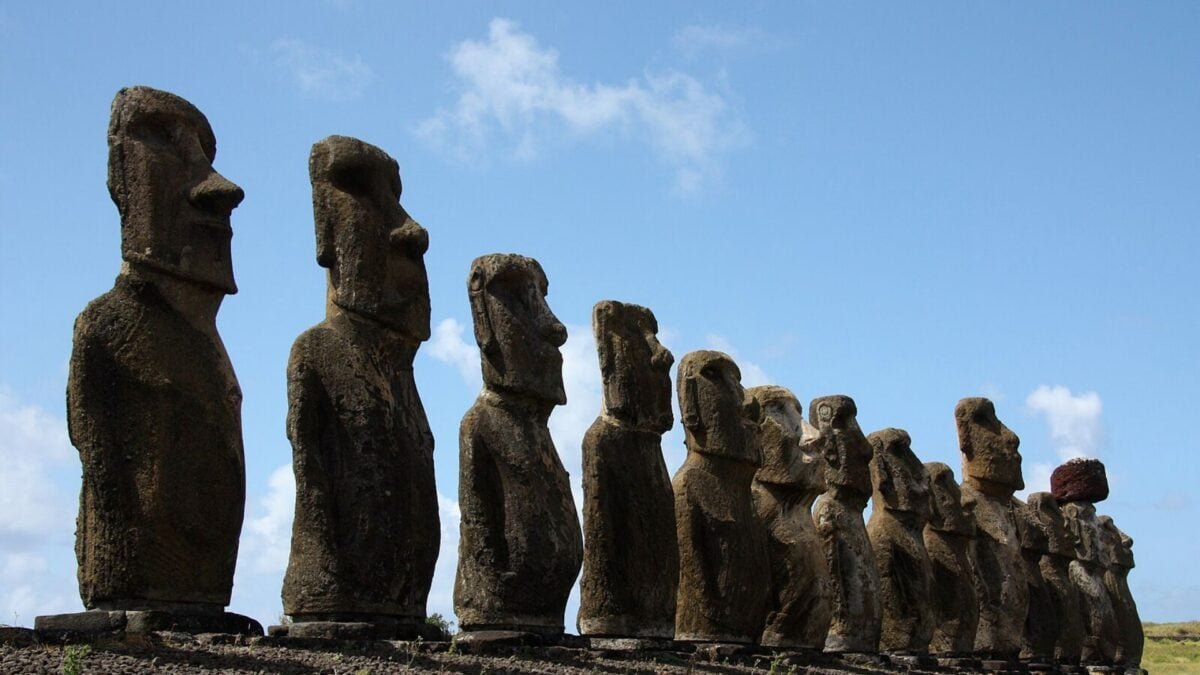
Experts believe that Polynesian communities began carving moai in the 13th century. Sculpting and moving hundreds of these statues – the largest of which stands 66 feet (20 m) tall and weighs 90 tons (82 metric tons) – was an incredible engineering feat. It’s hard to imagine that this could have been possible without some kind of hierarchical management, but research published Wednesday in the journal PLoS One suggests that was the case.
Lead author Carl Philip Lipo, professor of anthropology at Binghamton University, told Gizmodo in an email that the findings reveal “a sophisticated alternative to hierarchical organization.” “Labor was self-organized rather than ordered.”
Modern technology reveals ancient practices
Lipo and his colleagues used drones to collect more than 11,000 images of the primary moai mine, Rano Raraku. They then used structure-from-motion photogrammetry to create a 3D model of the site by overlapping the 2D images.
Rano Raraku contains hundreds of moai preserved in various stages of perfection. According to Lipo, analysis of this model revealed 30 separate excavation zones, each functioning as a separate extraction zone with clear boundaries rather than one continuous operation.

In these independent workplaces there was evidence to suggest that the entire production process – from first cutting the cornerstone to carving the final touches to the statue – took place in separate areas. The analysis also revealed variations in production techniques, moai proportions, and stylistic details between regions, pointing to distinct traditions maintained by different social groups.
“These patterns suggest that moai construction, like broader Rapa Nui society, was not organized by central management,” Lipo said.
Rethinking the history of Rapa Nui
The findings paint a picture of moai production that better matches our understanding of the Rapa Nui people. Archaeological evidence strongly suggests that this society was not politically unified but rather consisted of small, independent family groups.
“Each excavation area probably represents an extended family or regional community working autonomously,” Lipo explained. “The small crew sizes required for transportation (18–20 people, based on experimental archaeology) correspond perfectly with extended kin groups.”
At the same time, the findings add to a growing body of evidence that undermines the long-held belief that Rapa Nui society collapsed around 1600. Experts had previously interpreted the island’s extensive deforestation and incomplete moai as signs that the human population had outgrown its resources and been depleted, but this new study tells a different story.
“Our findings at Rano Raraku and other studies conducted over the past 25 years have fundamentally rewritten the temporal narrative of Rapa Nui, replacing the story of rise and fall with one of continuous adaptation and persistence,” Lipo said. “The ‘incomplete’ moai at Rano Raraku are not evidence of sudden destruction but of normal mine operation.”
The implications of this study extend far beyond archaeology, shedding light on fundamental questions about human cooperation and social organization. According to Lipo, the findings demonstrate not only that humans can make remarkable achievements without hierarchical organization, but also that societies can develop sustainable, peaceful, and culturally rich lifestyles.
<a href