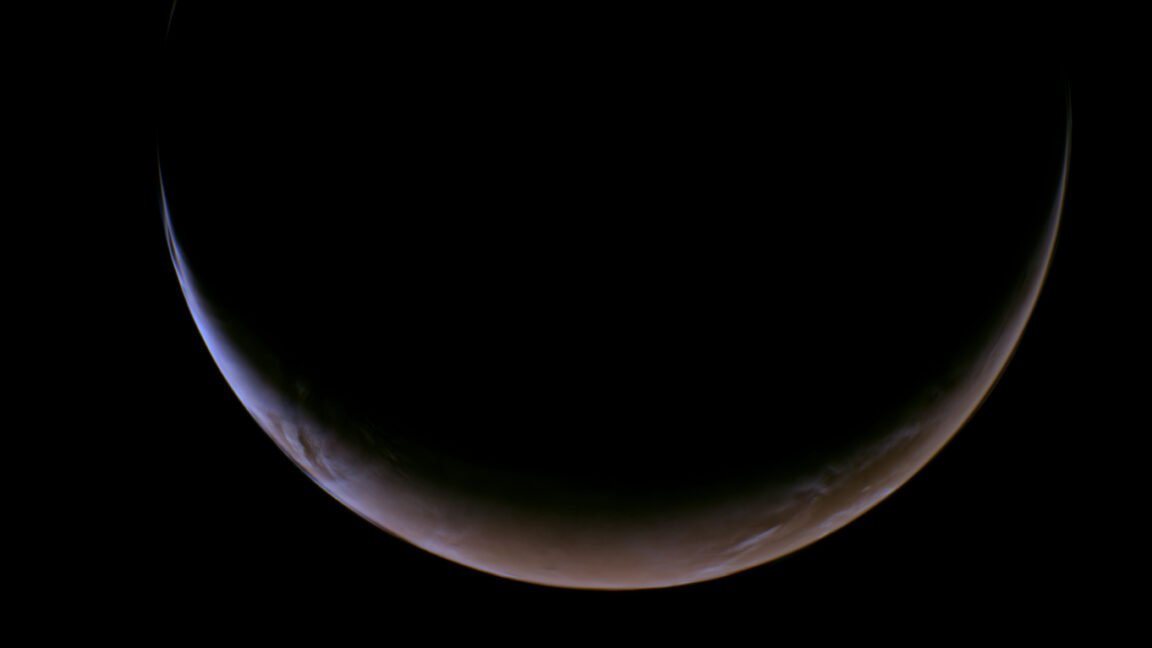
“As a bonus, it photographed Mars from a rare perspective,” NASA said in a press release.
The spacecraft approached Mars from a high phase angle, or from the opposite direction to the Sun, causing the planet to appear as a thin crescent as it headed for the Psyche encounter. The gloom of Mars’ thin atmosphere was on full display, with sunlight shining through dust clouds stretching dozens of miles across the sharp edge of the planet’s rust-colored surface.
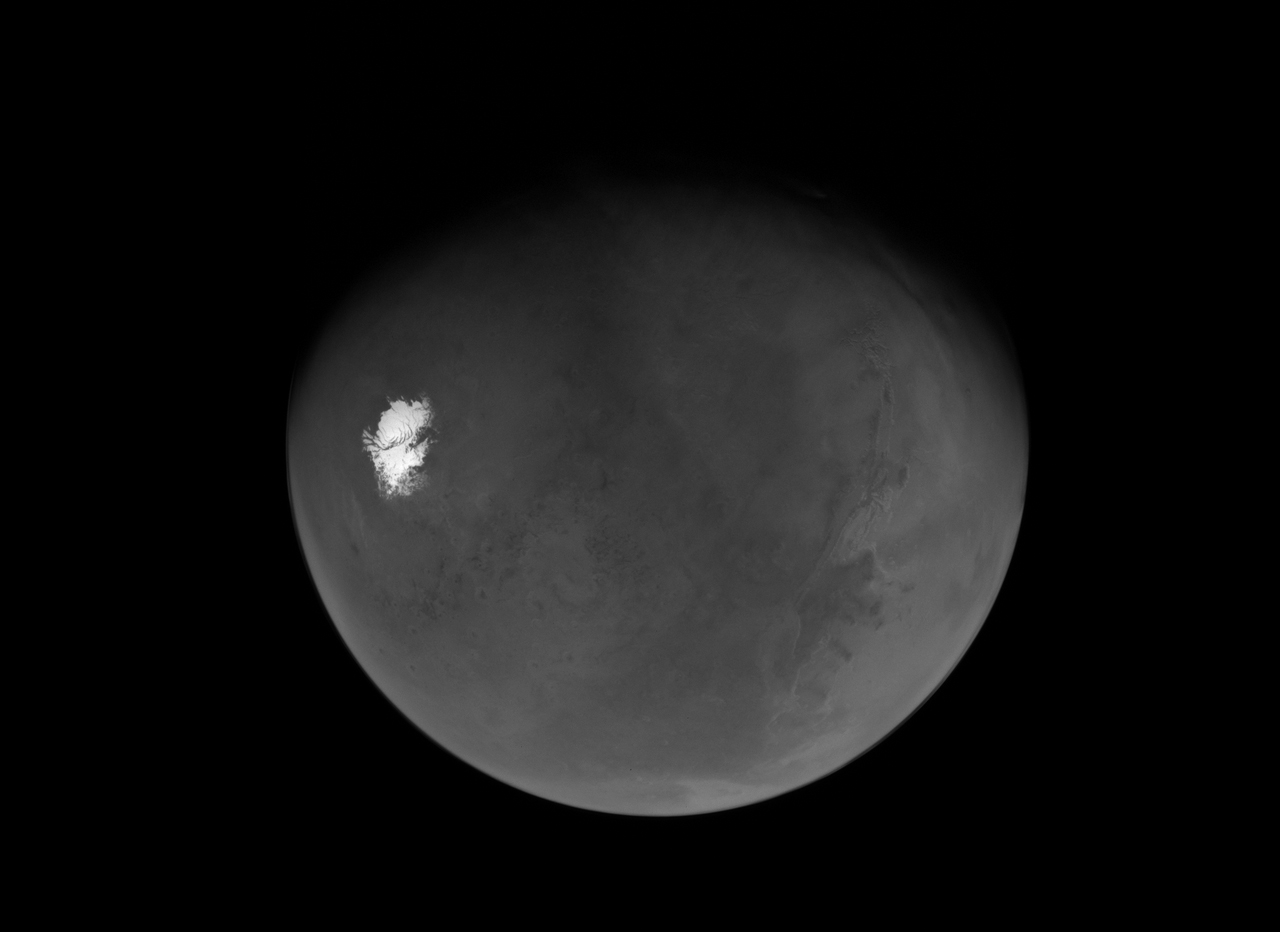
This is the first view of nearly “full Mars,” as seen by NASA’s Psyche spacecraft shortly after its closest approach to the planet on May 15, 2026. The view extends north from the southern polar cap to the Valles Marineris canyon system and beyond.
Credit: NASA/JPL-Caltech/ASU
This is the first view of nearly “full Mars,” as seen by NASA’s Psyche spacecraft shortly after its closest approach to the planet on May 15, 2026. The view extends north from the southern polar cap to the Valles Marineris canyon system and beyond.
Credit: NASA/JPL-Caltech/ASU
As Psyche zoomed in on the Red Planet, its cameras captured a wide-angle overhead view of Mars’ southern polar ice cap. Jim Bell, who leads the Psyche Imager instrument team at Arizona State University, said the spacecraft took thousands of images during the encounter. Bell said the observations will help scientists “calibrate and characterize” the cameras’ performance.
Psyche’s magnetometer would have detected signatures of the solar wind interacting with Mars’ upper atmosphere or its remaining magnetic field, and its spectrometer was tuned to measure the chemical composition of the Martian surface below the spacecraft’s flight path.
Many other missions are exploring Mars all the time, so there is little chance of any major discoveries hidden in the Psyche flyby dataset. But scientists should be able to calibrate the mission’s instruments by comparing flyby observations with archival data from other Mars missions.
It’s always interesting to gain new perspectives, even on something familiar. You can’t see the crescent-shaped Mars from Earth. But the real fruit of the Psyche mission will come in three years, when the probe approaches asteroid Psyche, an object the size of Massachusetts that is rich in iron, nickel and possibly other metals that we know only as a fuzzy blob through telescopes. This is truly uncharted territory, but the Psyche spacecraft will have more than two years to survey the asteroid, much longer than the fleeting glimpse of Mars last week.
<a href