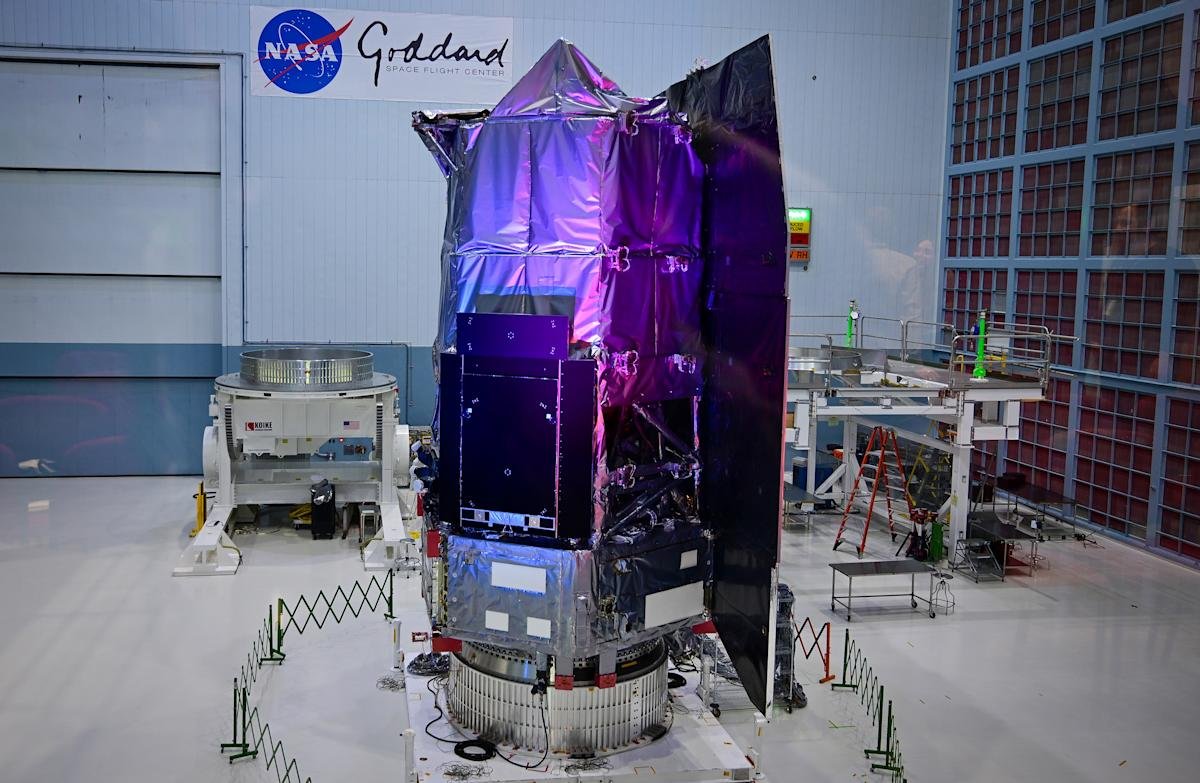
NASA’s next look at the universe is due to leave our planet later this year. The agency says it is aiming to launch the Nancy Grace Roman Space Telescope in early September. Roman’s (briefly) field of view is 100 times larger than Hubble’s.
The September date is the earliest possible launch for Roman. NASA says it will go up (aboard a SpaceX Falcon Heavy rocket) before May 2027.
The Nancy Grace Roman Space Telescope, named after NASA’s first chief astronomer and Hubble’s “mother”, was introduced in 2016. (At the time, it was known as the Wide Field Infrared Survey Telescope, or WFIRST.) The telescope’s mirror is about the same size as Hubble’s, but it can capture sections of the sky at least 100 times larger than its predecessor.

Julie McNary, Roman’s senior project scientist, said in 2023, “Roman will work closely with NASA observatories such as the James Webb Space Telescope and the Chandra Before the universe, we could even find entirely new classes of objects and phenomena.”
After leaving our atmosphere, Roman will head for a vantage point about 1 million miles from Earth. There, it will rely on a pair of instruments to study the space. The first is a 300.8-megapixel camera that captures light from visible to near-infrared. It also has a high-contrast coronagraph that will allow it to capture exoplanets that would otherwise be blocked by starlight.
Roman’s mission: “To solve essential questions in the fields of dark energy, exoplanets, and astrophysics.” Despite decades of study, astronomers know surprisingly little about dark energy, which makes up about 68 percent of the universe’s content. And while scientific discoveries are fantastic, you’ll be happy to know that Roman will definitely bring back more dazzling pictures of our universe.
<a href