MYCELX founder Hal Alper developed the MYCELX polymer, a material that permanently and chemically binds hydrocarbons upon contact, rather than simply filtering them out. In 1994, he co-founded MYCELX Technologies with petroleum industry veteran John Mansfield Sr. The company has since grown from a single polymer innovation to a global water treatment provider with expertise in produced water treatment in onshore and offshore operations.
Following successful deployments around the world, the company has recently shifted its strategy to focus on the Permian Basin, citing the value creation and performance improvements in water treatment produced by its technology.
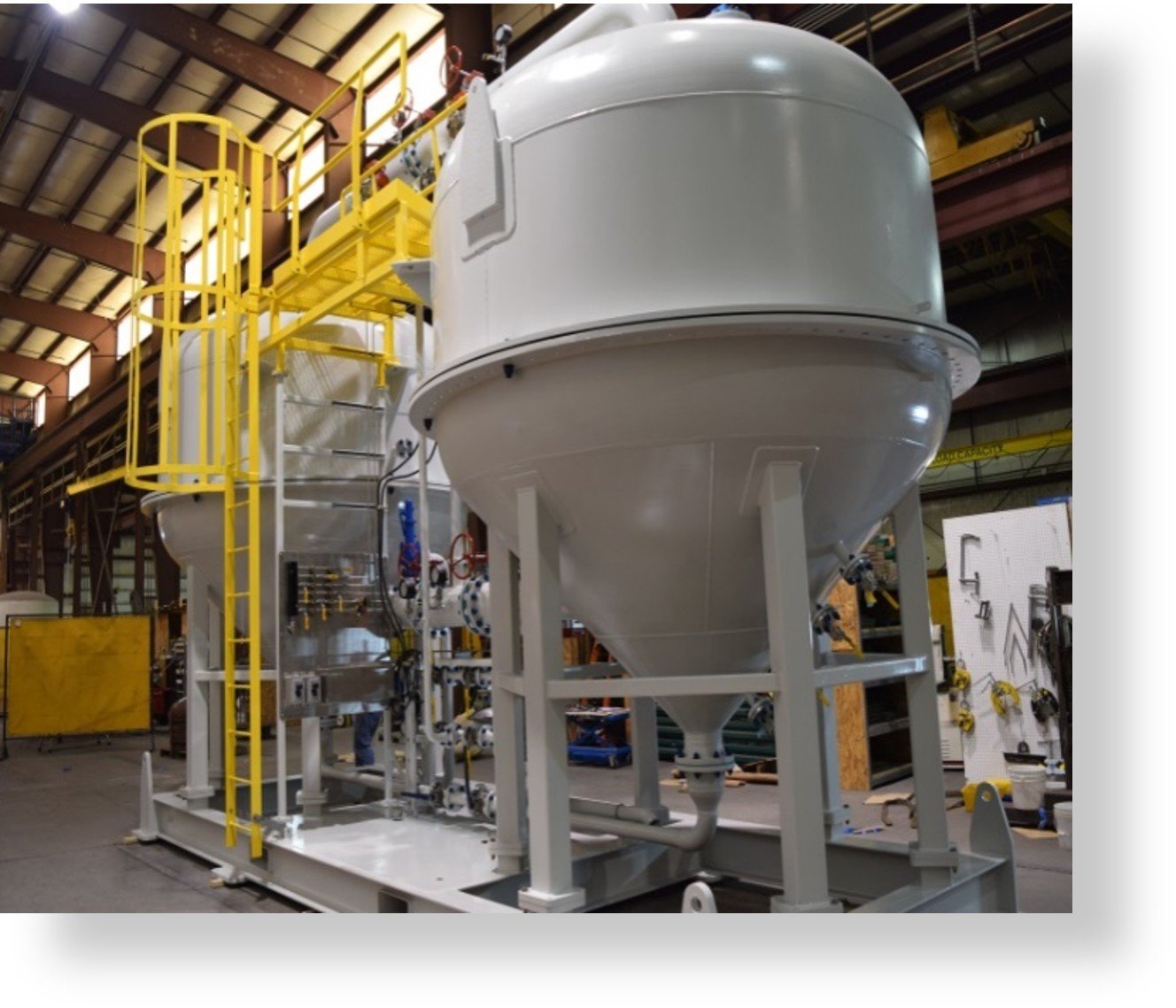
MYCELX offers two primary treatment systems for Permian Basin customers that work together, said Garrett Russor, business development manager of oil and gas.
One is MAC – MYCELX Advanced Coalescer – and the other is REGEN, Regenerative Media Filter. Combined, the technologies can recover up to 99% of selling-quality oil from produced water while capturing suspended solids. Russor said the treatment could be used before sending the water to saltwater disposal wells.
Rasor said the system could also be used as pretreatment for technologies that process produced water for beneficial reuse, desalination or evaporation.
REGEN is a backwashable media filter that produces recycle-quality water that can be placed in a frac pond or sold to a midstream or treatment company. He said the system operates within a small footprint.
Both technologies are also cost effective as they require no chemicals, no emissions and being automated, no labor is required.
Jim Weidler, executive vice president of business development, said the company was awarded its first field-scale project using REGEN in the Permian Basin by a major midstream operator in November. It will begin operations in the third or fourth quarter, he said.
Weidler called the project a showcase for the company and said it was generating significant interest in Mac technology as well.
The company recently conducted a pilot study with a supermajor operator in the Delaware Basin using the two-stage MAC and REGEN system to increase oil recovery, reduce solids, and meet recycling water quality specifications. After three months and 55 days of data collection, the company found that the coupled technologies were able to capture produced fluids from the pipeline and exceed the less than 15-parts-per-million specification for oil and grease, with the average flowing oil-in-water measurement being 11.64 parts per million.
Weidler said the company hopes to offer its PFAS treatment technology in the Permian Basin in the future.
<a href=