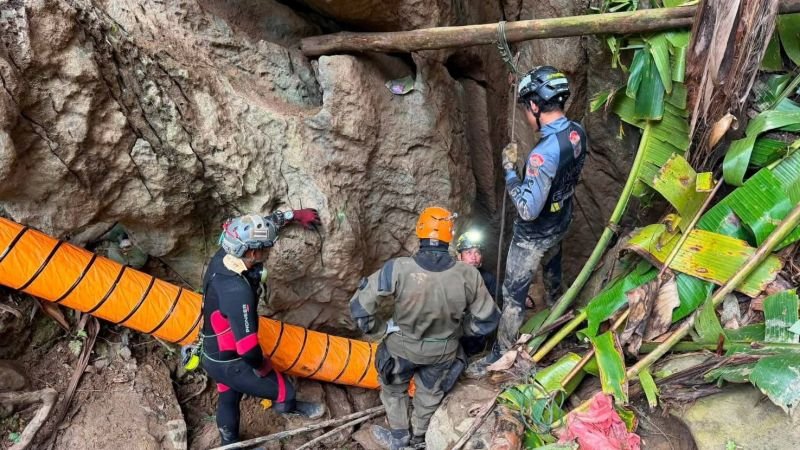

The village of Long Tieng, near the site of the rescue effort, is located in central Laos about 80 miles northeast of the capital Vientiane. Today, it is a dormant settlement of a few thousand people who depend mostly on the land for their livelihood.
It also hides a chapter of America’s Cold War history – a place that was once known as “the most secret place on Earth.”
From the late 1960s to the early 1970s, Laos played a central role in the United States’ fight to stop the spread of communism in Southeast Asia. Long Tiếng was the secret headquarters of a US-backed Hmong anti-communist force fighting against Pathet Lao forces, which were supported by the North Vietnamese Army.
At its peak, thousands of residents – Hmong soldiers, their families, refugees from other parts of Laos, Thai soldiers, and a small contingent of American CIA operatives and secret US Air Force pilots, known as the “Ravens” – called the place home.
It was the center of the largest paramilitary operation ever conducted by the CIA.
The impact of America’s horrific bombing campaign on Laos is still being felt today. According to the Mines Advisory Group (MAG), an estimated 30% of the 270 million unexploded ordnance dropped in the country did not explode. According to MAG, this unexploded ordnance continues to kill, injure, and hinder development across the country.
Around the hills of Long Tieng, villagers still rarely venture off established roads and trails to avoid unknown weapons.
Read more about the history of Long Tieng Here.
<a href=