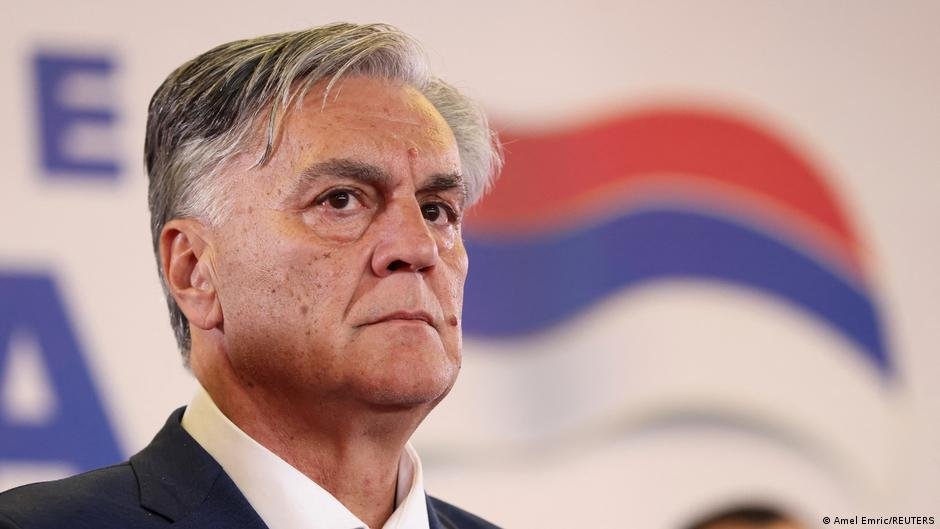
Sinisa Karan, a candidate backed by the Independent Social Democrats (SNSD), the ruling coalition of ousted President Milorad Dodik, emerged victorious, with his supporters applauding his victory.
However, the opposition has rejected the results and accused the SNSD of committing what it says is another case of electoral fraud, claiming it happens in every election in the entity.
On the other hand, SNSD officials claim that the election results show that foreign actors and the Office of the High Representative, which is tasked with implementing the Dayton Agreement in Bosnia-Herzegovina, are not welcome in Republika Srpska.
Dodik comes out on top again
The snap presidential election took place approximately three months after Bosnia’s Central Election Commission revoked President Dodik’s mandate.
In February, the country’s highest court sentenced Dodik to one year in prison and banned him from all political activity for six years for disregarding the decisions of the High Representative, Christian Schmidt, and for his separatist policies seeking to annex Republika Srpska from Bosnia-Herzegovina. He saved himself from jail by paying the fine.
Yet despite the court decision and the fact that he was, until recently, subject to US sanctions, Milorad Dodik once again came out on top.
Indeed, the US decision to lift sanctions against Dodik also dealt a blow to the credibility of Schmidt and the Office of the High Representative, which no longer has the support of the current US administration.
‘Two Dodics’
Dodik said that those who had sought his removal from power “got two Dodyks” instead.
“These elections were held under adverse conditions and with interference from outside elements,” he declared, calling the result a major victory.
“This is a victory for Republika Srpska and a demonstration of its stability,” he said.
Newly elected President Karan is considered by many to be Dodik’s political puppet. He will hold office for one year until the next regular general election in the fall of 2026, when three members of the Presidency of Bosnia-Herzegovina and the heads of its two institutions will be elected.
Newly elected President Karajan has called for peace, stability and resistance to foreign influence in the lives of Serbs in Bosnia and Herzegovina.
“The Serbian people have now given their final answer by saying ‘no’ to any foreigner or usurper who wants to change their will,” he said.
SNSD’s ‘Bermuda Triangle’
Although the towns of Zvornik, Doboj and Laktasi have long been seen as SNSD strongholds, opposition leaders doubt that opposition candidate Branko Blanuša could win in all three and claim that voters were “imported” from neighboring Serbia to vote in Karajan’s favor.
Igor Crnadak, vice-chairman of the opposition Party of Democratic Progress (PDP), accused the ruling party of large-scale fraud, saying, “In the SNSD’s Bermuda Triangle of Doboj-Zvornik-Lactasi, the will of the people of Republika Srpska to end the SNSD’s rule disappeared.”
“They stole like crazy because SNSD thought it was over,” Crandak said.
“If it weren’t for this manipulation, I could declare victory tonight,” Blanusa said Sunday, announcing plans to seek reruns in three cities.
The opposition once again failed to achieve victory, weakened by the fact that members worked against each other rather than the ruling SNSD and often failed to agree on candidates for positions or elections.
political immaturity
These reactions to the election results within Republika Srpska and the fact that turnout was only 35% are a reflection of the country’s chronic political immaturity and lack of democratic development.
Voter turnout in Republika Srpska is traditionally low, but the fact that it did not exceed 35% on Sunday suggests a major drop in SNSD support, with the ruling party receiving approximately 100,000 fewer votes than in previous elections.
That’s why Banja Luka’s PDP mayor Drasko Stanivukovic, who has already announced he will run for president of Republika Srpska next year, is portraying the opposition’s strong showing in his city as a symbolic victory, even if it was not enough to secure an overall victory.
some congratulations from abroad
Interestingly, although leaders of neighboring Serbia have indirectly supported Karan, there has been no official reaction or congratulations from Belgrade yet.
Nor has there been any comment on this from the neighboring country Croatia. Dodik has good relations with both Croatia’s leadership and Dragan Covic, president of HDZ BiH, the Bosnian sister party of the Croatian party HDZ.
So far, the only head of government to congratulate Karan has been Hungary’s Viktor Orban.
Orban wrote on Twitter, “Congratulations to President-elect Sinisa Karajan and the SNSD on their election victory in the Republika Srpska. We have long worked together for stability in the region. I look forward to continuing this cooperation!”
What do the results mean for Bosnia-Herzegovina?
Dodik’s victory, indirectly endorsed by Karan, highlights an inescapable political reality for Bosnia-Herzegovina. Although he is no longer president, Dodik remains the central power broker in Republika Srpska.
As the leader of Republika Srpska’s largest political party, which also wields influence at the state level, Dodik’s partners in the Bosniak-Croat entity within Bosnia-Herzegovina will now have to negotiate with him once again, especially after this “confirmation” at the ballot box.
“The President of the Republika Srpska is an indispensable actor in political negotiations,” said Vlado Adamovic, a Zaragoza-based professor. “This means that the President of Republika Srpska – no matter who takes office – will support the policy of the SNSD, whose chairman is Dodik.”
At this point, the main question is whether Dodik will be able to use his new leverage to “erase” the political damage caused by the court ruling against him and whether he will suffer a complete collapse or a complete victory in next year’s general election.
There is no possibility of finding any middle path.
Edited by: Angiel Flanagan
<a href