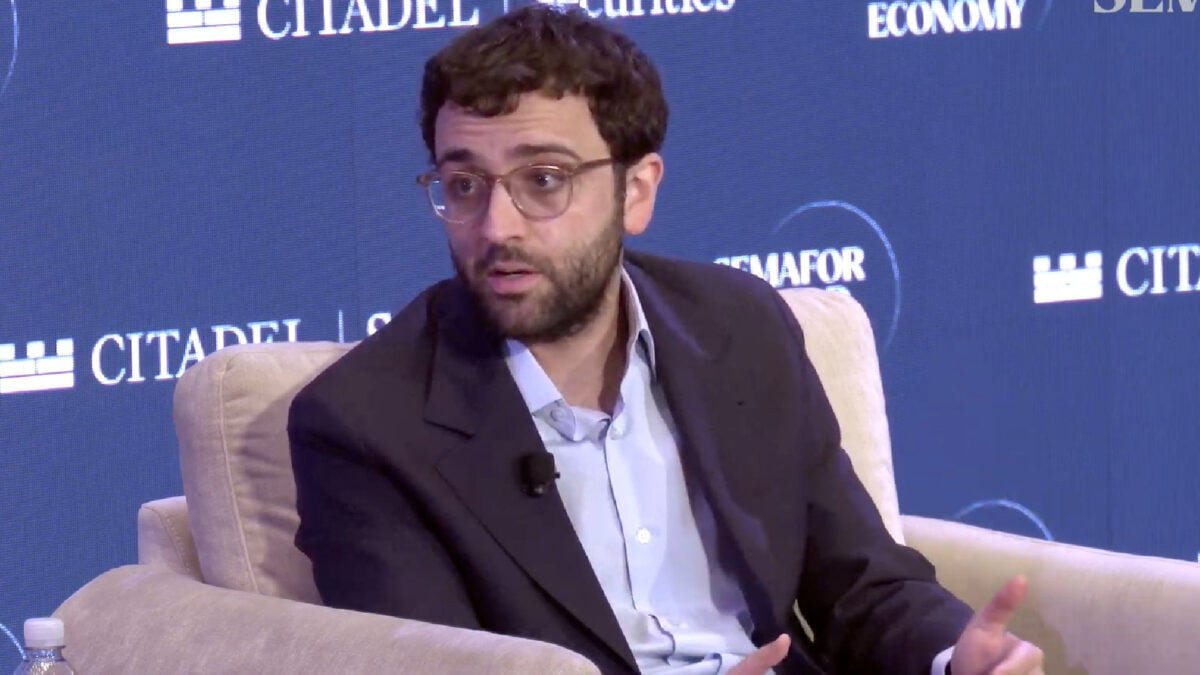
“We’re launching a portal for parents to basically submit their ID, even if they don’t want to be a user of Kalshi, to see if anyone is using it. Because then they can see if their kids are using their ID and the police can investigate,” Mansour said.
The Kalshi boss made the announcement during an interview at the Semaphore World Economy Summit in Washington, DC on Wednesday, where he talked about the ways he is trying to improve his platform as the company faces heat from regulators.
They also said they are thinking about launching “family accounts” to let family members know if they are gambling too much, because “we want this to be a tool for good, not for excessive behavior.”
Mansour’s big point, as it was on Wednesday, is that prediction markets can provide some unique insights into the world. In particular, he said there has been a decline in not only trust in traditional media to accurately represent the world, but also distrust in social media. Mansour said that people in the audience probably did not trust his X feed, pointing out that clickbait created perverse incentives.
Mansour said, “If you say a smart subtle thing on Twitter, you get maybe four likes. If you say something crazy on Twitter, nothing to do with the truth, you get 400,000 likes.”
“There’s an inverse incentive structure in the prediction market, right? If you’re the first one in and you say some subtle things, you’ll probably make money. You’re self-calibrated, you’re smart, and those are the people we attract.”
Mansour said that his product was important because the “vast majority” of his customers used Kalshi as a news feed.
Platforms like Kalashi and Polymarket prefer the term “prediction markets” over gambling, but most people understand what is going on with the latter. You can bet on almost anything these days, although Kalshi has also cracked down on some of the more serious bets. Betting on war and death is prohibited on the platform.
Kalshi has faced pressure from state regulators in recent months as more and more attorneys general become concerned about the staggering growth of online gambling. Nevada and Arizona are working on cases to outlaw this practice.
Mansour claimed that state laws related to gambling had failed because they were “patchwork” and said that federal regulation was necessary.
“I think [there are] “There are 34 or 35 states where sports betting is legal,” he said, adding, “Of those 34 states, one state prohibits marketing to people who have a problem. This is a kind of madness. Two of them banned marketing…explicit marketing to minors. A kind of madness.”
When Mansoor was asked about insider trading on Kalshi, he said that it should be banned. But he said the reason for doing so is that no one wants to participate in a market that is not fair. Keeping people in business seemed to be his biggest concern. He also said that it was incredibly difficult to police insider trading on Kalshi.
“If you look at Tesla, the number of people who know in advance about a product release is obviously a large portion of the employees, and then probably their spouses and their cousins,” Mansour said. “And how do you find that cousin who is buying Tesla options in the first place…” he trailed off.
The entire interview, which is available on YouTube, is a little strange, simply because Mansoor was very clearly leading the discussion and suggesting the next topic he would talk about. The Semaphore World Economy Summit will continue till Friday.
<a href