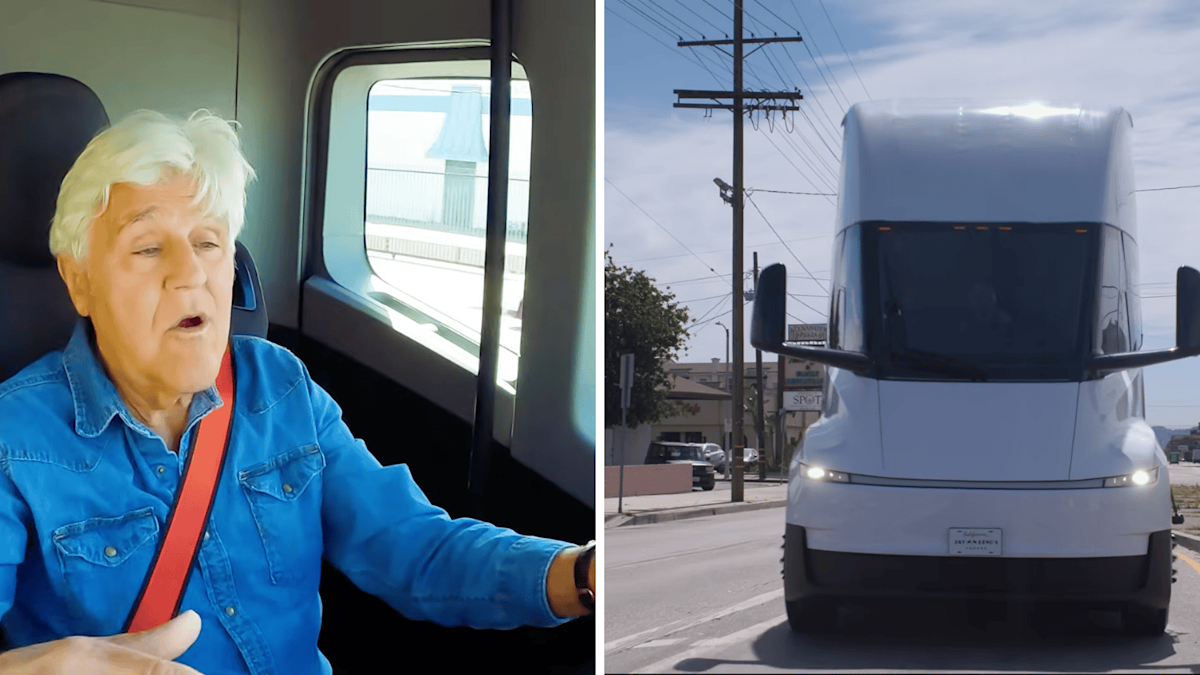
When Jay Leno sat behind the wheel of a Tesla Semi, it wasn’t just a typical celebrity test drive. They offered a glimpse of what the future of freight transportation might look like.
Leno recently drove the all-electric Semi, which The New York Times says boasts nearly 500 miles of range on a single charge (1), and came away impressed by both its performance and its potential to reshape long-haul trucking.
But his experience comes at a time when diesel prices (2) and operating costs (3) remain a major concern for trucking companies, and when electric options are finally starting to take off on a large scale.
One of the standout features of the Tesla Semi is its durability. Leno’s drive highlighted the truck’s long-range capability, including a battery designed to last up to 1 million miles (4).
This figure can dramatically reduce downtime, long-term maintenance and replacement costs for fleet operators and drivers – critical factors in an industry where margins (5) are often tight.
Read More: How to Apply Dave Ramsey’s 7 Baby Steps to Your Life
Electric heavy-duty trucks have been discussed for years, but adoption has been slow until recently. The New York Times agrees, citing growth in electric commercial truck ownership (6), but there is still plenty of room to grow.
The US Department of Energy report (7) gives concrete reasons for this increase:
-
Battery costs have fallen by approximately 90% since 2008, reducing the price barrier
-
Early adopters reported lower maintenance costs than diesel due to fewer moving parts
-
The federal government has put $1.5 billion on the table to accelerate the switch
-
New EPA emissions standards for 2027-2032 model years mean the clock is ticking
-
Major fleets like Amazon, FedEx and DHL have made public electrification commitments
-
Annual zero-emission truck sales to increase 20-fold between 2019 and 2023
And this is evidenced by the fact that according to Mordor Intelligence, the $22.74 billion North American electric truck market is expected to grow nearly three times over the next three years (8).
Dan Priestley, director of the Tesla Semi program, said “a few hundred” Semis have been built through October 2023 and there is “substantial demand” for the vehicle, including from independent truck operators, Autoblog reports (9).
The change is timely – it comes as diesel prices remain volatile and are putting pressure on businesses that depend on predictable fuel expenses.
For trucking companies, the biggest appeal of electric vehicles is not environmental, but financial.
According to the U.S. Department of Energy (10), electric trucks can offer lower fuel costs per mile than diesel vehicles, because electricity is often cheaper than traditional fuels. They may also require less maintenance because they have fewer moving parts.
But it still can’t offset the sticker price, so adoption hasn’t been quick.
According to a New York Times report (11), electric semis like Tesla are significantly more expensive than conventional diesel trucks, almost twice as much. Electrek says (12) Tesla has bid $260,000 for the 325-mile model and $290,000 for the 500-mile model.
Despite growing interest, the transition away from diesel faces major logistical challenges.
The New York Times notes (13) that fast-charging infrastructure for heavy-duty trucks is still limited, especially for long-haul routes that require quick, reliable charging over large distances. It is generally not feasible for long distance drivers to spend hours recharging, so standard chargers are not always practical.
But building that fast-charging network will take time and significant investment from both private companies and governments.
Without it, electric trucks could remain focused on specific regions or use cases rather than replacing diesel across the board.
not yet. But for the first time its dominance is being seriously challenged.
While Leno’s test drive underscores how far electric trucking has come, the broader industry is still in transition. Cost, infrastructure and scale will ultimately determine how quickly change happens.
Diesel trucks continue to dominate long distance freight transportation due to their range, refueling speed and established infrastructure.
Plus, (14) according to The New York Times, electric trucks could weigh up to 2,000 pounds more than diesel trucks, because the heavier batteries potentially put a lot of strain on the roads.
But the pace is changing.
Battery improvements such as the longer lifespan (15) of the Tesla Semi, combined with rising (16) fuel costs and regulatory pressure (17), are making electric options increasingly competitive.
For consumers, the effect may not be immediate, but it may be reflected in the price of goods over time. Shipping costs are a major factor in retail pricing, and changes in fuel and transportation technology can disrupt the economy.
Join over 250,000 readers and be the first to get MoneyWise’s best stories and exclusive interviews – candid insights curated and delivered weekly. Subscribe now.
We only rely on verified sources and reliable third-party reporting. For details, see our Ethics and Guidelines.
New York Times(1),(6),(11),(13),(14); Wall Street Journal(2),(16); WEX Inc. (3),(5); YouTube (4); Autoblog(9),(15); US Department of Energy (7),(10); Mordor Intelligence (8); Electrek (12); Business Wire (17)
This article was originally published on Moneywise.com under the title: Jay Leno takes the Tesla Semi for a spin. Its 1 million mile battery could spell trouble for diesel
This article provides information only and should not be construed as advice. It is provided without warranty of any kind.