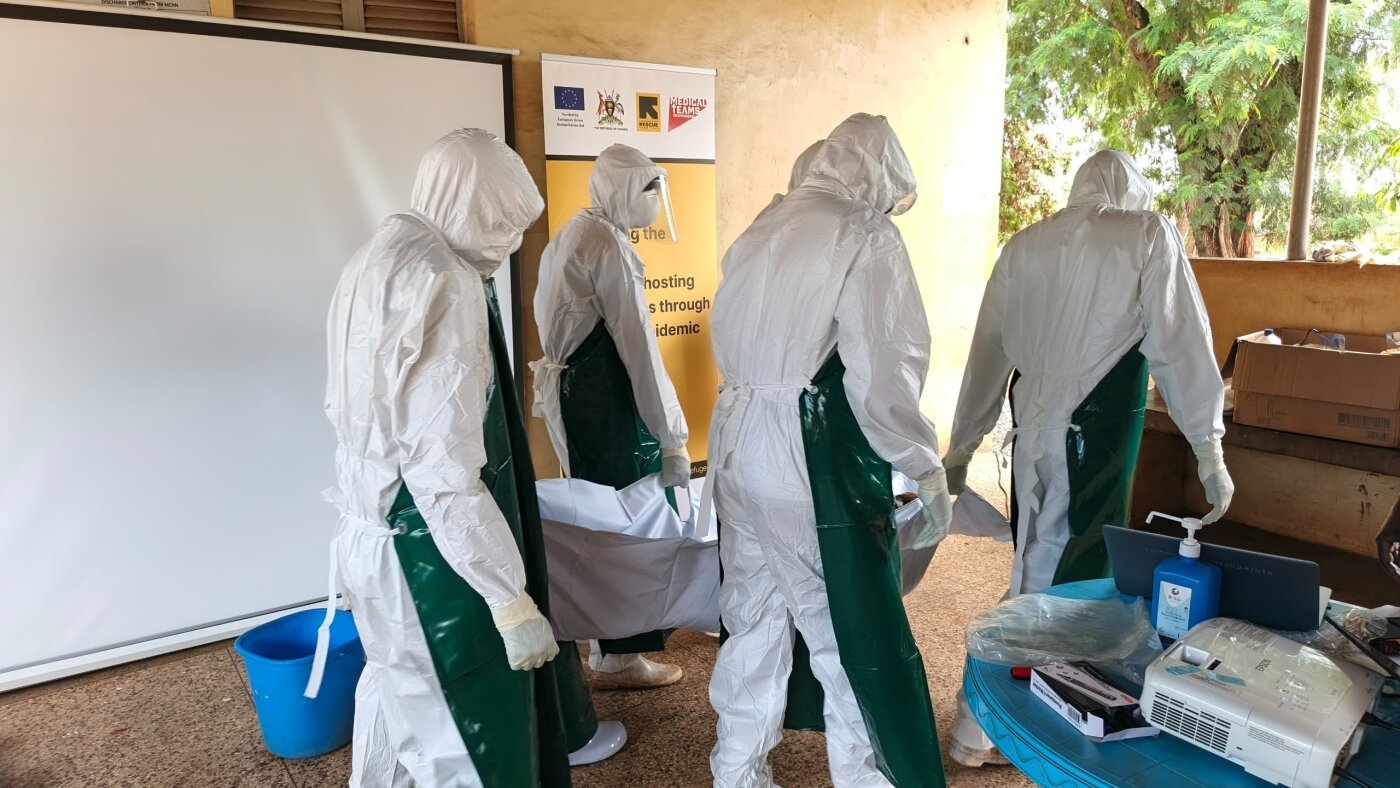

Healthcare workers take part in a simulation exercise in Uganda, practicing how to bury a dead Ebola patient in a safe and dignified manner.
leonard musinguzi
hide caption
toggle caption
leonard musinguzi
A massive Ebola outbreak is spreading in Central Africa, and misinformation about the virus is making matters worse.
Rumors on social media claim that Ebola is not real or that health care workers are acting for their own benefit.
According to the World Health Organization, more than 1,000 suspected and confirmed cases have been reported, with at least 223 deaths suspected to be caused by Ebola. Health workers say this is probably a major undercount.

The epicenter of the outbreak is in the Democratic Republic of Congo.
Uganda, which borders the DRC, has so far been spared the worst of the outbreak. On 27 May, the country closed its official border with Congo.
“We still have many porous border points… where people continue to cross,” said Leonard Musinguzi. She is a community and monitoring officer for the International Rescue Committee in Uganda.
Musinguzi’s job is to track down potential Ebola cases, isolate refugees, train health workers, and prepare his community to fight the disease.

It’s an uphill battle, especially because misinformation about Ebola can spread faster than the virus itself.
Musinguzi One way to combat that misinformation is through public health messaging. His organization distributes information in radio spots, posters, and on hospital television to educate about the disease.
However, governments such as the United States have reduced their support for programs such as the IRC. This means Musinguzi has less money for the projects he wants to do.
Previously, he would have paid to deliver educational messages during five radio talk shows. Now, he said, “because of this reduced funding, you only have one.”
In a statement to NPR, the State Department said recent federal funding changes have had no significant impact on U.S. funding levels for global health programs or health protection programs in eastern DRC.
“The United States responded within 24 hours of the first confirmed case, mobilizing a wide range of medical, humanitarian, operational, and consular resources to rapidly respond to the Ebola outbreak,” said spokesman Tommy Pigott.
NPR’s Adrian Florido spoke to aid workers and a former employee of the United States Agency for International Development to learn more about the pressures facing the global health system and how federal government cuts may have contributed.
Listen to the full story by clicking the blue play button above.
<a href