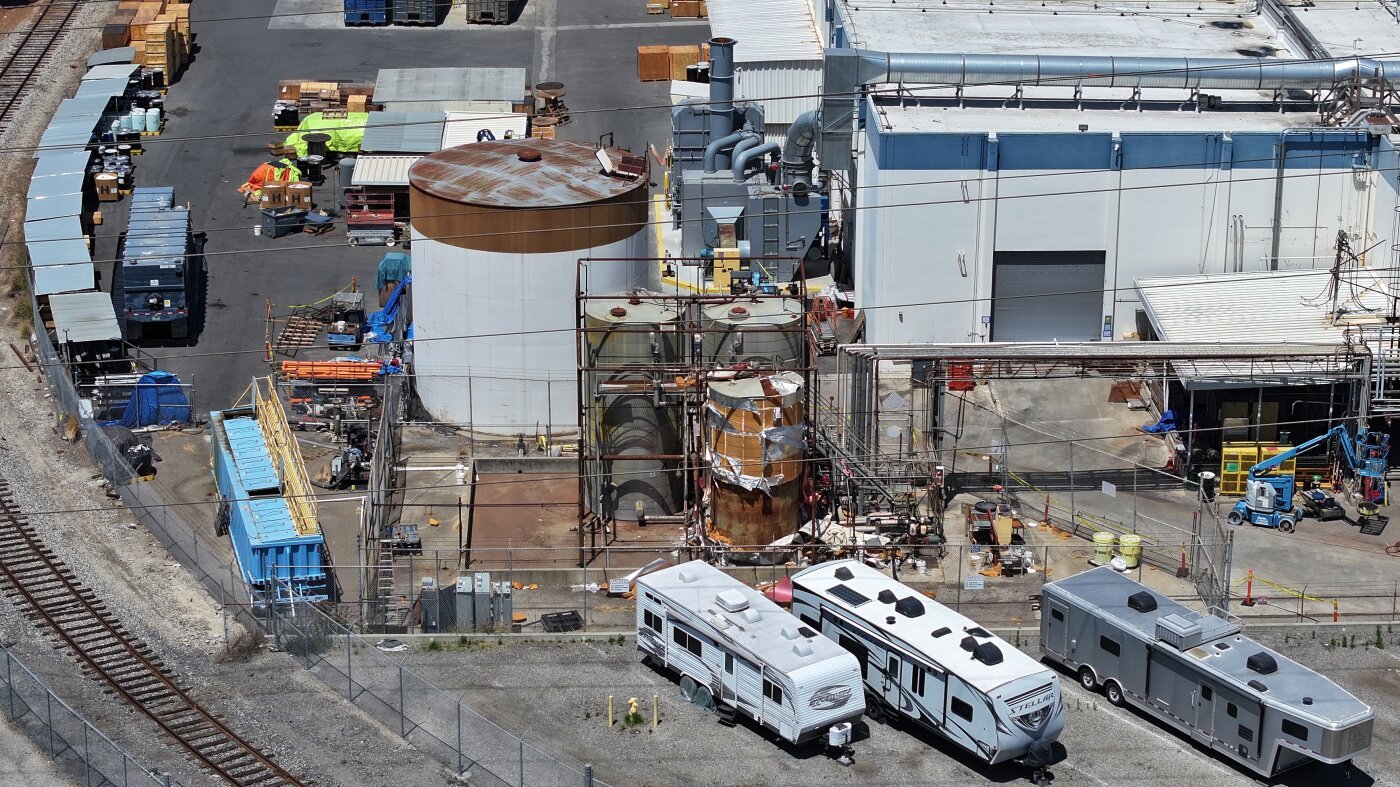

Aerial view of a chemical tank at GKN Aerospace in Garden Grove, California, on Wednesday.
William Liang/AP
hide caption
toggle caption
William Liang/AP
LOS ANGELES — Federal authorities served a search warrant Wednesday at a Southern California aerospace facility where a chemical tank overheated last month, forcing the evacuation of 50,000 residents as officials feared a catastrophic explosion.
The warrant signed by a federal judge last week authorized the seizure of documents and records related to the “storage, use or disposal” of the chemical methyl methacrylate inside the affected tanks.
According to the warrant, “Samples of the substance within any tank, tote, drum, vat, vessel, or container that contains or is suspected to already contain methyl methacrylate and/or any hazardous substance” were also sought.
The warrant also orders agents to seize records related to “any cooling device or other device used to control or regulate the temperature of methyl methacrylate.”
The FBI confirmed that its agents were searching the GKN Aerospace Transparency System in the Orange County city of Garden Grove. Multiple vehicles and several federal agents were seen outside the facility Wednesday morning.
The company says it is cooperating with authorities
GKN Aerospace manufactures cockpit windows, canopies and windshields. The tank that overheated contained 6,000 to 7,000 gallons (22,700 to 26,500 l) of methyl methacrylate, which is highly flammable. This liquid is used in the manufacture of plastics and coatings such as plexiglass and dental prosthetics.
According to the Environmental Protection Agency, exposure to the chemical can cause serious respiratory problems, neurological problems and irritation to the skin, eyes and throat.
The chemical that overheated is still in a holding tank, according to the Orange County Health Care Agency, which is leading the site’s cleanup and waste removal efforts.
The agency planned to pump inert methyl methacrylate from storage tanks into sealed trucks for transport and disposal late last week, according to a press release on the agency’s website. But on Friday, he said the eviction did not take place “due to unavailable resources.”
Once the new date is confirmed, they will provide advance notice to the community.
In response to a request for comment on the FBI investigation, a GKN spokesperson told the AP on Wednesday morning: “We are cooperating with authorities at our Garden Grove facility and will continue to do so.”
Steve Carlin of GKN Aerospace spoke at a community meeting Tuesday evening. He thanked the firefighters and local leaders who responded to the incident at the plant that employs more than 500 people and apologized to the community.

FBI agents stage at GKN Aerospace in Garden Grove, California, on Wednesday.
William Liang/AP
hide caption
toggle caption
William Liang/AP
“On behalf of GKN and the Garden Grove plant, I want to say that I am sorry that this incident and this incident occurred. I understand, and I realize sitting here tonight, what a disruptive event this was and how upsetting it is for the larger community. This is especially upsetting for us at GKN because of the long history we have with Garden Grove and how connected we are to this community.”
Garden Grove city leaders and residents urged GKN Aerospace to consider moving these tanks of methyl methacrylate away from the Garden Grove plant, so the chemicals remain away from residents and businesses. But Carlin said it is still very early in the investigation into what happened, so it is too early to determine what the company might do in response to the incident. He promised to be transparent with the community about the investigation.
There was a risk of a catastrophic explosion due to overheating of the tank
The incident was reported on 21 May and evacuation began the next day. Officials said the tank overheated because a valve in the cooling system that kept it at 50 °F (10 °C) failed.

Crews sprayed water on the tank until the internal temperature dropped from 100 F (37.7 C) to a stable 92 F (33.3 C). A sprinkler system was used to extinguish the tank, and the company said its technicians and firefighters removed insulation from the tank to help cool it.
An accidental crack in the tank relieved pressure and helped prevent a catastrophic explosion, allowing most of the evacuees to return home over Memorial Day weekend. After the temperature at the tank remained stable for four hours without sprinkler intervention, officials announced they were withdrawing the final order.
Separately, the Orange County District Attorney’s Office is also conducting a criminal investigation into the GKN Aerospace plant, according to DA spokeswoman Kimberly Eads.
“We have sent a preservation letter to GKN instructing them not to modify or destroy any evidence, which the company’s outside counsel has confirmed receipt of,” Edes told The Associated Press in an email.
Lawyers welcome FBI involvement in federal lawsuits
About a dozen people and businesses, among the 50,000 evacuated during the chemical emergency, have filed a lawsuit against the company. Some residents reported strong odor, respiratory irritation, headaches and dizziness. Their question is why the chemical plant was allowed to operate so close to homes.
Attorney Rickard McCune has represented Big Rob’s Pizzeria and Fruit Caboose Concession in a federal lawsuit claiming that GKN Aerospace and parent company Melrose Industries were negligent and endangered surrounding communities. He said he was pleased the federal government was investigating. The FBI’s involvement will help bring justice to those who have been harmed, he said.
Another attorney, Alex Wheeler, represents Dinh Tran and Drippy’s Gourmet Ice Cream Sandwiches and said he is relieved the FBI is using its resources to investigate possible criminal acts.
“As more information becomes public, it is becoming clear that the risk posed to our community by GKN’s operation of the Garden Grove facility may require a long-term and permanent solution,” Wheeler said.
GKN did not immediately respond to the allegations in the lawsuit.
Orange County health officials assured residents that no contamination or smoke would be released, and that they would continue to monitor the air and check sewer and storm drains for several months.
The California incident was the first of two major hazardous chemical emergencies on the West Coast within a week of each other. Five days after the GKN Aerospace situation began, a large tank containing a corrosive chemical at a Longview, Washington paper mill ruptured and exploded, killing 11 people.
<a href